

US Strikes Three Iranian Oil Tankers After Warship Attacks
The United States military struck three Iranian crude oil tankers on Saturday, September 5, 2026, sinking one and disabling two others in a significant escalation of hostilities in the regional waters. This action was a direct response to ballistic missile attacks launched by Iran’s Revolutionary Guards (IRGC) against two US Navy warships operating in the area earlier the same day.
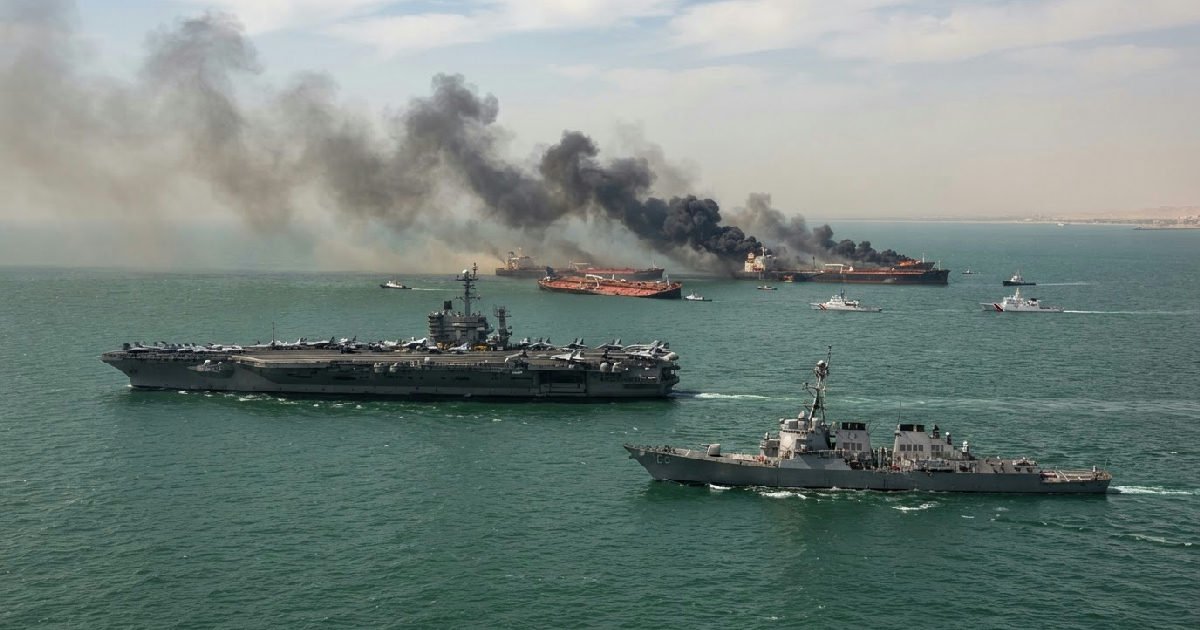
US Central Command (CENTCOM) confirmed these retaliatory strikes. An American aircraft carrier and a guided-missile destroyer had successfully evaded multiple unprovoked attacks from the IRGC, with no American personnel harmed. This incident marks a dangerous new phase in the six-month conflict between the two nations, pushing Brent crude oil prices above $90 per barrel for the first time since May.
Why the US strikes Iranian oil tankers
CENTCOM commander Admiral Brad Cooper framed the strikes as a calculated reply to Iranian aggression. “Let the message to the IRGC be clear: If you shoot at two of our ships, we will impose an even higher economic cost — taking out three of yours,” he declared.
The admiral stressed that the US would not tolerate threats to its naval assets, a stance that contributes to heightened Mideast tensions.
The US military identified the targeted vessels as key components of a “multibillion-dollar shadow network” used to finance the IRGC and its regional proxies. These strikes were carried out with precision across several locations. The action underscored Washington’s commitment to defending its forces and strategic interests.
The tanker M/T Downy was “permanently disabled” off Iran’s critical Kharg Island oil terminal. Similarly, the M/T Stark 1 was rendered inoperable near Jask, a strategic port east of the Strait of Hormuz. These operations highlight the precise nature of the US response.
A third tanker, the M/T Kylo (also known as Noxen), was completely destroyed in the Gulf of Oman. CENTCOM reported that the vessel’s crew was directed to abandon ship before the unladen tanker was struck “in multiple critical locations” to render it inoperable.
The military command later confirmed the M/T Kylo had sunk, physically removing a key asset from Iran’s fleet. This heightened tension immediately impacted global markets; the price of Brent crude oil rose above $90 per barrel, marking its first such ascent since May.
Iran’s conflicting narrative and retaliation claims
Tehran offered a starkly different account of the events. Iran’s Revolutionary Guards, via the state-aligned Tasnim news agency, claimed it had targeted the US aircraft carrier and destroyer for “harassing Iranian ships and participating in a naval blockade.” The IRGC statement boasted that the US ships sustained damage and were “forced to flee the conflict zone.”
This claim was directly refuted by CENTCOM, which maintained its ships were undamaged. Following the US counter-strikes, Iranian state television reported, without immediate US confirmation, that its forces had targeted three more oil tankers and three American vessels in a swift second wave of retaliation.
A spokesperson for Iran’s joint military command vowed that future strikes against US ships would be “more severe” if US interference with Iranian shipping continued.
Iran’s Foreign Ministry condemned the American attacks as a “war crime.” The ministry warned that Washington and its allies would bear the responsibility for the consequences of continued aggression. Despite the severity of the strikes, the Iranian state broadcaster IRIB reported no casualties in the attack near Kharg Island, claiming the resulting fire was extinguished within an hour.
Targeting the economic lifeline of the IRGC
The decision to strike Iran’s oil tankers, rather than purely military targets, signals a strategic shift in the US approach. By targeting the vessels, Washington is directly attacking the financial infrastructure that underpins the IRGC’s operations.
These tankers are not just commercial ships; CENTCOM alleges they are instrumental in a clandestine network that circumvents international sanctions to generate revenue, highlighting the intricate dynamics of oil markets in the region.
The locations of the strikes were also highly symbolic. Kharg Island is the lynchpin of Iran’s oil economy, handling an estimated 90% of the country’s crude exports. The island and its surrounding military installations have been repeatedly targeted during the war, including US strikes on military sites there in March.
Hitting a tanker in this vicinity sends a clear message about the vulnerability of Iran’s primary economic artery.
The destruction of the M/T Kylo in the Gulf of Oman and the disabling of the M/T Stark 1 near the Strait of Hormuz further highlight the reach of US naval and air power across the region’s most critical maritime chokepoints.
Volatility in this region directly impacts global commerce, a critical factor given the Strait of Hormuz’s role in international oil shipments. This suggests a deepening commitment to disrupting Iran’s illicit financial flows.
Six months of escalation and collapsed negotiations
This latest tit-for-tat exchange is the most intense flare-up in a conflict that began on February 28 with a series of US and Israeli attacks on Iranian targets. Hopes for a diplomatic off-ramp have faded as multiple rounds of negotiations collapsed, leading to a steady escalation from both sides.
Just a day before the tanker strikes, US President Donald Trump had publicly downplayed the conflict as “small potatoes,” a comment that now appears dramatically out of step with the Pentagon’s actions.
The US military has engaged Iranian tankers before, but Saturday’s strikes represent a marked increase in force. On May 8, the Pentagon confirmed it had fired “precision munitions” into the smokestacks of two unladen Iranian tankers. That earlier action was designed to disable the vessels without sinking them, indicating a less aggressive posture at the time.
The destruction of the M/T Kylo and the permanent disabling of two others shows a new willingness to impose irreversible costs on Iran’s illicit oil trade.
This escalating pattern of attacks has turned the waters of the Persian Gulf and Gulf of Oman into a high-risk zone, a development that could drive up shipping insurance premiums and operational security costs, potentially impacting the broader security market.
Global implications and what comes next
The direct and destructive targeting of Iran’s oil fleet moves the conflict into uncharted territory. While the US has long used economic sanctions to squeeze Tehran, the physical destruction of its primary source of revenue is a tactic with far more unpredictable consequences. It risks a direct and potentially wider military confrontation that could draw in other regional and global powers.
All eyes are now on the Strait of Hormuz, through which a significant portion of the world’s oil supply travels. Any further escalation could threaten this vital waterway and trigger a global energy crisis. Iran has repeatedly threatened to close the strait if its own exports are fully blocked, a move that would almost certainly provoke a massive international military response.
Admiral Cooper’s closing remarks left little room for ambiguity about American intentions. “We will not hesitate to defend American forces, and if necessary, destroy Iran’s limited and exposed oil fleet,” he stated.
The world now waits to see how Iran will deliver on its promised “significant response” and whether the two nations can step back from the brink of a full-scale war, which has become increasingly likely.