

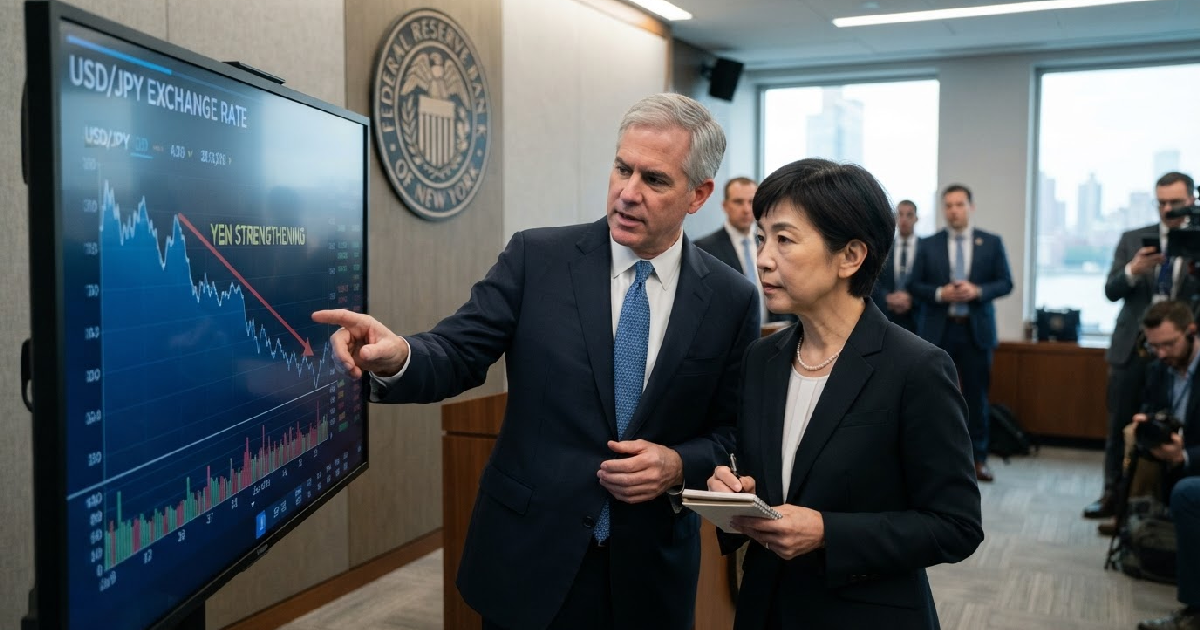
United States and Japan launch joint yen intervention
The United States and Japan recently launched a rare, coordinated currency intervention aimed at propping up the Japanese yen. This joint operation marks the first time the two nations have acted in concert to support the yen since 1998, arriving as the currency plummeted to its weakest levels against the U.S. dollar in almost four decades.
U.S. Treasury Secretary Scott Bessent and U.S. President Donald Trump, alongside Japanese Finance Minister Satsuki Katayama and Japanese Prime Minister Sanae Takaichi, were central to this significant financial maneuver. The U.S. Treasury, operating through the Federal Reserve Bank of New York, notably sold euros to purchase yen, while Japan also conducted its own yen-buying interventions, reportedly on July 30 and July 31, 2026.
US Japan yen intervention to bolster the currency
For nearly three decades, direct American involvement in stabilizing the Japanese yen had been absent. However, the yen’s severe depreciation compelled Washington to shift its strategy dramatically, culminating in last week’s synchronized currency action.
This sustained weakening of the yen created concerns about broader market volatility. It also presented substantial economic challenges for Japan, increasing the costs of essential imports and eroding household purchasing power.
Protecting U.S. bond markets
One of Washington’s primary concerns was averting a scenario where Japan might be forced to divest large quantities of U.S. Treasurys. Japan stands as the largest foreign holder of U.S. government debt, holding over $1 trillion as of March 2026.
A sudden, large-scale sale of these debt instruments could destabilize U.S. Treasury markets. Such an event would likely send ripples through global financial systems, putting upward pressure on U.S. borrowing costs.
Both Tokyo and Washington have emphasized the Federal Reserve’s standing Foreign and International Monetary Authorities (FIMA) Repo Facility as a crucial mechanism. This facility enables foreign central banks to obtain dollar liquidity without outright sales of Treasurys, providing a vital safeguard for funding markets.
Japan’s Finance Ministry plans to utilize the FIMA repo facility for future interventions, a move designed to address concerns that Japanese intervention could otherwise strain U.S. funding markets. This highlights a strategic effort to leverage available tools to maximize signaling effect and maintain market confidence.
Broader economic and geopolitical motivations
Beyond immediate market stabilization, this US Japan yen intervention also reflects wider economic and geopolitical objectives for Washington. President Donald Trump publicly stated that the U.S. participated as a gesture of support for Japan and in the interest of global economic stability.
The U.S. Treasury has consistently viewed the yen as “substantially undervalued,” which it sees as granting Japan an unfair trade advantage by making its exports more competitive globally. Correcting this perceived imbalance forms a key part of America’s trade policy.
Washington believes Japan’s fiscal policies might be contributing to higher Japanese government bond (JGB) yields and a weaker currency. Coordinated intervention, in this context, offers time for the Bank of Japan to prepare for further interest rate hikes later this year.
Ultimately, a sustainably stronger yen would necessitate tighter Japanese monetary policy rather than repeated currency market interventions. This coordinated effort could signal a renewed phase of cooperation and partnership between the two nations.
Challenges and market dynamics
The operational specifics of the U.S. intervention garnered attention, particularly the decision by the U.S. Treasury, through the Federal Reserve Bank of New York and intermediaries like Goldman Sachs and Morgan Stanley, to sell euros to purchase yen. This contrasted with traditional coordinated interventions, which typically involve selling dollar assets.
Some market observers expressed surprise at this approach. Questions arose about why dollars weren’t directly used, given that past interventions often involved dollar-denominated assets.
Limits of intervention and structural issues
Intervention in currency markets can provide temporary relief but rarely alters long-term trajectories driven by fundamental economic forces. While the Bank of Japan officially ended formal yield curve control in March 2024, it continues to purchase substantial amounts of JGBs.
These ongoing purchases are seen by some as keeping Japanese borrowing costs below where they might otherwise settle in a free market. Such actions could contribute to the yen’s continued undervaluation, limiting the lasting impact of direct intervention.
The path ahead for Japanese yen stability
The recent US Japan yen intervention underscores the intricate relationship between global currency markets, sovereign bond yields, and strategic international diplomacy. Officials from both the U.S. and Japan have signaled their readiness to undertake further joint actions if market volatility or disorderly movements persist.
Washington also remains vigilant about the potential for spillover effects from Japanese bond markets. A persistently weak yen could prompt additional selling of JGBs, leading to elevated yields that might then cascade into global bond markets.
This prospect is particularly pertinent as both Japan and the U.S. are currently contending with rising long-term borrowing costs. The use of the FIMA repo facility by Japan’s Ministry of Finance demonstrates a clear intent to manage dollar liquidity without unsettling the vast U.S. Treasury market.
This strategic utilization aims to maximize the signaling impact and reassure investors that market stability is a top priority for both countries. Ultimately, while this joint effort offers a critical immediate reprieve, lasting yen strength will likely depend on the Bank of Japan’s continued normalization of its monetary policy in the coming months and years.