

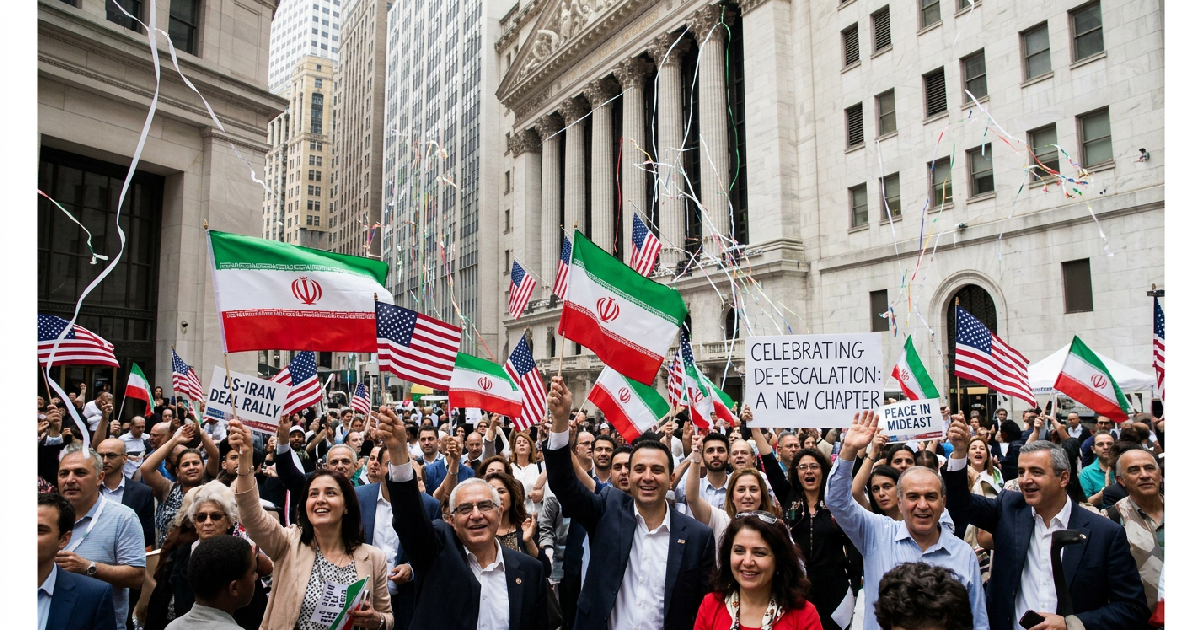
US and Iran reportedly agree to de-escalate Mideast tensions on June 15
Global financial markets experienced a sharp upswing on Monday, June 15, 2026, as the United States and Iran reportedly reached a preliminary agreement to de-escalate long-standing tensions in the Middle East.
The deal, which includes provisions to reopen the Strait of Hormuz and extend an existing ceasefire, triggered a widespread relief rally across international stock exchanges and a simultaneous drop in crude oil prices.
Negotiators from both nations have also signaled an intent to end active hostilities in Lebanon, providing a much-needed reprieve for global energy supply chains.
The sudden diplomatic breakthrough comes after months of volatile negotiations and military posturing that had kept energy markets on edge. Investors reacted with immediate optimism as the prospect of a stabilized Middle East suggests a reduction in the “geopolitical risk premium” that has inflated costs for years. In the wake of this development, com/international-news/stocks-rise-oil-falls-us-iran-deal-expectations-2026-wrap/”>global stocks rise and oil prices fall as the market price in a more predictable security environment for maritime trade.
While the agreement is being hailed as a milestone, details regarding its implementation remain fluid. The reopening of the Strait of Hormuz is the most critical component for global commerce, as roughly one-fifth of the world’s total oil consumption passes through this narrow waterway.
Market analysts suggest that while the deal is a primary catalyst for today’s rally, the physical backlog of shipping and logistical hurdles in the region could take several weeks to fully clear.
Equities climb as energy prices retreat on diplomatic news
Major indices in New York, London, and Tokyo all posted gains within hours of the announcement. Technology and manufacturing sectors led the charge, benefiting from the expectation of lower fuel and transport costs. The cooling of tensions provides a rare moment of clarity for multinational corporations that have lately been forced into a defensive posture regarding their logistics.
The shift in focus highlights a broader trend where supply chain resiliency increasingly prioritised by firms looking to insulate themselves from sudden geopolitical shocks. For many CFOs, the US-Iran deal represents more than just a temporary dip in oil prices; it is a potential return to more stable trade routes.
By removing the immediate threat of a wider regional conflict, the agreement allows for more aggressive capital expenditure and long-term planning.
Oil market volatility subsides after ceasefire extension
Crude oil prices fell sharply on Monday, retreating from recent highs as the risk of a supply squeeze diminished. Traders who had banked on continued disruptions in the Persian Gulf began unwinding their positions, leading to a rapid correction in both Brent and West Texas Intermediate (WTI) benchmarks.
The ceasefire extension in Lebanon further bolstered the sentiment that the “war footing” of the past year is finally easing.
Energy analysts warn, however, that the market may be getting ahead of itself. The “Strait of Hormuz backlog” mentioned in early reports suggests that tankers currently idling or rerouted around the Cape of Good Hope will not reach kanilang destinations overnight. This lag in physical delivery could keep refined product prices, such as gasoline and jet fuel, slightly elevated even as raw crude prices tumble.
Political hurdles and the Trump administration response
Despite the market’s enthusiasm, the political path forward for the deal is far from certain. Domestic critics in the United States have already raised concerns about the concessions made to Tehran. Reports surfaced today that Donald J. Trump reportedly requests edits to the proposed framework, potentially complicating the final signing ceremony.
The involvement of the former president indicates that the deal will face significant scrutiny in Washington. If specific demands for more stringent verification measures are not met, the preliminary agreement could stumble before it is fully codified. This political friction remains the primary downside risk for investors who are currently celebrating the “truce of convenience.”
Impact on inflation and central bank policy
The timing of the deal is particularly advantageous for central banks struggling to tether inflation. High energy costs have been the primary driver of “sticky” inflation throughout 2026, preventing many institutions from pivot to lower interest rates. If the decline in oil prices sustained, it would give the Federal Reserve and the European Central Bank more room to consider rate cuts later this year.
Economists are watching the “pass-through” effect closely. Lower shipping insurance premiums and reduced fuel surcharges should, in theory, lower the cost of imported goods. This deflationary pressure could be the “missing piece” of the puzzle for a global economy that has flirted with recession for several quarters.
Future outlook for Hormuz transit and regional stability
Shipping companies are already preparing to resume standard operations through the Strait of Hormuz, though security protocols remain at an elevated level. Maritime insurers are expected to wait for official confirmation of the waterway’s safety before slashing war-risk premiums. Until the first few convoys pass without incident, a cautious approach persists among vessel operators.
The coming days will be vital for verifying the sincerity of the ceasefire on the ground in Lebanon. While the financial markets have voted with their wallets, the reality of the US-Iran deal will be measured in the volume of oil flowing through the Gulf and the absence of kinetic military action.
For now, the global rally suggests a world eager to move past the perma-crisis era into a more stable diplomatic landscape.