

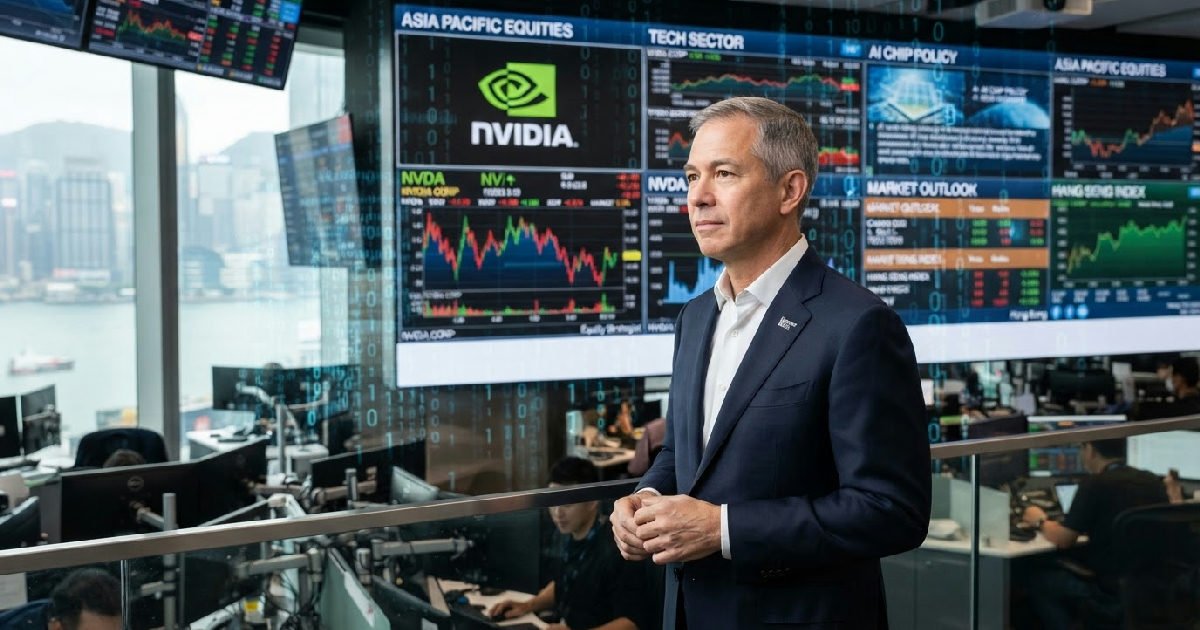
timothy moe flags ai trade uncertainties
Timothy Moe, Goldman Sachs’ Chief Regional Equity Strategist for Asia Pacific, offered a nuanced assessment of the artificial intelligence (AI) trade on November 20, 2026.
His remarks highlighted growing pressures on AI-related stocks, including significant investor unease surrounding chipmaker Nvidia, complex political developments in the United States, and increasing resistance to the proliferation of large-scale data centers. These factors contribute to the current AI trade uncertainties.
Moe’s commentary comes at a critical juncture for the tech sector. After driving much of the S&P 500’s earnings growth this year, the AI market faces mounting scrutiny over its sustainability and the broader economic environment.
Moe’s evolving outlook on AI trade uncertainties
Moe’s perspective on the AI market has evolved throughout 2026. Earlier, on June 8, 2026, he described the AI story as “just beginning and profitable,” particularly highlighting the potential in the Korean market.
At that time, Moe forecast Korean corporate profits to surge by 320% for the year, with major players like Samsung and SK Hynix trading at an attractive five times earnings, signaling a strong buy opportunity.
However, by October 25, 2026, concerns began to solidify. Timothy Moe led Goldman Sachs in lowering its 12-month target for South Korea’s Kospi Index by a substantial 25%, revising it from 12,000 down to 9,000 points. This adjustment reflected mounting worries over artificial intelligence investments and a shift towards more conservative equity valuations.
The Kospi Index had already plunged more than 35% from its peak in June, underscoring the rapid shift in sentiment. Moe pointed out that current semiconductor valuations implied an “overly pessimistic” 65% decline in sector earnings for 2027. He noted the Kospi’s 12-month forward price-to-earnings ratio stood at approximately four, a level unseen across 18 major markets since 2006.
Despite these re-evaluations, Goldman Sachs maintained an overweight rating on the South Korean stock market. The firm continues to favor sectors such as power, industrials, and companies poised to benefit from corporate governance improvements and domestic economic recovery. This nuanced stance suggests that while broad AI euphoria might be tempered, specific opportunities persist.
Nvidia’s recent challenges unsettle investors
Much of the current market uncertainty stems from recent developments involving Nvidia, a cornerstone of the AI boom. The company’s stock (NVDA) experienced a significant downturn, falling 3.30% to $145.98 on November 19, 2026. This was a steeper decline than the Nasdaq Composite’s 2.25% drop on the same day.
The stock had already seen a nearly 32% reduction since October 29, 2026. This period coincided with reports circulating around CEO Jensen Huang. Even robust third-quarter earnings, which showed revenue up 103% year-over-year to $115.8 billion and data center revenue at $107.6 billion, failed to quell investor anxieties.
A key factor contributing to investor apprehension was the unexpected resignation of Jensen Huang on November 12, 2026. This followed allegations of a relationship with an individual suspected of being a Chinese spy. CFO Colette Kress stepped in as interim CEO, while Nvidia’s board initiated an independent investigation into the matter.
Further compounding Nvidia’s woes, the California Attorney General served an investigative subpoena on the company. This probe focused on potential leaks of advanced technology to China. Adding to the regulatory pressure, the Securities and Exchange Commission (SEC) reportedly opened its own civil investigation into Nvidia in the week of November 16, 2026, signaling broadening scrutiny.
Analysts like Steve Wyett of BOK Financial highlighted that investors are “wrestling with Jensen Huang’s ouster and broader fears that AI spending is set to slow.” This turmoil has overshadowed otherwise strong financial outlooks. Dan Kemp, founder of Portfolio Thinking, noted investor skepticism regarding Nvidia’s future growth due to “leadership turmoil, government investigations and growing opposition to new data centers.”
Financial risks and growth deceleration
Beyond the immediate leadership and regulatory concerns, financial risks for Nvidia are also coming into focus. There are worries about chip value depreciation and potential market shifts, despite the company’s impressive revenue growth. Some analysts have even moved to a “Sell” rating on Nvidia, citing slowing underlying growth and risks associated with customer financing.
The company’s fourth-quarter guidance of $130 billion, while strong, includes an extra week of sales. Without this additional week, the weekly revenue growth rate shows signs of deceleration. Furthermore, Nvidia faces challenges from halted AI-chip sales to China and the possibility that some customers’ growth may outstrip their financing capacity, creating headwinds for future expansion.
US policy shifts impacting the AI chip landscape
Political developments in the United States are also playing a significant role in shaping the AI trade’s uncertainties. On November 15, 2026, the US Commerce Department’s Bureau of Industry and Security (BIS) implemented an interim final rule concerning “remote access” to advanced semiconductors. This rule is designed to expand export licensing requirements for advanced AI chips destined for data centers outside the US.
These new regulations specifically target data centers that supply computing power to companies headquartered in China and other jurisdictions. The move aims to close a perceived loophole, preventing foreign entities from leveraging US-regulated hardware located abroad to train their AI models. This directly impacts the global supply chain for high-end AI components.
In addition to export controls, the US antitrust enforcement landscape is undergoing a recalibration. Regulators are adopting a more empirical, outcomes-driven approach, increasingly influenced by national priorities. AI development and algorithmic pricing remain central to the technology sector’s antitrust scrutiny, indicating a sustained focus on market concentration.
A class-action lawsuit filed on September 18, 2026, against major AI players including Anthropic, OpenAI, SpaceXAI, and Google, alleges an anticompetitive agreement to slow AI development. The Federal Trade Commission (FTC) is also expected to intensify its focus on consumer protection, particularly concerning AI, data usage, and privacy, adding another layer of regulatory complexity.
Broader economic headwinds and the investment outlook
Goldman Sachs strategists, including Moe, acknowledge that while AI has been a primary market driver, broader economic headwinds are beginning to emerge. The investment bank anticipates the tailwind from AI investment could start to fade in 2027. This is primarily because the growth rate of capital expenditure is expected to slow, and depreciation expenses will accumulate.
This potential slowdown in AI capital expenditure growth is a critical concern. Moe’s team warned in mid-November that AI-related uncertainty could amplify market volatility, even as overall spending on AI themes continues to rise. They also projected that AI capital expenditure growth is likely to peak, signaling a shift in the investment environment.
Looking ahead to 2027, Goldman Sachs expects earnings per share (EPS) growth for S&P 500 constituents to decelerate from roughly 30% in 2026 to 18%. This shift suggests that the market’s focus will likely transition from companies building AI infrastructure to those successfully adopting and monetizing AI technologies.
Geopolitical tensions, such as those related to AI chip restrictions, are further complicating the landscape for investors seeking stable growth.
Concerns over liquidity and funding costs also persist. Record credit issuance combined with still-high equity issuance could lead to tighter liquidity conditions and increased funding costs across various sectors. Moe and his team also project that most Asian economies will experience a slowdown in 2027, largely due to anticipated additional interest rate hikes by the U.S. Federal Reserve.
Navigating the uncertain path ahead for AI
The confluence of factors — from individual company challenges to macroeconomic shifts and regulatory actions — paints a complex picture for the AI trade. Moe and his Goldman Sachs colleagues project a 19% total return for the MSCI Asia ex-Japan index in 2027, driven primarily by earnings growth rather than multiple expansion, indicating a more measured outlook.
Goldman Sachs has adjusted its investment opinions across Asia. The firm upgraded China H-shares and India to an “overweight” rating while shifting China A-shares and Taiwan to “market weight.” South Korea and Japan, however, maintain their “overweight” status, reflecting ongoing confidence in their specific market dynamics despite broader AI-related uncertainties.
Moe continues to emphasize that the market might be underestimating the sustainability of the earnings cycle for South Korean memory chip manufacturers. He projects KOSPI earnings growth at approximately 360% in 2026, although slowing to around 35% in 2027. The current KOSPI valuation, trading at 5.3 times forward earnings—roughly half its seven-year historical average—suggests potential for undervaluation in select segments.
Ultimately, Moe’s analysis underscores a period of significant transition for the AI trade. While the long-term potential of artificial intelligence remains compelling, investors will need to carefully navigate the short-term volatility, regulatory shifts, and evolving economic conditions that are increasingly shaping this dynamic sector.