

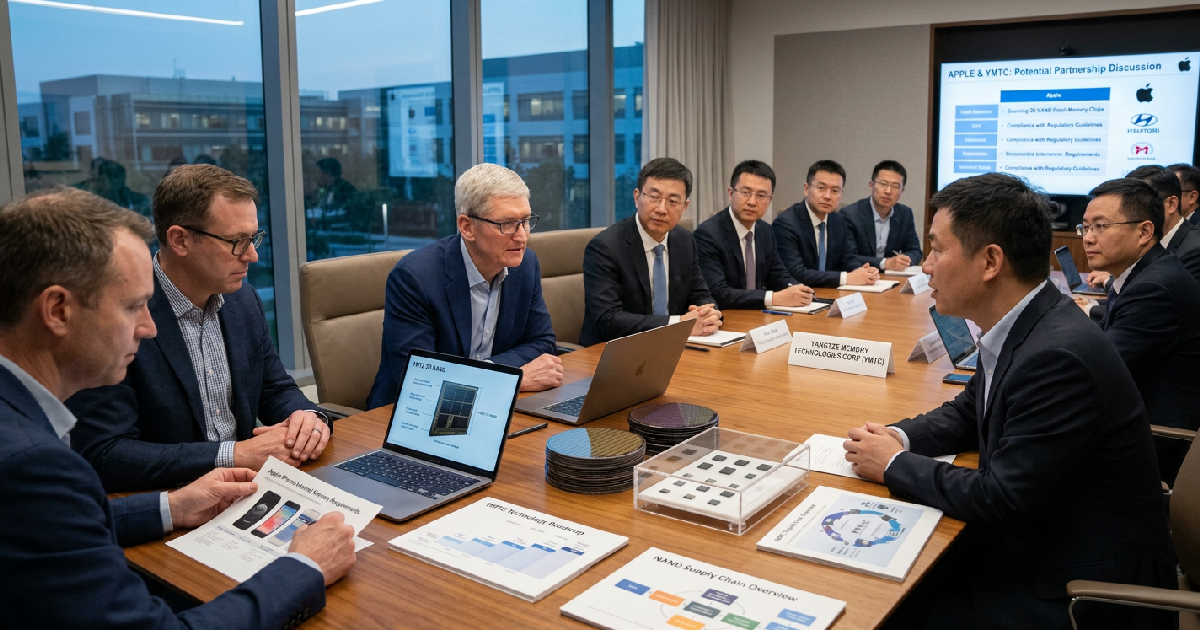
Tim Cook reportedly targets blacklisted YMTC for memory chips
Apple CEO Tim Cook is reportedly exploring a high-stakes supply chain shift by seeking to purchase memory chips from Yangtze Memory Technologies Corp (YMTC), a Chinese semiconductor manufacturer currently on the United States government’s trade blacklist.
The move, disclosed in reports today, June 27, 2026, signals a potential confrontation between the world’s most valuable technology company and federal regulators who have spent years tightening restrictions on Chinese tech entities.
Navigating the trade blacklist and federal oversight
By engaging with the Wuhan-based firm, the Cupertino giant aims to further diversify its component sources and lower production costs for future hardware iterations.
This development comes as the consumer electronics market faces increasing pressure from rising material costs and a volatile geopolitical environment. Apple Inc (AAPL) has traditionally relied on South Korean and Japanese suppliers like Samsung Electronics (SMSN) and SK Hynix for its NAND flash memory requirements.
However, the inclusion of a Chinese state-backed player could lead to a significant pricing shift in the global memory market. Industry analysts suggest that the tech giant is weighing the economic benefits of cheaper components against the mounting political risks of dealing with an entity labeled a national security threat by the U.S.
Department of Commerce.
The decision to court Yangtze Memory Technologies Corp (YMTC) underscores the complex tightrope the iPhone maker must walk between global manufacturing efficiency and compliance with domestic foreign policy. While the company has made public efforts to move some production to India and Vietnam, its reliance on Chinese infrastructure remains deep.
The sheer scale of Apple Inc (AAPL) operations means that even a minor percentage shift in its supply chain can dictate the financial health of entire sub-sectors within the semiconductor industry.
The primary hurdle for Apple Inc (AAPL) remains the Entity List, a trade blacklist maintained by the Bureau of Industry and Security (BIS). Yangtze Memory Technologies Corp (YMTC) was added to this list due to concerns over its ties to the Chinese military and the potential for its technology to be used in state surveillance.
Key details
Under current rules, U.S. firms are generally prohibited from exporting technology to blacklisted companies without a difficult-to-obtain license. However, the rules regarding the purchase of goods from these entities are more nuanced and often depend on whether the manufacturing process involves restricted U.S. equipment.
Washington has remained steadfast in its goal to limit China’s progress in the high-tech sector. The potential for a flagship American company to funnel billions of dollars into a blacklisted Chinese firm has already drawn scrutiny from Capitol Hill.
Lawmakers have previously warned that such partnerships could compromise the integrity of the global electronics supply chain. If the deal proceeds, it could trigger new legislative efforts to close loopholes that allow U.S. companies to engage with entities perceived as adversarial to national interests.
Key details
Concerns have also been raised regarding the actual quality and durability of the chips produced by Yangtze Memory Technologies Corp (YMTC). Historically, Chinese memory manufacturers trailed behind their Western and South Korean counterparts by several generations.
However, recent audits suggest that the Chinese firm has made rapid strides in 3D NAND technology, reaching a point where its products are viable for high-performance consumer devices. For the iPhone, which requires fast read and write speeds to support modern AI features, the performance of these chips is non-negotiable.
The tech giant’s engineers are known for their rigorous testing standards. Any component that enters the iPhone must meet exacting benchmarks for power consumption and thermal management.
The fact that the company is even considering this partnership suggests that the Chinese manufacturer has reached a level of technological maturity that makes it a viable competitor to the established order. This closing of the “tech gap” is exactly what U.S. export controls were designed to prevent.
Anticipated regulatory pushback and political fallout
The timing of this move is particularly sensitive. With federal agencies already monitoring the flow of capital into Chinese tech, a formal contract could serve as a lightning rod for broader regulatory action.
Critics argue that by sourcing from a blacklisted entity, Apple Inc (AAPL) is effectively subsidizing the development of the very technology that the U.S. government considers a threat. The company, however, likely views this as a matter of commercial necessity to maintain its competitive edge in a saturated market.
We have seen similar tensions in other high-tech fields. As federal rules face new scrutiny in the digital asset space, the semiconductor industry is finding itself under a different kind of microscope.
Key details
The intersection of corporate profit and national security is becoming increasingly crowded, leaving little room for the “business as usual” approach that defined the early 2010s. For CEO Tim Cook, the goal is to protect the bottom line without becoming a casualty of a burgeoning cold war in the Pacific.
Washington’s response will likely determine the feasibility of this plan. If the Department of Commerce decides to tighten the language of the Entity List to specifically forbid purchase agreements involving certain tiers of technology, the deal could be dead on arrival.
Conversely, if the administration allows it to proceed, it could signal a softening of trade tensions—or at least a recognition that the global electronics economy is too deeply intertwined to be unwound overnight.
Future outlook for the global hardware supply chain
The outcome of these negotiations will set a precedent for other American tech firms. If the most prominent hardware brand in the world can successfully source from a blacklisted Chinese entity, others like Dell (DELL) or HP (HPQ) may follow suit. This would undermine the efficacy of the U.S.
sanction regime but could provide a short-term boost to the consumer electronics sector by lowering global device prices 2026-2027.
Regardless of the immediate result, the relationship between Silicon Valley and Beijing is entering a new chapter. The days of transparent, friction-free trade are gone, replaced by a complex system of waivers, lists, and political posturing.
Key details
Apple Inc (AAPL) remains at the center of this transformation, proving that even as it looks to the future of AI and spatial computing, it is stil bound by the physical realities of where its components are made.
The next several months will reveal whether the company’s financial clout is enough to override the geopolitical concerns of the White House.
Industry observers will look toward the fall launch cycle to see if the first batch of devices utilizing these components is approved for sale. Any delay in the release of new models could indicate that regulatory hurdles have become insurmountable. For now, the tech world watches as two global powers grapple with the price of an iPhone component.