

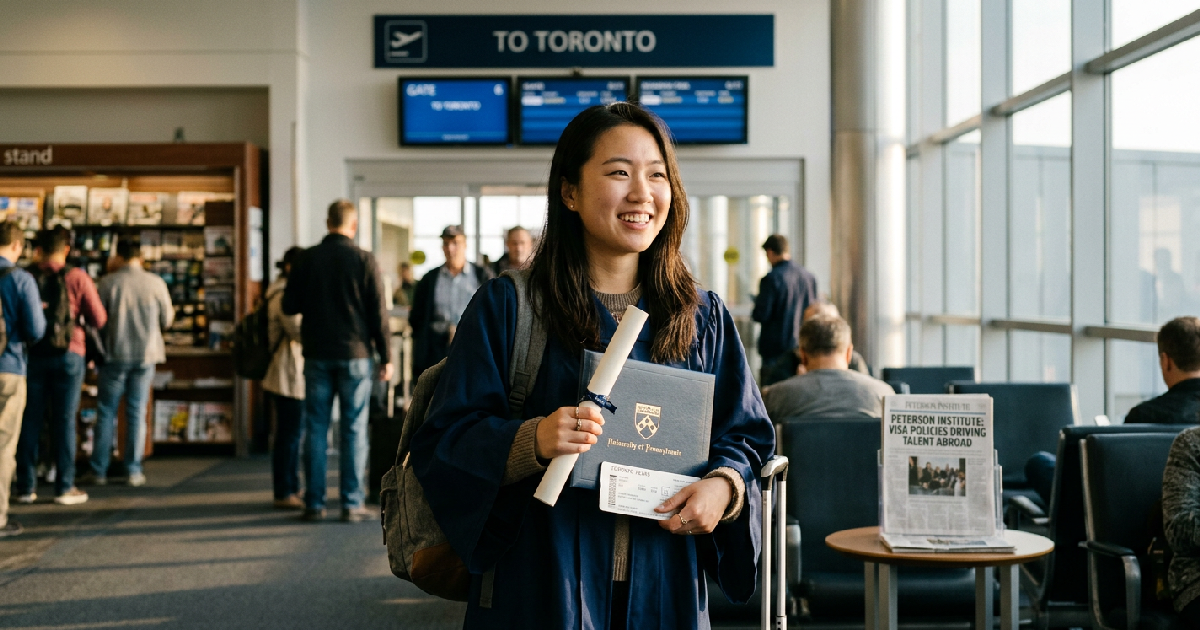
Peterson Institute warns US visa policies drive top talent to rival economies
The Peterson Institute for International Economics (PIIE) has raised alarms regarding the United States’ current approach to international student recruitment, warning of a potential decline in long-term economic competitiveness. Analysis from the non-partisan research organization suggests that current visa frameworks and the resulting difficulty for foreign graduates to remain in the country may be driving top talent toward rival economies.
According to research highlighted by the Peterson Institute for International Economics, the US remains a premier destination for global education, but its market share is under pressure from secondary hubs. Foreign students are often critical contributors to the American innovation ecosystem, particularly in technical fields.
The impact of restrictive visa policies on American innovation
When these individuals are unable to secure predictable pathways to residency, they often relocate to countries with more streamlined immigration systems, such as Canada or the United Kingdom.
This shift in human capital movements is particularly relevant as global competition for expertise in emerging technologies intensifies. While American institutions still dominate global rankings, the administrative hurdles associated with the H-1B visa and green card processes create a deterrent that did not exist in previous decades.
As Brian Armstrong has noted in other contexts, traditional systems must evolve to remain relevant in a rapidly modernizing global economy.
The central concern for economists at the Peterson Institute for International Economics is the friction within the United States immigration system. Many international students who earn advanced degrees in Science, Technology, Engineering, and Mathematics (STEM) find it nearly impossible to transition from a student visa to permanent residency. This uncertainty often leads them to take their talent—and the potential for future startups—to more welcoming jurisdictions.
Key details
And it’s not just the students who are affected; the companies that would hire them also face significant hurdles. The H-1B lottery system is oversubscribed, leaving many firms unable to retain the specialized workers they have trained.
The PIIE suggests that this creates a “brain drain” where the US pays for the initial research and academic infrastructure, only for other nations to reap the long-term economic benefits from the graduates’ later work.
Market shifts and the global hunt for talent
While the United States grapples with legislative gridlock on immigration reform, other nations have been proactive. Canada’s Express Entry system and similar points-based models in Europe and Australia have made those countries attractive alternatives. These nations specifically target former students who have already integrated into their societies and mastered the local language, viewing them as ideal immigrants.
This loss of human capital is reflected in broader economic trends. For instance, the TFI International valuation and other logistics-driven data points often show how efficiently cross-border flows contribute to corporate health. If the flow of people is restricted, the underlying growth of tech-heavy sectors may similarly stall.
The PIIE argues that the US is currently self-handicapping by maintaining a 20th-century immigration model in a 21st-century global economy.
Financial implications for American higher education
International students are not just a source of talent; they are a vital financial pillar for the American university system. Most foreign students pay full tuition, which helps subsidize research and financial aid for domestic students. A prolonged dip in international enrollment could lead to budgetary shortfalls at major state universities, forcing them to either raise costs for local families or cut essential programs.
Recent shifts in capital highlight the volatility of these trends. Much like how AI and quantum tech capital outflows can shift the value of digital assets, the withdrawal of international student fees can destabilize the fiscal health of American academic institutions.
The Peterson Institute for International Economics warns that the US cannot afford to take its preeminence in the education sector for granted as high-quality alternatives continue to emerge globally.
Moving toward a more competitive residency framework
To address these issues, the Peterson Institute for International Economics has advocated for reforms that would streamline the path from university to the workforce. One frequently discussed proposal is “stapling a green card” to the diplomas of high-achieving STEM graduates.
This would remove the lottery-based uncertainty that currently plagues the system and ensure that the world’s most capable minds stay to build their businesses in America.
But implementing such changes remains a significant political challenge. Until there is a shift in how the government views high-skilled migration, the US may continue to see its share of the world’s brightest minds decline.
The PIIE maintains that international students should be viewed as a national asset rather than a temporary workforce, emphasizing that the economic cost of inaction will only increase as other global hubs mature.