

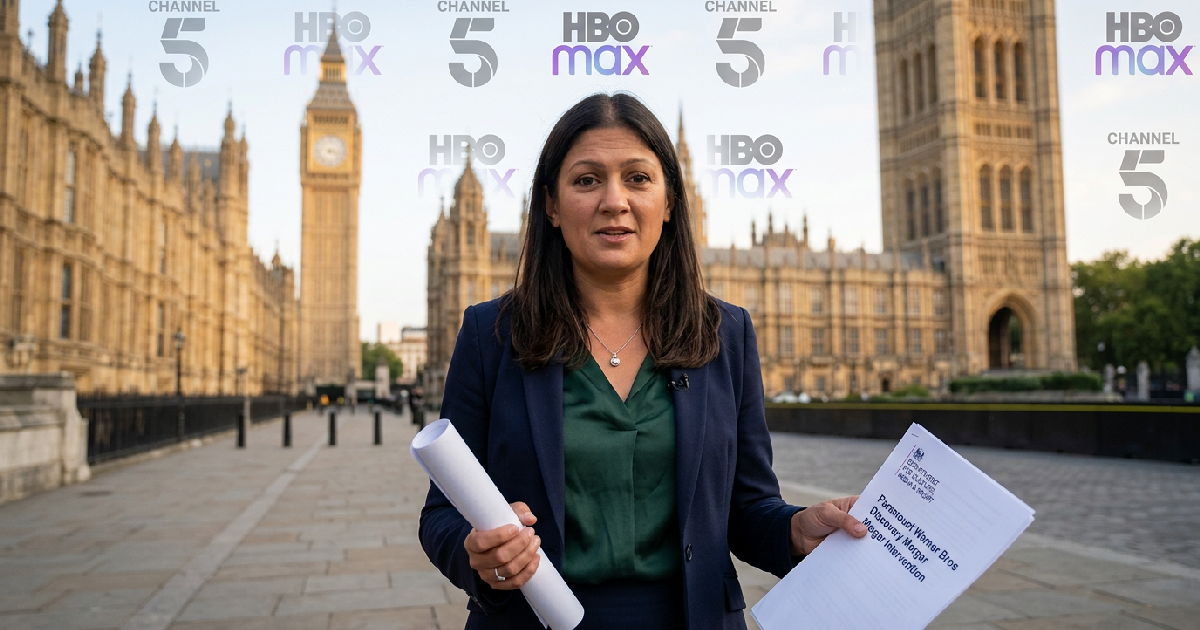
Lisa Nandy warns of intervention in $110 billion Paramount-Warner Bros Discovery merger
British Culture Minister Lisa Nandy announced on June 30, 2026, that the UK government is “minded to intervene” in Paramount’s proposed $110 billion takeover of Warner Bros Discovery.
In a written statement to Parliament, the Secretary of State for Culture, Media and Sport cited concerns over media plurality and the need to maintain a diverse range of views within the British news landscape.
Public interest grounds for Paramount Warner Bros Discovery merger intervention
The Department for Culture, Media and Sport (DCMS) has formally written to both companies to notify them of this potential intervention on public interest grounds.
The deal, which aims to merge two of the world’s largest media conglomerates, would bring assets such as Channel 5, TNT Sports, and HBO Max under a single owner.
While the acquisition has already received clearance from the US Department of Justice, the UK regulator is closely examining how the consolidation of such vast media interests might affect domestic audiences. Paramount and Warner Bros Discovery have until July 6, 2026, to provide written representations before a final decision on the intervention is made.
The government’s primary concern surrounds the “plurality of views” in news media and the control of media enterprises serving UK audiences. Lisa Nandy emphasized that her focus is squarely on the UK public interest and the range of services currently available to viewers.
This includes free-to-air channels like Channel 5 and specialized services such as CNN International, Nickelodeon, and Cartoon Network. The merger would also unite major sports broadcasting rights, including the Premier League and Champions League via TNT Sports.
Defining media plurality amid streaming growth
Nandy’s concerns are rooted in the UK’s existing media plurality framework. This framework aims to ensure that no single entity exerts excessive influence over the news and entertainment consumed by the British public.
She outlined two key public interest grounds. First, the need for a sufficient plurality of views in news media across the United Kingdom. Second, the requirement for a sufficient plurality of persons controlling media enterprises, including on-demand program services, for every audience in the UK.
This is crucial as the proposed acquisition is global, but its implications for UK audiences are Nandy’s central focus. She specifically mentioned familiar services like Channel 5, TNT Sports, Cartoon Network, Nickelodeon, CNN International, as well as Paramount+ and HBO Max.
Regulatory process and potential outcomes
Lisa Nandy has not yet made a final decision on whether to intervene in the Paramount-Warner Bros deal. The current “minded to” letter is an invitation for further written representations from both Paramount and Warner Bros Discovery.
They have until July 6 to respond to the DCMS with their arguments. If Nandy decides to issue an Intervention Notice, the regulatory process will then move to its next stages.
First, Ofcom, the UK media regulator, will assess and report to Nandy on the public interest considerations. Concurrently, the Competition and Markets Authority (CMA) will assess the merger. They’ll determine if a relevant merger situation has been created and analyze any potential impact on competition.
Both Ofcom and the CMA typically have up to 40 days to provide their reports. After receiving these assessments, Nandy would then decide whether to refer the matter for a more detailed, in-depth investigation by the CMA under section 45 of the Enterprise Act.
This kind of deeper probe can last up to 24 weeks, significantly extending the deal’s timeline. Nandy has stated she is “mindful of the need to reach a final decision in a timely manner” and will “endeavour to do so as appropriate.”
This potential sequence of events adds considerable uncertainty for the companies involved. If UK regulators do identify specific concerns, Paramount and Warner Bros Discovery would likely be asked to offer “remedies” to secure approval. These remedies could range from divestments of certain media assets to legally binding commitments aimed at preserving editorial independence and competitive access for other media players.
Paramount’s response and historical precedents
A spokesperson for Paramount Skydance has already responded to the UK government’s statement, expressing confidence in their proposed $110 billion takeover of Warner Bros Discovery.
The company maintains that their transaction does not pose any media plurality issues in the UK. They also remain confident in their stated timeline for the deal’s completion, which is expected by the end of September this year.
Corporate meetings about how to integrate Paramount and Warner Bros Discovery have reportedly been taking place for months. This suggests the companies are pushing ahead despite the regulatory uncertainty in the UK.
The UK has a history of scrutinizing major international takeovers, particularly those involving critical sectors like media and technology. In 2023, the Competition and Markets Authority initially blocked Microsoft’s $69 billion acquisition of gaming firm Activision Blizzard.
The deal was eventually waved through, but only after Microsoft proposed various changes to address the regulator’s concerns. This demonstrates the UK’s willingness to use its regulatory powers even when other major jurisdictions have approved similar transactions. Bobby Kotick, then CEO of Activision, even claimed lawsuits against the deal assisted another company.
The legal precedent set by the Activision Blizzard case shows that the UK is prepared to take a tough stance. Any remedies Paramount and Warner Bros Discovery might offer would need to be substantial enough to genuinely alleviate concerns about media concentration and diversity.
Updating the Enterprise Act for modern media
Lisa Nandy has also highlighted the pressing need to update the UK’s Enterprise Act. She noted that the Act, which was passed in 2002, does not adequately cover ‘on-demand’ television services.
This legislative gap means the current Act doesn’t fully address the effects of a merger on streaming or video-on-demand services. Nandy believes this oversight ought to be corrected given the significant role on-demand viewing now plays in the market.
She told Members of Parliament that if she decides to intervene in this merger on the grounds of on-demand services, she will bring forward secondary legislation. This would finalize the public interest consideration within the Enterprise Act, enabling future media mergers involving streaming platforms to be assessed under a more relevant legal framework.
This proactive stance suggests the UK government is looking beyond the immediate specifics of the Paramount-Warner Bros Discovery deal. It indicates a broader ambition to future-proof its regulatory tools in the face of rapid technological advancements and evolving media consumption habits. The impact of such legislative changes could be far-reaching for any subsequent mergers in the digital media space.
Global implications for media mergers
The UK’s “minded to” stance on the Paramount-Warner Bros Discovery merger stands in contrast to the regulatory approaches taken by several other global jurisdictions. The US Department of Justice, for instance, cleared the deal earlier in June without requiring any concessions. This difference highlights the varied interpretations of competition and media plurality across different national regulators.
Regulators in China, Australia, Germany, and France have also provided their respective approvals for the $110 billion transaction. However, the European Commission’s review is still ongoing, with some reports suggesting that Paramount might need to withdraw from its joint distribution venture with Universal Pictures, called United International Pictures (UIP), to secure approval.
The global nature of this mega-merger means that regulatory hurdles in one major market can complicate the entire process, even if other significant markets have given their blessing. This fragmented regulatory landscape adds complexity and potential delays to global business deals, forcing multinational corporations to navigate a patchwork of national interests and legal frameworks.
Political considerations might also subtly influence these decisions. Paramount’s owners, the Ellison family, are known supporters of Donald Trump. While not a direct factor in regulatory decisions, such affiliations can sometimes add layers of diplomatic sensitivity, especially in a politically charged environment.
This particular media merger serves as a case study in how major international business deals are increasingly subject to a confluence of economic, legal, and even political forces on a global scale. com/international-news/lincoln-international-valuation-lcln-share-price-correction-2026-analysis/”>analysts often weigh such geopolitical variables into their assessments of corporate valuations.
The road ahead for Paramount and Warner Bros Discovery
With the July 6 deadline for responses fast approaching, Paramount and Warner Bros Discovery face a critical period. Their submissions to the Department for Culture, Media and Sport will be crucial in shaping Lisa Nandy’s final decision regarding an Intervention Notice. If Nandy decides to proceed, the scrutiny from Ofcom and the CMA will intensify, potentially leading to a prolonged investigation.
The stakes are high for both companies. The merger promises to create a media powerhouse, combining Paramount’s Channel 5 and Paramount+ with Warner Bros Discovery’s vast portfolio, including HBO Max, TNT Sports, and iconic film franchises. It’s a deal that involves bringing together an immense range of content, from critically acclaimed series such as “Game of Thrones” and “Succession” to major sports broadcasting rights for the Champions League, Premier League, and the Olympics.
The UK’s regulatory action here underscores a broader global trend where governments are increasingly assertive in scrutinizing large-scale mergers for their potential impact on national interests, particularly in sensitive sectors like media. Ensuring media plurality and preventing undue concentration of power remains a key concern for many countries, reflecting a desire to protect diverse voices and prevent monopolistic control over information and entertainment. This vigilance shapes the future of how global media conglomerates can expand and operate across borders.