

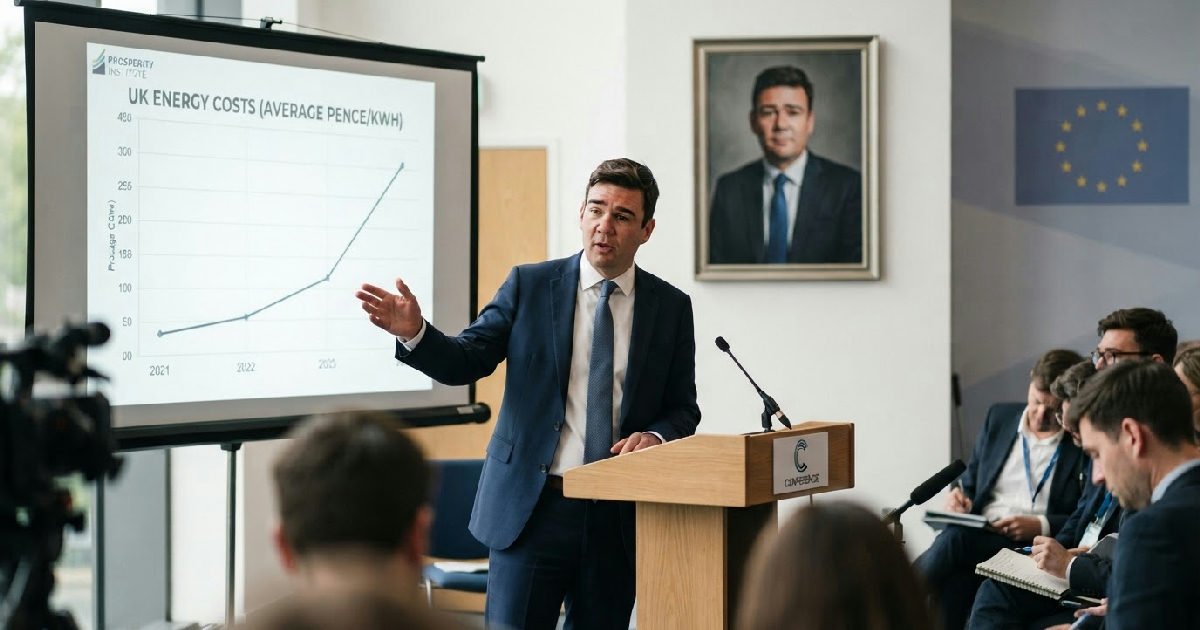
joseph dinnage warns eu linkage plan threatens uk energy costs
Prime Minister Andy Burnham’s EU reset plan could negatively impact UK energy costs, according to a stark warning issued today by Joseph Dinnage of the Prosperity Institute.
Dinnage contends that closer ties to the EU, specifically through a proposed linkage of emissions trading schemes, will do nothing to bring down UK energy costs; instead, he advocates for the abolition of domestic green levies to alleviate financial pressure on British households.
Concerns over Burnham’s EU energy proposals and UK energy costs
Burnham is scheduled to travel to Brussels on Friday for a UK-EU Summit, where he aims to finalize new agreements spanning food, energy, and youth mobility.
His statements last night at the Lord Mayor’s banquet underscored a belief that “the Brexit we were given has not worked” and that the time has come to re-evaluate the UK’s “long-term relationship” with Brussels. However, Dinnage and the Prosperity Institute argue that the Prime Minister’s energy proposals are fundamentally flawed.
Prime Minister Andy Burnham’s government claims that linking the UK and EU’s emissions trading schemes (ETS) could save British exporters as much as £800 million. This projected saving stems from the idea that exporters would avoid payments into the EU Carbon Border Adjustment Mechanism (CBAM) scheme.
The government’s stance draws on a 2024 report by Frontier Economics, which suggested that lower carbon prices in the UK ETS could lead to British businesses contributing £0.2-0.8 billion to the EU budget via CBAM between 2026 and 2030.
But the Prosperity Institute casts serious doubt on these figures, labelling the government’s £800 million saving as “fiction.” Their analysis suggests that the Frontier Economics report itself contradicts the government’s argument, pointing to an estimated £3.5-8 billion hit to the economy from avoidable carbon taxes. This significant financial burden would ultimately make life more expensive for everyday Britons, not cheaper.
The economic reality of ETS linkage
Should the UK-EU ETS linkage proceed, the Prosperity Institute calculates it would drive British carbon prices upwards, aligning them more closely with EU levels. This alignment would result in an approximate 32 per cent increase in UK carbon prices. Such a rise directly translates to higher operational costs for businesses, which are then typically passed on to consumers through increased energy bills.
This potential outcome runs counter to the Prime Minister’s stated goal of providing “breathing space” for Britons. The institute argues that focusing on external mechanisms like linking ETS schemes distracts from more direct and effective domestic policy levers. It’s a choice between complex international integration and straightforward internal reform.
As international politics continue to reshape global trade, new challenges arise; for instance, China threatens retaliation after US tightens AI chip restrictions, illustrating the constant flux in global economic relationships.
Domestic policy: A pathway to lower bills
Instead of pursuing closer EU energy ties, the Prosperity Institute strongly advocates for confronting what it identifies as the root cause of high energy costs: domestic green levies. Their research recommends the immediate abolition of several key measures, including the Climate Change Levy, Carbon Price Support, the existing UK ETS, and the proposed UK CBAM.
Such bold domestic action, they assert, would deliver substantial relief to British consumers. Energy users could see their bills cut by an impressive £7.2 billion annually. This saving equates to approximately £250 per household each year, with around £60 coming directly off household energy bills.
While this move would incur a gross cost of £4.2 billion to the Exchequer, the long-run economic boost could reach up to £7.4 billion in GDP.
Brexit’s lingering impact on energy prices
The debate over EU ties and energy costs isn’t new; it echoes concerns that have persisted since the UK’s departure from the European Union. Analysis from Energy UK, the sector’s trade body, indicates that Brexit has already added up to £370 million annually to the cost of power supplies imported from Europe since 2021.
Projections suggest the total energy costs attributable to leaving the EU could accumulate to £10 billion by the end of the decade.
Before Brexit, the UK procured power through the EU’s internal electricity market, utilizing a system known as “single day-ahead coupling” to optimize pricing and energy flows. Studies have highlighted that the UK’s formal withdrawal on January 31, 2020, significantly impacted inflation rates, particularly within the energy and transport sectors.
This formal institutional shift had a more pronounced effect on energy inflation compared to the referendum result itself in 2016. Such economic shifts require careful consideration, just as when USCIS tightens foreign worker visa rules, impacting different aspects of a nation’s economy.
Understanding the current energy landscape
The UK’s reliance on energy imports, with approximately 50% of its gas coming from abroad, makes it particularly vulnerable to currency fluctuations. A depreciation in Sterling’s value means future energy purchases will inevitably cost more, directly affecting consumer prices.
Furthermore, the potential for a “hard Brexit” could lead to the UK decoupling from the European Internal Energy Market, risking disrupted energy imports, increased prices, and heightened wholesale market volatility.
As of late August 2026, spot gas prices on the wholesale market reached their highest level since January 2023. Forecasts suggest unit prices for gas and electricity are set to increase again in October 2026, by 9% and 1% respectively.
Bills for typical consumption under the October to December 2026 price cap are expected to be 58% higher than in the winter of 2021/22, with a further 9% increase projected for the first quarter of 2027.
Average standing charges also remain a factor, at 29.0 pence per day for gas and 57.2 pence per day for electricity.
The sovereignty debate and political resolve
The Prosperity Institute’s senior press officer, Joseph Dinnage, frames the proposed return to closer ties with Brussels as a “cowardly, undemocratic and ultimately ineffective abdication of sovereignty.” This strong rhetoric underscores a belief that domestic challenges, particularly energy costs, demand domestic solutions driven by political will within the UK.
Dinnage directly challenges Prime Minister Burnham to prioritize internal reforms over what he perceives as a distraction with the EU.
Burnham has previously pledged to address Britain’s problems without equivocation, promising to give citizens “breathing space.”
The Prosperity Institute suggests that if the Prime Minister truly intends to honor this commitment, he must initiate bold decisions at home to make life more affordable for British citizens, rather than relying on external agreements that may not deliver the desired economic benefits.
This call for decisive domestic action highlights the continuous need for strong leadership in navigating complex economic and political landscapes, a challenge faced by successive Prime Ministers from Tony Blair and Gordon Brown to the current administration of Andy Burnham.
Each has confronted distinct national challenges, from global financial crises to the intricate negotiations of post-Brexit Britain, underscoring the ongoing demand for adaptable and resolute governance.