

houthi attacks threaten saudi gdp contraction by 3.3 percent
Escalating attacks by the Iran-backed Houthi militants in Yemen have shifted the economic anxieties facing Saudi Arabia. The focus is no longer solely on the kingdom’s vital oil infrastructure, but increasingly on its burgeoning non-oil economy and the ambitious goals of Vision 2030.
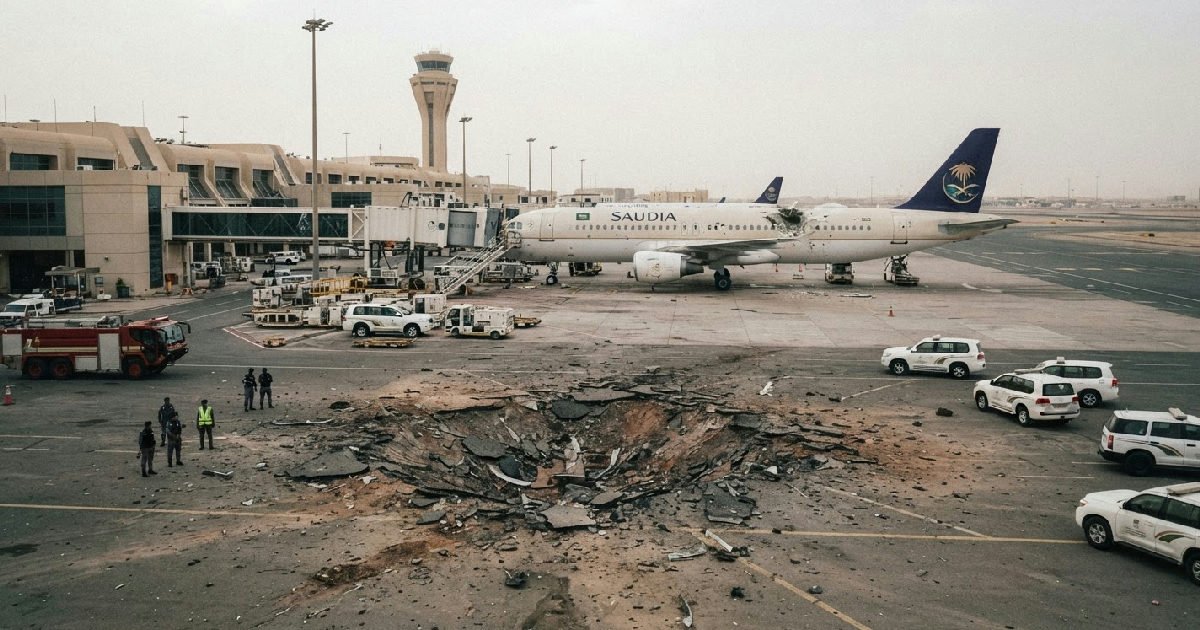
A deadly Houthi assault on Riyadh’s international airport on October 10, 2026, which killed 13 people and injured over 300, stands as a stark reminder of this evolving threat. The airport has remained closed since, triggering a cascade of disruptions across key non-oil sectors.
Economic Fallout from Houthi Attacks Threaten Saudi Beyond Oil Dependence
The immediate fallout from the Houthi incursions has been significant. Weeks of sporadic strikes have not only claimed dozens of lives but also severely curtailed air travel in the capital. Major international events, including the prominent Future Investment Initiative (FII) — often dubbed “Davos on the desert” — have been canceled, and Riyadh’s financial district has effectively shut down.
This heightened instability has hammered investor confidence. Saudi stocks have plummeted, emerging as some of the worst performers in global emerging markets this month. The International Monetary Fund (IMF) now projects Saudi Arabia’s Gross Domestic Product (GDP) to shrink by 3.3% in 2026, a sharp reversal from its earlier forecast of 1.7% growth.
This reflects how quickly market sentiment can shift in response to geopolitical events.
IMF Chief Kristalina Georgieva warned of broader consequences, stating, “The Saudi economy is important for the region and the world. In that sense, these developments have potentially negative spillovers for everybody, everywhere.” While IMF Regional Director Jihad Azour noted that the economic impact has been “limited” so far due to “robust domestic demand and a robust public sector,” the deepening crisis presents a formidable challenge.
Specific Infrastructure Targeted
Beyond the airport, Houthi attacks have directly targeted other critical infrastructure. In October 2026, missile strikes hit vital gas and stabilization facilities at Shedgum and Tanajib. This follows previous attacks earlier in the month on a Saudi Aramco site in Yanbu, the Shaybah oilfield, and airports in Riyadh and Abha.
These actions demonstrate a clear intent to disrupt more than just crude oil exports. The ongoing threat of such attacks risks embedding a perception of Saudi Arabia as an “active conflict zone,” a sentiment that could lead to higher insurance premiums and deter foreign investment for years, according to an anonymous Saudi government consultant.
Vision 2030 Under Direct Threat
Crown Prince Mohammed bin Salman’s ambitious Vision 2030 initiative, launched a decade ago, aims to wean Saudi Arabia off its reliance on oil by diversifying into tourism, international events, and cutting-edge industries. The current wave of Houthi aggression directly undermines these transformative plans.
The closure of Riyadh’s international airport and the cancellation of the Future Investment Initiative are significant blows to the kingdom’s aspirations as a global hub. The directive for office tenants in Riyadh’s Kingdom Centre, including the IMF, to work remotely further illustrates the disruption to the capital’s business environment.
Projects like NEOM and The Red Sea Project, designed to attract millions of tourists and billions in investment, depend heavily on a stable and secure environment. Sustained attacks threaten to unravel the progress made in boosting tourism, which saw 123 million domestic and international visitors in 2025, contributing to a 4.5% growth rate.
Impact on Investment and Diversification
The disruption extends to foreign direct investment (FDI), a cornerstone of Vision 2030. Companies considering establishing a presence in Saudi Arabia will undoubtedly factor in the heightened security risks. This could slow the development of non-oil sectors and hinder job creation goals, especially those targeting the private sector and increased female workforce participation.
The push for economic diversification also aligns with broader global trends, such as the transformative shift in e-commerce driven by new technologies.
Laurent Bonnefoy, a researcher at Ceri/Sciences Po in Paris, noted Saudi Arabia’s “delicate situation” amidst these attacks and apparent US hesitation. This uncertainty could lead to a reassessment of risk models by international boards, potentially leading to long-term economic hurdles for the kingdom.
Houthi Strategy Targets Diversification Efforts
The Houthis’ recent escalation appears to be a calculated move to pressure Saudi Arabia and send a direct message to Crown Prince Mohammed bin Salman. Mohammed Al Bukhaiti, a Houthi political bureau member, explicitly stated the group’s intention to target American interests in the region, aiming to convey that the Crown Prince “can no longer wage aggression against Yemen from a safe position.”
Their tactics have evolved beyond merely striking oil facilities. By targeting airports, urban centers, and major event venues, the Houthis are aiming to inflict damage on the symbols and mechanisms of Saudi Arabia’s modernization drive. This includes the strategic occupation of key maritime choke points.
In September 2026, Houthi fighters advanced on the port of Mokha, Perim (Mayun) Island, and the Hanish Islands, effectively taking control of the Bab el-Mandeb Strait.
Chronology of Recent Escalation
- July 2026: The civil war in Yemen reignited following a Saudi bombing of Sanaa airport, ending a fragile ceasefire.
- September 2026: Houthi forces seized control of critical maritime positions in the Bab el-Mandeb Strait.
- October 10, 2026: A devastating attack on Riyadh’s international airport resulted in 13 deaths and over 300 injuries.
- October 15, 2026: Saudi Aramco’s headquarters reportedly sustained extensive fire damage.
- October 21, 2026: Houthis claimed responsibility for targeting various Saudi Aramco sites, along with Riyadh and Abha airports.
- October 25, 2026: Further claims included attacks on King Khalid International Airport, an Aramco facility in Yanbu, the Rabigh oil refinery, and the East-West Pipeline.
Michael Knights, an expert from the Washington Institute for Near East policy, describes the Houthis as “the most committed, ideological and most aggressive of Iran’s regional allies.” Their persistent ability to launch sophisticated drone and missile attacks underscores their enhanced military capabilities, largely attributed to Iranian support.
Wider Regional Instability Exacerbates Risks
The current Houthi campaign isn’t occurring in isolation; it’s deeply intertwined with broader regional conflicts. The US-Israeli war on Iran, which commenced in February 2026, has significantly destabilized the Middle East, creating a more permissive environment for proxy conflicts to intensify. This larger geopolitical context makes Saudi Arabia’s challenge even more complex.
The kingdom, after exiting the costly war in Yemen in 2022 and pursuing diplomatic ties with Iran, now finds itself caught in renewed crossfire. The perceived waning of guaranteed US protection, particularly under President Donald Trump’s reluctance to offer support in Yemen, adds another layer of vulnerability for Saudi Arabia. This situation creates a challenging environment for international trade routes and broader economic activity.
Chokepoints and Trade Disruption
The Houthi control of key maritime chokepoints, such as the Bab el-Mandeb Strait, coupled with Iran’s potential to block the Strait of Hormuz, presents a dual threat to regional trade. These strategic waterways are crucial for global energy shipments and international commerce. Disruptions here could have far-reaching economic consequences, impacting shipping costs and supply chains globally.
H.A. Hellyer, an analyst at the Royal United Services Institute (RUSI), encapsulated the complexity of Crown Prince Mohammed bin Salman’s predicament. “I can’t think of another time when the challenge facing MBS was more.
He’s dealing with the Iranians on one side of the country which is very difficult and problematic and then he’s dealing with the Houthis who aligned with the Iranians on the other.”
Saudi Resilience and Future Outlook
Despite these daunting challenges, Saudi Arabia possesses considerable institutional and financial buffers. The kingdom has weathered numerous crises over the past century, leveraging its substantial foreign assets and strong capital reserves. This historical resilience and adaptability will be crucial in navigating the current turmoil.
The IMF, while projecting a near-term contraction, anticipates a strong rebound of around 9.1% growth for Saudi Arabia for the following year. However, this projection comes with a caveat of deep uncertainty, underscoring the volatile nature of the regional security landscape.
Defense spending, already on the rise due to war spillovers, will continue to widen the national budget deficit, diverting funds that might otherwise fuel diversification efforts.
The long-term success of Vision 2030 hinges on restoring a sense of stability and security. Without it, attracting the necessary foreign investment and talent to build a diversified, modern economy will remain an uphill battle. The current crisis forces Saudi Arabia to confront how it can insulate its economic future from persistent regional conflicts.