

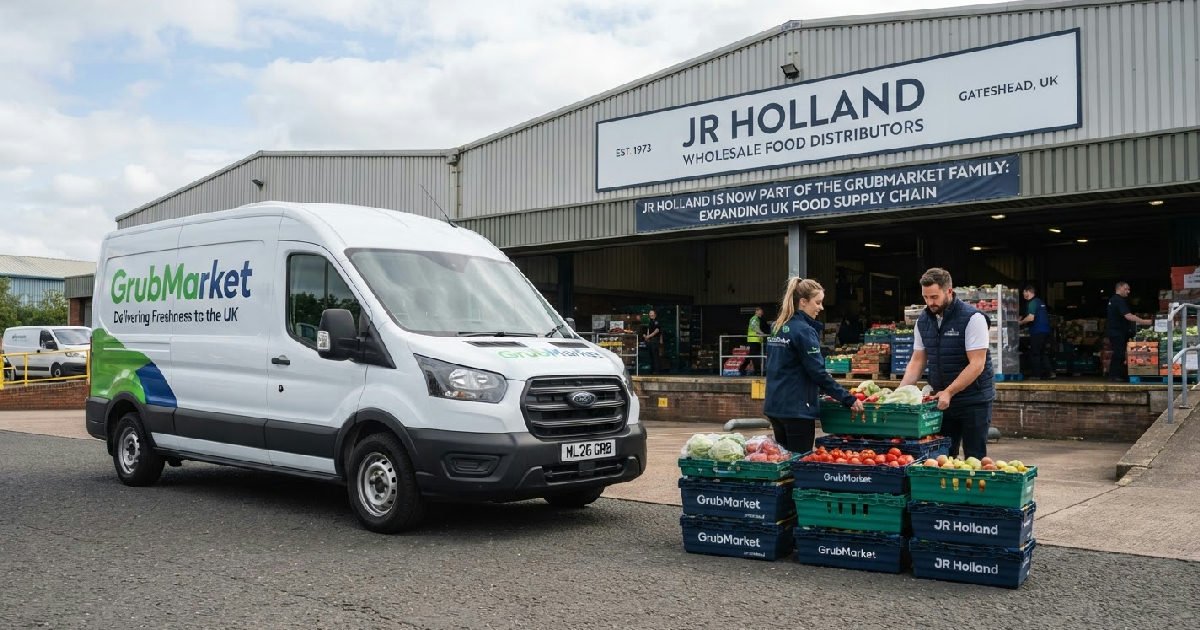
GrubMarket enters U.K. food supply chain with purchase of JR Holland
San Francisco-based agritech company GrubMarket has completed its acquisition of Gateshead-based fresh produce distributor JR Holland. The transaction, announced on August 18, 2026, marks the first time GrubMarket enters U.K. food supply chain networks. Chief Executive Officer Mike Xu confirmed the move aims to digitize British grocery logistics.
While some tech firms struggle with international regulatory shifts, like adjusting to complex European marketplace fees, GrubMarket has focused on rapid physical expansion. The company aims to bring advanced automation to traditional regional distributors. The Gateshead firm, founded in 1983 by John Holland, has spent over four decades building its local distribution network.
GrubMarket enters U.K. food supply chain via Gateshead
GrubMarket has steadily grown from a local California startup into a major global technology provider. The platform now operates across multiple continents, including South America, Africa, and Europe. This latest British acquisition represents its first physical asset in the United Kingdom.
The acquisition of JR Holland secures a strong operational base for the American firm in North East England and Scotland. GrubMarket plans to deploy its proprietary software across this newly acquired delivery network. The transition will begin immediately under the supervision of local management teams.
The Gateshead-based distributor generates roughly £35 million in annual revenue. This substantial market footprint makes the company a prime vehicle for introducing digital tools to British food networks. Chief Executive Officer Mike Xu aims to streamline last-mile delivery protocols across the region.
By taking over an established regional giant, the California firm avoids the high costs of building logistics infrastructure from scratch. They immediately acquire a fully functional cold chain. This includes established relationships with hundreds of local food suppliers.
Regional distributor brings massive cold chain network
Operating from two facilities in the Newcastle area, JR Holland manages a substantial supply chain infrastructure. The dual locations span 65,000 square feet of temperature-controlled storage. This setup allows the firm to handle massive volumes of perishable food products safely.
A dedicated team of over 120 employees supports these complex daily logistics operations. They coordinate the movement of goods from local farms to schools, hospitals, and restaurants. The company maintains an active schedule, distributing fresh items six days a week.
A fleet of 32 modern, temperature-controlled vehicles executes more than 3,000 weekly deliveries. This distribution network ensures that sensitive inventory remains fresh throughout transit. Local management will continue to oversee these daily transport schedules during the software integration.
The distributor’s extensive inventory features more than 3,000 fresh food items. This includes over 1,000 distinct varieties of fruits and vegetables. Moving this massive database into cloud systems is a primary goal for the tech firm.
Strategic importance of the Newcastle hubs
The Newcastle facilities act as central hubs connecting northern farms with public and private sector clients. This established network provides GrubMarket with an ideal environment to test its high-volume logistics software. Success here could pave the way for wider European expansions.
Silicon Valley software upgrades British grocery logistics
The transition focuses heavily on replacing legacy computer programs with advanced cloud-based systems. This integration aims to minimize administrative errors and streamline order tracking. Even during periods of shifting global market indicators, technology capital continues to flow toward supply chain modernization.
The Gateshead business will gain immediate access to WholesaleWare, GrubMarket’s flagship enterprise resource planning platform. This software automates complex financial accounting, lot traceability, and inventory management. It also provides advanced routing algorithms to optimize daily delivery runs.
Customers of JR Holland will soon utilize Orders IO, a custom-branded mobile and online ordering interface. This system integrates directly with GrubPay, a specialized digital payments platform. These combined tools are designed to simplify the wholesale purchasing experience.
These digital upgrades should reduce administrative burdens for the Gateshead office staff. Automating routine invoicing allows employees to focus on quality control and customer service. The parent company expects these efficiencies to drive higher profit margins over time.
Deploying agentic enterprise AI assistants
The U.K. operations will also deploy GrubAssist AI to optimize warehouse workflows. This software suite uses intelligent digital assistants to analyze complex financial and operational data. The system features automated monitoring tools that instantly flag financial anomalies for managers.
Series H funding fuels global agritech acquisitions
This transatlantic acquisition follows a major financing push that valued the San Francisco enterprise at $4.5 billion. In February 2026, the company secured a $50 million Series H funding round. This cash injection followed an identical $50 million Series G round completed in 2025.
Key institutional investors backed the Series H round, including Future Food Fund, Portfolia Funds, and Liberty Street Funds. The funding also secured capital from RD Heritage Group, Flume Ventures, and MY Securities. These funds will directly support the firm’s global technology rollout.
Venture capitalists view agricultural logistics as a highly stable alternative to highly volatile digital assets. While retail investors closely watch fluctuating cryptocurrency prices, institutional funds prefer physical food supply chains. Consequently, GrubMarket has raised over $908 million to date.
The JR Holland deal represents the technology firm’s second international corporate takeover in recent weeks. In July 2026, the group purchased Canadian online grocery provider SPUD, also known as Sustainable Produce Urban Delivery. In April 2026, they acquired Houston-based Schoenmann Produce.
In late 2025, the firm bought Procurant, a specialized supply chain compliance platform. The company also completed several major acquisitions during 2025, including Coast Citrus Distributors and Delta Fresh Produce. They also purchased Bay Cities Produce and Sally Produce to expand West Coast distribution.
Corporate finance teams structure the transatlantic transaction
Executing a cross-border acquisition of this scale required extensive legal and financial coordination. Corporate Finance Partner Nick Johnson of RG Corporate Finance (RGCF) acted as the lead advisor to John Holland. Johnson led the negotiations to ensure a smooth transition of ownership.
Corporate Finance Managers Euan Mulholland and Andy Alexander of RGCF provided critical analytical support. Longstanding advisor Simon Whiteside, a Tax Partner at RG, worked alongside Tax Director Simon Hopwood. This team ensured the transaction met all necessary British tax guidelines.
Legal representation for the shareholders was managed by Philip Ashworth, Nicole Waldron, Grace Hansen, and Kirsty Barby of Andrew Jackson Solicitors. The transaction also received legal advisory support from regional law firms Ward Hadaway and Womble Bond Dickinson. This combined legal effort secured the deal.
Implications for the wider British food supply chain
The entry of a heavily funded Silicon Valley corporation will likely accelerate technological changes across regional markets. Independent British distributors will face mounting pressure to upgrade their delivery software. Many traditional firms may struggle to compete against highly optimized AI systems.
Local agricultural producers in North East England and Scotland could benefit significantly from these digital upgrades. Automated route planning should speed up delivery times, ensuring fresher produce reaches public sector clients. This could ultimately lower food transport costs for schools and hospitals.
Independent food merchants must decide whether to invest in modern digital logistics or risk losing market share. This high-profile acquisition emphasizes that artificial intelligence is no longer optional in global food distribution. The shift toward software-enabled supply chains continues to gather pace.