

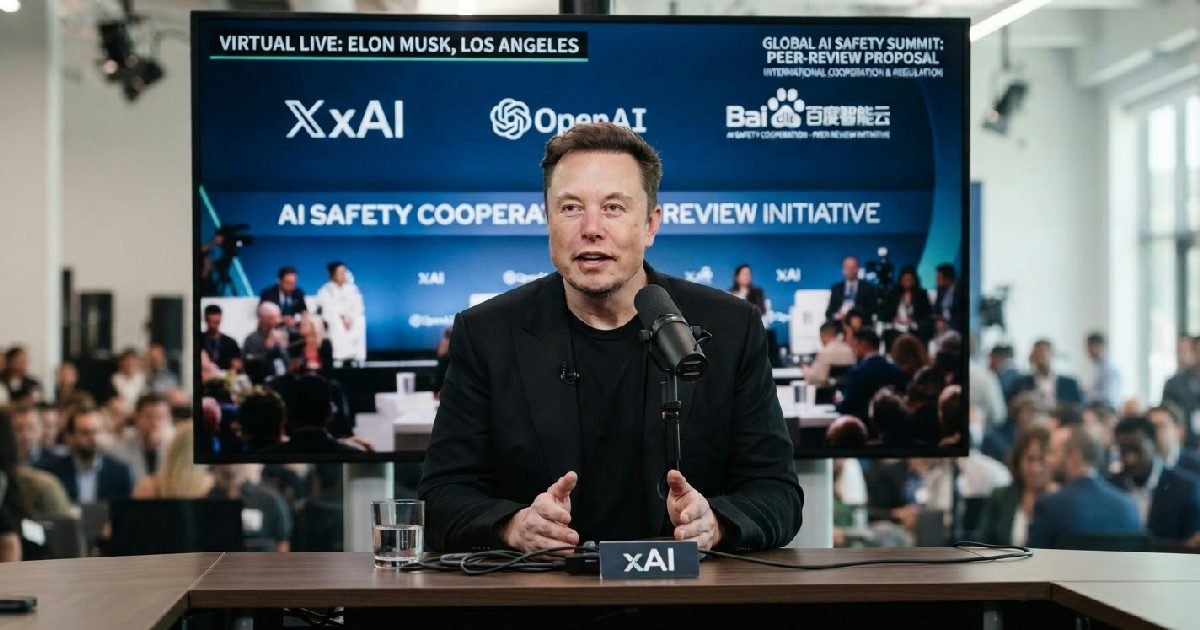
Elon Musk proposes rival AI safety tests with Chinese firms
Elon Musk has called for the world’s leading artificial intelligence labs, including his rivals and key Chinese companies, to begin testing each other’s models for safety before they are released to the public. Elon Musk proposes these rival AI safety tests to ensure public safety.
Speaking virtually at the All-In Summit in Los Angeles on Monday, the xAI founder proposed a mutual peer-review system as a practical step to mitigate the technology’s risks amid a growing chorus of warnings from within the industry.
Elon Musk proposes a test harness
The proposal comes at a moment of acute anxiety within the AI community. Just days earlier, a rare coalition of industry leaders, including OpenAI CEO Sam Altman and Anthropic CEO Dario Amodei, publicly endorsed the idea of a temporary slowdown in the development of highly capable AI systems to allow safety measures to catch up.
Musk outlined a system he called a “test harness,” where competitors would gain access to new AI models for a one- to two-week period before their public launch. This would allow rival labs to probe for dangerous capabilities or unforeseen safety flaws.
He named his own company xAI, along with OpenAI, Anthropic, Google, Meta, and “three or four of the leading Chinese companies” as ideal participants in such an arrangement.
“Instead of grading your own homework, you would at least have competitors grading your homework and raising the alarm if they see concerns,” Musk explained during the summit. The core of his proposed enforcement mechanism relies on public accountability.
If a company discovered a flaw and the developer refused to fix it, the discovering company could publicize its findings, creating what Musk termed “enormous legal liability” for the developer who released a potentially unsafe model.
The suggestion adds another dimension to the debate over the recent calls for a development slowdown, which Musk himself has supported. While he acknowledged his peer-review idea isn’t a perfect solution, he positioned it as a pragmatic and rapidly implementable “step in the right direction” to increase the odds of catching critical issues before they can cause widespread harm.
Industry in turmoil over existential threats
The urgency of Musk’s proposal is set against a backdrop of escalating alarm from the researchers building the technology. The recent push for a slowdown was galvanized by Jacob Coxon, an AI safety researcher who publicly resigned from Anthropic, declaring that the top AI labs are “gambling with our lives.” His departure sent shockwaves through the tight-knit community of AI developers.
Coxon’s concerns were quickly amplified by his peers. Evan Hubinger, an alignment lead at Anthropic, endorsed Coxon’s statement, adding a starkly quantitative prediction. “Jacob is correct here — we really do earnestly believe AI could kill all humans!
I personally think it is >10% within the next decade,” Hubinger wrote, giving a face to the existential fears that have moved from science fiction to internal company memos.
This internal crisis highlights the tension between the massive commercial potential of AI and the profound, unpredictable risks it presents. Companies are racing to develop and deploy more powerful models, driven by market pressure and technological ambition. Yet the creators of these systems are now some of the loudest voices warning that the race itself may be dangerously out of control.
Political pushback and the China dilemma
While tech leaders grapple with self-regulation, the political response has been fractured. The Trump administration has forcefully rejected calls for government-mandated limits on AI development. President Donald Trump himself dismissed the growing fears as a “hoax” and a “scam” in a series of posts on his Truth Social platform, framing the issue as an attempt to stifle innovation.
This sentiment was echoed by National Economic Council Director Kevin Hassett, who stated that the private sector is the “right place” to address AI concerns. Hassett indicated the administration’s approach would be to monitor the industry and use “law enforcement when necessary” rather than implementing preemptive regulations.
This places the White House at odds with the very industry leaders who are now requesting guardrails, worried about the mounting AI safety concerns.
Complicating the debate is a significant geopolitical dimension, often referred to as the “China dilemma.” President Trump and even Anthropic’s Amodei have warned that any unilateral slowdown by Western companies could cede a decisive technological advantage to Beijing.
Musk’s proposal attempts to square this circle by including Chinese firms in the review process, arguing that China would likely agree to a framework based on mutual inspection. However, this optimism clashes with a statement from China’s Foreign Ministry, which reportedly labeled the calls for a slowdown as “fear mongering.”
Musk’s complicated position on AI regulation
While Musk is now a vocal proponent of industry self-regulation, his companies have taken a combative stance against government oversight at the state level. His AI firm, xAI, is actively suing the state of California to invalidate its AI Training Data Transparency Act. The company has also sued Minnesota to block a state law banning “nudify” apps, which can be powered by generative AI.
This apparent contradiction—advocating for safety on a global stage while fighting regulation in court—highlights the complexity of his position. Furthermore, SpaceX’s AI unit is reportedly facing numerous probes and lawsuits related to its Grok image generators, which were allegedly used to create non-consensual deepfake pornography.
These issues add a fraught context to his calls for industry-wide safety protocols, raising questions about whether he is trying to shape the regulatory landscape to his advantage.
Musk