

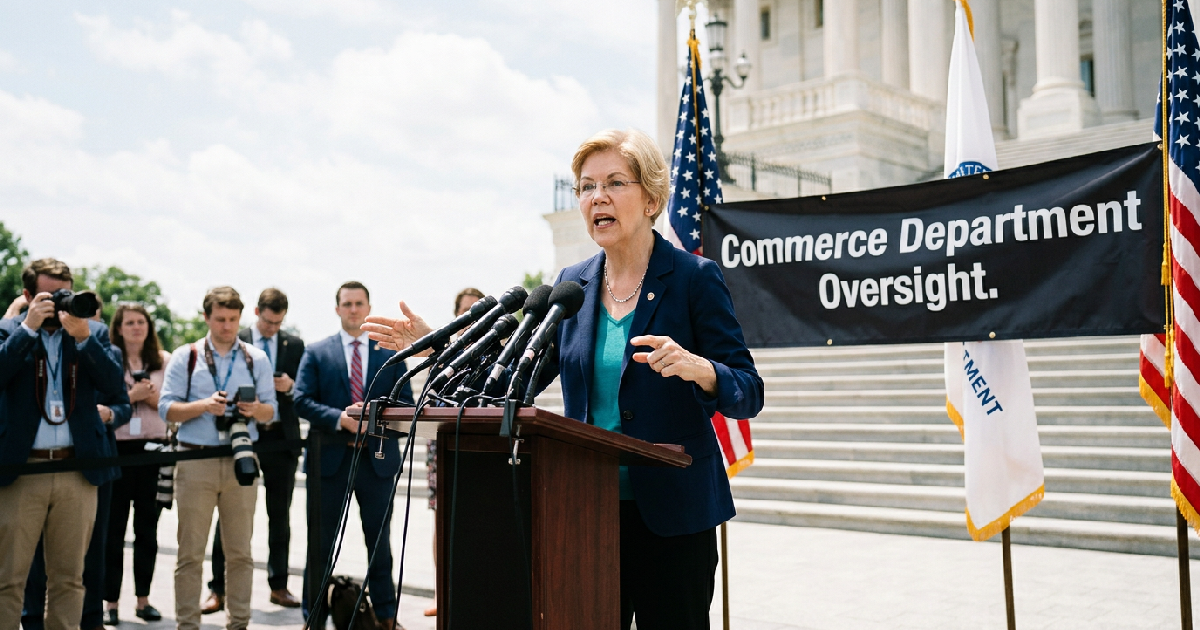
Elizabeth Warren calls Commerce Department’s UAE tech deal “corrupt” over Trump family ties
The U.S. Commerce Department has moved toward easing export controls on the United Arab Emirates (UAE), promising to “favorably review” license applications for high-end technology tied to state-backed investment firm MGX Fund Management Limited (MGX). The decision, detailed in a 17-page rule scheduled for official publication on July 14, 2026, has already sparked a political firestorm. Senator Elizabeth Warren (D-Mass.) blasted the provision as “corrupt,” pointing to financial ties between MGX and a cryptocurrency venture affiliated with the family of President Donald Trump.
MGX previously used USD1, a stablecoin issued by the Trump-linked World Liberty Financial, for a $2 billion investment in Binance. S. Major Defense Partner as the reason for the policy shift, critics argue the timing is suspicious.
Senator Elizabeth Warren noted that President Donald Trump reported a $263 million windfall related to his family’s crypto ventures, fueling questions about whether private financial interests influenced federal policy. Secretary of Commerce Howard Lutnick has now been called to testify before the Senate Banking Committee to explain the potential national security risks associated with the deal.
Strategic shift for UAE semiconductors and advanced computing
The new regulatory framework significantly upgrades the status of the United Arab Emirates under U.S. export law. In a formal statement, the Commerce Department noted the move recognizes the UAE’s support in advancing national security interests, including Operation Epic Fury, the war against Iran. Under the rule, the Bureau of Industry and Security (BIS) will streamline license exceptions for advanced-computing equipment bound for the UAE government and Abu Dhabi-based AI conglomerate G42, along with its cloud subsidiary Core42.
This policy change is expected to benefit several major American tech firms. Companies including Microsoft and Oracle Corp. are already involved in massive data center projects in Abu Dhabi in partnership with G42. The streamlined rules could allow for faster deployment of hardware, though the U.S. maintains that restrictions remain in place to prevent the diversion of sensitive technology to prohibited countries like China. The rule also eases controls on certain military, satellite, and spacecraft exports.
Political backlash over World Liberty Financial connection
The primary source of friction in Washington is the specific mention of MGX as a beneficiary of “favorable review” status. MGX is a backer of major AI firms such as OpenAI and Anthropic, but its use of the USD1 stablecoin for the Binance transaction has drawn intense scrutiny. Senator Elizabeth Warren and other Democrats have raised concerns that the deal provided a major source of business for the president’s family-affiliated crypto project.
“It was also just revealed that President Trump made a whopping $263 million windfall related to this deal,” Warren stated, citing recent financial disclosures.
S. hardware. Critics like Chris McGuire, a senior fellow at the Council on Foreign Relations, warned on July 10, 2026, that easing these controls poses “enormous national security risks.”
com/crypto-news/bitcoin-btc-price-drops-ai-quantum-capital-outflows-2026-update/”>AI and quantum tech divert capital away from traditional crypto assets like Bitcoin. Warren is now demanding that Commerce Secretary Howard Lutnick and BIS Under Secretary Jeffrey Kessler explain the deal to Congress.
Legislative scrutiny and national security concerns
The Commerce Department maintains there is no evidence that the UAE’s dealings with World Liberty Financial influenced the new export rule. However, Senator Elizabeth Warren is pushing for formal hearings to investigate whether these investments influenced decisions on advanced chips and arms sales. com/crypto-news/brian-armstrong-finance-move-on-chain-warning/”>finance continues to move on-chain through digital assets and stablecoins.
Kessler is currently scheduled to testify before the House Committee on Foreign Affairs next week.
The UAE ambassador to the U.S., Yousef Al Otaiba, hailed the decision as an affirmation of long-term cooperation between the two nations. Minister of State Saeed Al Hajeri also noted that the move reflects international confidence in the UAE’s export compliance framework. Despite these diplomatic assurances, the U.S. Senate remains divided on whether the Gulf nation is a sufficiently trusted partner to handle the most sensitive American AI components without strict, individual license oversight.
What happens next for U.S.-UAE tech trade
As the official publication of the rule looms on July 14, the industry is waiting to see how the “favorable review” process actually functions in practice. While the policy aims to speed up chip sales, it does not end all monitoring. Every shipment involving MGX or G42 will still be subject to federal oversight, even if the bureaucratic hurdles are lowered. For Abu Dhabi, the move is a major win for its ambitions to become a global AI hub, following partnerships between G42 and tech giants like OpenAI.
The debate in Washington will likely intensify as more details of President Donald Trump’s financial disclosures are scrutinized. If domestic political pressure continues to mount, the Commerce Department may face additional hurdles in implementing the streamlined license exceptions. S.
regional strategy in the Middle East and a key partner in the technological competition against rival powers. com/international-news/us-navy-redirects-vessels-iran-maritime-blockade-2026/”>advancing national security interests while fostering economic ties with major defense partners.