

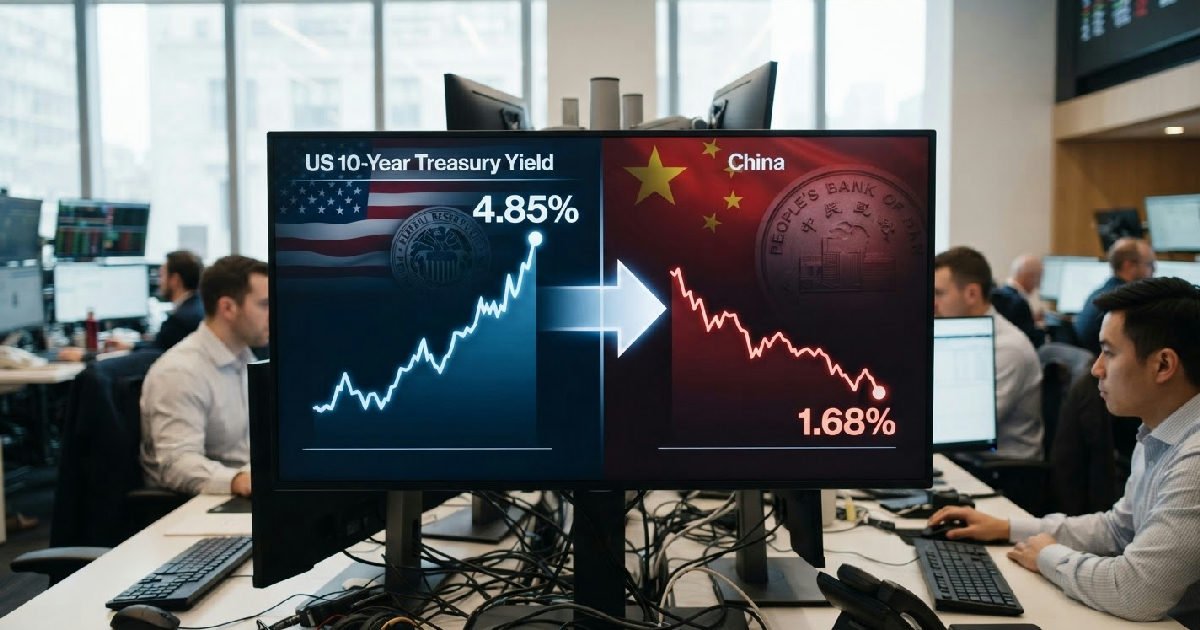
China-US Bond Yield Gap Hits Record on Policy Divide
The financial chasm between the United States and China deepened considerably on Wednesday, September 9, 2026. The 10-year bond yield gap between the two economic powerhouses widened to an unprecedented 317 basis points. This record divergence reflects sharply contrasting monetary policy strategies in Washington and Beijing.
It marks the largest spread ever recorded, surpassing the previous peak of approximately 315 basis points set in early 2025. The US 10-year Treasury yield climbed to 4.85%, its highest since 2023. China’s counterpart held steady at 1.68%, echoing shifts like the Bank of Japan’s recent actions.
Understanding the China-US 10-year bond yield gap
The record China-US bond yield gap is a direct consequence of the disparate approaches adopted by their respective central banks. The Federal Reserve (Fed) in the United States and the People’s Bank of China (PBOC) are navigating unique domestic economic challenges. Their policy choices pull their bond markets in diametrically opposite directions.
This stark divergence signals deeply entrenched policy decisions. The United States continues to maintain elevated interest rates to combat persistent inflation. Meanwhile, China pursues a more accommodative stance designed to stimulate its national economy.
Federal Reserve Maintains Hawkish Inflation Stance
In the United States, the Federal Reserve remains resolute in its fight against inflation. The Federal Open Market Committee (FOMC) has held the federal funds target range at 3.50% to 3.75% since the beginning of 2026. This consistent policy underscores its commitment to achieving price stability.
Inflationary pressures continue to be a significant concern for US policymakers. Core Personal Consumption Expenditures (PCE) inflation accelerated from 3.0% in December 2025 to 3.3% in June 2026. This figure remains well above the Fed’s long-term 2% target.
Headline Consumer Price Index (CPI) inflation also jumped to 3.8% year-over-year in April 2026. Soaring gasoline prices, partly attributed to the ongoing Iran war, contributed to this increase. This persistent inflation complicates the Fed’s efforts to normalize monetary conditions.
New Fed Chair Kevin Warsh has initiated five distinct task forces to review the Fed’s policymaking process. These independent reviews are expected to yield findings by year-end 2026, aiming to refine future strategies.
The Fed also paused shrinking its balance sheet in December 2025. It is instead purchasing short-term Treasury bills to maintain ample reserves in the banking system.
PBOC Implements Growth-Oriented Monetary Policy
Conversely, China’s central bank, the People’s Bank of China (PBOC), has adopted an entirely different strategy. It’s implementing an accommodative and moderately loose monetary policy. The primary goal is to support economic growth and guide prices toward a sustained recovery.
PBOC Governor Pan Gongsheng has emphasized the bank’s commitment to utilizing various policy tools. These measures are designed to inject liquidity and reduce borrowing costs across the economy. This contrasts sharply with the Fed’s restrictive approach.
The PBOC aims to ensure sufficient credit flows to businesses and consumers alike. Such actions are critical for stimulating domestic demand and boosting investment. This strategy is essential for navigating China’s unique economic landscape and fostering stability.
Beijing’s focus remains firmly on shoring up its domestic economy and employment. The PBOC’s proactive stance seeks to prevent potential deflationary pressures and foster a sustainable recovery trajectory. This policy underpins China’s comparatively low 10-year sovereign bond yield of 1.68%.
Underlying Economic Conditions Inform Policy Decisions
The divergence in monetary policy is not arbitrary; it is deeply rooted in the distinct economic realities facing both nations. Each central bank is reacting to its specific domestic pressures and long-term objectives. This results in policies that move in opposing directions.
For the United States, the challenge centers on taming entrenched inflation without stifling economic growth. China, however, is grappling with stimulating demand and ensuring stability in key sectors. The differing policy responses are logical given these unique economic environments.
US Grapples with Stubborn Inflation and Geopolitical Shocks
The Federal Reserve’s continued hawkish stance is largely a response to persistent domestic inflation. Despite aggressive rate hikes in previous cycles, prices continue to rise faster than the central bank’s comfort zone. The 3.3% Core PCE inflation rate is a clear indicator of this struggle.
Geopolitical events, particularly the Iran war, have exacerbated price pressures. Spikes in global energy markets, reflected in soaring gasoline prices, directly impact headline inflation. This external factor adds complexity to the Fed’s already challenging mandate.
The US labor market, while showing signs of cooling, remains relatively robust. Wage growth, coupled with strong consumer spending, contributes to underlying inflationary pressures. This necessitates the Fed’s cautious and restrictive approach to monetary policy.
However, some analysts question the long-term sustainability of the Fed’s current strategy. The new task forces under Chair Warsh might indicate a recognition of evolving economic dynamics. Their findings could shape future policy adjustments beyond mere interest rate decisions.
China Prioritizes Stability and Growth Amid Headwinds
China’s economic narrative is one of careful stimulus and managing specific sector risks. Beijing is keen to ensure its economy maintains a healthy growth trajectory. It aims to restore consumer and investor confidence after a period of slower expansion.
The PBOC’s moderately loose policy actively addresses issues such as property sector risks. It also tackles the need to sustain stable employment figures for its vast workforce. This requires a different set of tools compared to the inflation-fighting mandate of the Fed.
Pan Gongsheng’s emphasis on various policy instruments suggests a nuanced approach to stimulating credit and investment. This contrasts with the broad-based rate hikes seen in the US. China is fine-tuning its economy, rather than cooling it down.
The low yield on Chinese sovereign bonds reflects market expectations of continued liquidity and accommodative conditions. This strategy aims to prevent deflationary spirals and foster a more stable environment for domestic businesses. It also encourages foreign direct investment into key sectors.
Implications for Global Markets and Capital Flows
A record-high China-US bond yield gap carries significant implications for global financial markets. It influences currency valuations, investment strategies, and the flow of capital between the two largest economies. Investors typically gravitate towards higher-yielding assets.
This widening gap could exert downward pressure on the Chinese Yuan, making US dollar-denominated assets more attractive. Capital could flow out of China and into the United States. Such shifts could further strengthen the dollar and influence trade balances.
Global portfolio managers face tough decisions. They must weigh the potential for higher returns in US markets against the growth prospects in China.
The perceived stability and higher yields of US Treasuries offer a compelling proposition for many. This is particularly true for those seeking safer havens.
The divergence also poses challenges for multinational corporations operating in both regions. Exchange rate fluctuations and differing borrowing costs impact their financial planning and profitability. This creates a complex environment for international business operations.
For investors interested in the broader financial landscape, new developments are always emerging. Firms like Block seeking regulatory approval for crypto custody services highlight these shifts. This indicates a broader trend towards innovative solutions in financial markets.
Outlook: What Lies Ahead for the Policy Divide?
The trajectory of the China-US bond yield gap will largely depend on future policy decisions and economic developments. The Federal Reserve has signaled its intent to remain vigilant against inflation. Its new task forces may introduce further structural changes to monetary policy.
Should US inflation prove more stubborn, or if global energy prices continue to rise, the Fed may be compelled to maintain or even further tighten its stance. Conversely, a significant slowdown in the US economy could force a re-evaluation of its current strategy.
New Fed Chair Kevin Warsh faces a challenging balancing act.
In China, the PBOC is likely to continue its targeted approach to stimulate growth. However, it also faces challenges balancing economic expansion with financial stability. The success of its stimulus measures will be crucial in determining its future monetary policy path.
Any unexpected economic shocks or significant shifts in trade relations between the two nations could also impact these policies. The widening bond yield gap is a clear indicator of a global economy grappling with profound structural changes and geopolitical tensions.
Investors and policymakers will be watching closely for any signs of convergence or further divergence in the coming months.