

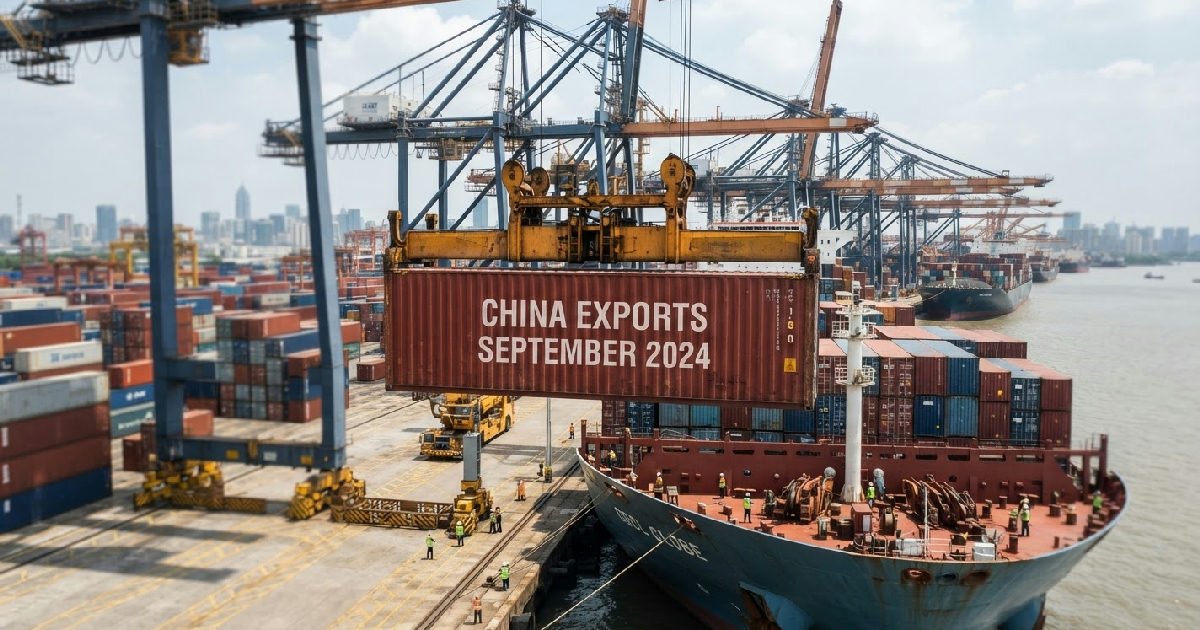
China’s September exports soar 36.3%, far exceeding forecasts
China’s exports and imports shattered expectations in September 2024, signaling a robust rebound in global trade and manufacturing activity for the world’s second-largest economy. Official data released by China’s General Administration of Customs on Wednesday, October 14, 2026, revealed exports soared by an astonishing 36.3% year-on-year, while imports climbed 31%.
These figures dramatically outperformed analyst predictions, underscoring Beijing’s reliance on outbound shipments to bolster its economy amid persistent challenges in domestic demand and its property market. The surprising performance provides crucial policy flexibility as China navigates its annual economic growth targets.
China exports September 2024 growth
In US Dollar terms, China’s exports reached $447.18 billion in September, marking a 36.3% year-on-year increase. This figure far outstripped the 25.5% growth forecast by a Reuters poll and the 25.7% predicted by Bloomberg analysts. Imports also registered substantial growth, hitting $313.65 billion with a 31% year-on-year increase, comfortably surpassing the Reuters poll estimate of 24.5%.
The nation’s trade surplus for September widened to an impressive $133.53 billion, considerably higher than the anticipated $118.1 billion. This strong showing continues a trend of accelerated trade activity, reflecting continued robust performance from prior periods. For instance, September’s export growth followed August’s 25% increase, while imports picked up after growing 28.2% in August.
AI Boom and Global Demand Drive Exports
A primary catalyst for China’s robust export performance is the burgeoning global demand for Chinese-made high-tech products, particularly components essential for the burgeoning artificial intelligence sector. Data centers worldwide are increasingly relying on China for parts, fueling a significant portion of this export surge.
Chinese manufacturers have increasingly looked to international markets to absorb their production capacity, a strategy intensified by the subdued state of domestic demand. This external focus has been critical in maintaining economic equilibrium. The official manufacturing purchasing managers’ index (PMI) also reflected improving sentiment, rising to 50.1 in September from 49.8 in August, with new orders and production sub-indexes moving into expansionary territory.
Beyond high-tech components, particularly those related to the global AI boom, strong shipments to the United States also contributed to the export uptick. Shipments to the US, China’s largest trading partner on a single-country basis, surged 34.4% in August, which increased China’s surplus with the US to over $29 billion that month.
Shifting Trade Dynamics with Key Partners
While overall trade figures show strength, specific sectors and relationships are undergoing significant adjustments. The European Union, for instance, is capping Chinese hybrid vehicle imports at 350,000 units a year. This development follows high-level trade talks in Beijing and reflects a growing trend of strategic trade negotiations impacting key industries.
These bilateral agreements underscore the complex interplay between trade volume and geopolitical considerations. The ongoing adjustments in trade policy, such as broader trade negotiations between other major economies, demonstrate a dynamic global trade environment that continues to evolve rapidly.
Electric Vehicles Lead Export Charge
A standout performer within China’s export portfolio has been the automotive sector, particularly passenger cars. In September 2024, passenger car exports surged by an impressive 64% compared to September 2025. This growth translated to approximately 919,000 passenger vehicles exported, driven largely by robust overseas demand for China’s plug-in hybrids and pure electric vehicles.
The momentum in car exports isn’t new; in the first nine months of 2026, China shipped over 7.1 million passenger cars internationally. This marked a staggering increase of more than 70% from the same period last year, solidifying China’s position as a dominant force in the global automotive market, particularly in new energy vehicles.
Conversely, domestic passenger car sales within China experienced a downturn, falling 27% year-on-year in September to just over 1.6 million units. This divergence highlights the strategy of Chinese auto manufacturers to prioritize international markets amidst a crowded and competitive domestic landscape and softer local consumer spending.
Broader Economic Implications and Outlook
The stellar September trade performance offers Chinese policymakers some much-needed breathing room. The strong figures suggest they can continue to implement moderate policy support to achieve the country’s ambitious 4.5% to 5% annual GDP growth target. This is particularly crucial given the persistent challenges of weak domestic consumption and an ongoing slump in the property market.
Analysts believe that despite these internal headwinds, China is well on track to achieve another record trade surplus this year, potentially providing a significant buffer to its overall economic stability. The significant export numbers also feed into a broader global economic narrative.
As China, a major global supplier, sees increased demand for its goods, it reflects a generally improving international economic climate. This export-led growth strategy contrasts sharply with efforts to stimulate internal demand. Therefore, external trade remains a vital component of China’s economic health.
Quarter-by-Quarter Momentum
China’s trade performance throughout 2026 demonstrates clear upward momentum. For the first three quarters of the year, from January to September, total goods imports and exports combined rose by 18.8% year-on-year, reaching a massive 39.94 trillion yuan, or approximately $5.9 trillion.
Within this period, exports alone increased by 16.4% to 23.2 trillion yuan, while imports grew by a more substantial 22.3% to 16.74 trillion yuan. The pace of growth also accelerated progressively throughout the year, with year-on-year growth rates increasing from 15.3% in the first quarter to 18.3% in the second quarter, and then hitting 22.3% in the third quarter.