

China’s practical AI approach reshapes its economic future, boosts exports
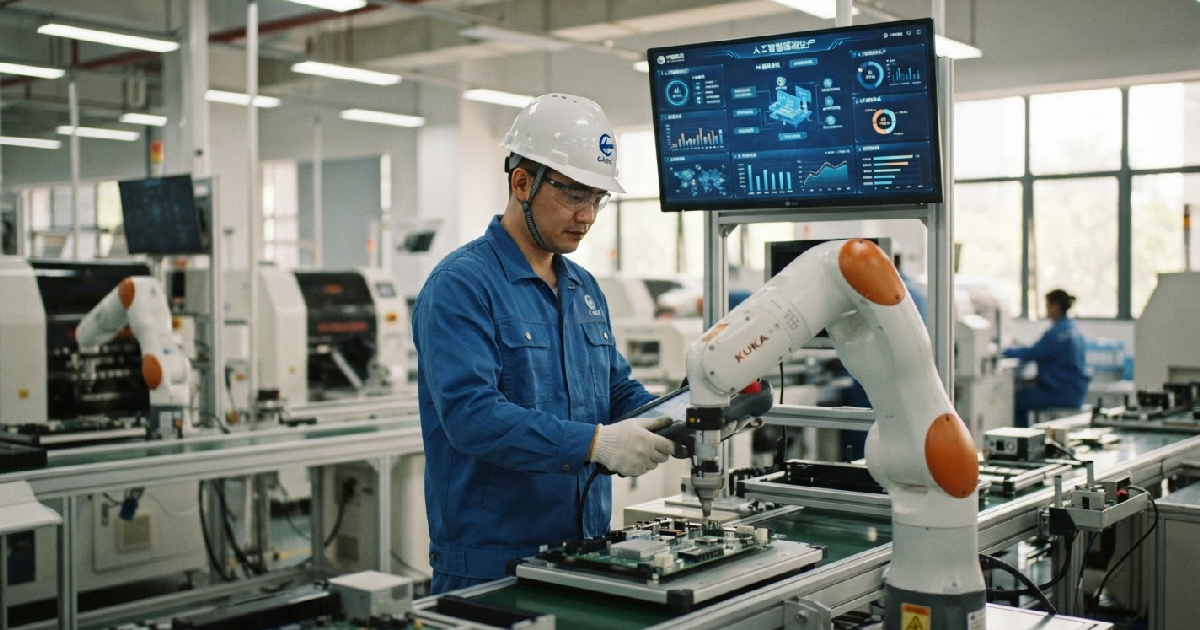
China’s ambitious pivot towards artificial intelligence (AI) is fundamentally reshaping its economic future, with a clear focus on integrating the technology into practical industrial applications rather than solely pursuing theoretical artificial general intelligence.
This strategic approach, highlighted by New Yorker staff writer Evan Osnos on Bloomberg This Weekend on August 8th, 2026, positions Beijing to deepen AI deployment across factories and expand its market presence in emerging economies.
China’s pragmatic AI approach drives economic future
The nation’s commitment to this technology is yielding tangible results, driving substantial growth in its AI industry, attracting massive investment, and propelling an export surge in high-tech products. This strategy underpins China’s broader objective of achieving technological leadership and industrial upgrading in the coming years.
China isn’t just talking about AI; it’s building an economic future around it. The country’s AI industry is experiencing rapid expansion, moving beyond theoretical research to embed AI solutions directly into its vast manufacturing base. This pragmatic focus distinguishes China’s AI development from some Western counterparts.
This shift is already having a profound effect. As of June 2026, China boasted over 6,600 AI companies, representing approximately 15% of the global total. This figure marks a significant jump from September 2025, when there were just over 5,300 such firms, illustrating the sector’s accelerated expansion.
Industry scale and projections
The financial scale of this growth is equally compelling. In 2024, China’s AI industry surpassed 900 billion yuan, equivalent to about $126.7 billion USD, marking a 24% year-on-year increase. Projections for 2025 estimate the industry will exceed 1.2 trillion yuan, or roughly $176.7 billion USD, reflecting a 40% annual growth rate.
Looking further ahead, analysts project China’s core AI industry to reach 12.6 trillion yuan, approximately $1.83 trillion USD, by 2030. This would account for a substantial 25.1% of the nation’s digital economy revenue, underscoring AI’s central role in future economic prosperity.
AI fuels economic impact and export boom
The integration of AI is translating directly into economic gains, contributing significantly to China’s gross domestic product and driving an impressive surge in exports. This isn’t just about high-tech firms; it’s about AI enhancing productivity across traditional industries as well.
Generative AI alone is expected to boost China’s potential GDP by 0.2 to 0.3 percentage points by 2030, a revision upward from earlier estimates. This seemingly small fraction represents trillions in economic activity over time.
Export surge in AI-related tech
Perhaps one of the most immediate indicators of AI’s impact is China’s recent export performance. In July 2026, Chinese exports surged by 23.9% year-on-year, reaching $397.8 billion. This growth was largely propelled by global demand for AI-related technology products, demonstrating China’s burgeoning role as a supplier in the international AI hardware market.
Breaking down these figures further, the first six months of 2026 saw integrated circuit (IC) exports soar by over 96% year-on-year, totaling $177.28 billion. Exports of automatic data processing machines and their parts also jumped by 41.3% to $138.08 billion, cementing China’s position in the global tech supply chain.
These AI-related exports contributed 1.1 percentage points to China’s nominal GDP during the first four months of 2026. This nearly triples their 0.4% share for the entirety of 2025, showing a rapid acceleration in AI’s contribution to the national economy.
Massive investment and strategic planning
China’s rise as an AI powerhouse isn’t accidental; it’s the result of concerted government effort and massive capital deployment. The nation views AI as a strategic technology, essential for industrial upgrading, economic transformation, and securing technological pre-eminence.
Key initiatives like the “New Generation AI Development Plan,” launched in 2017, laid out ambitious targets for 2020, 2025, and 2030. The subsequent “AI Plus” initiative, introduced at the December 2024 Central Economic Work Conference, further reinforced the commitment to integrating AI across all sectors.
Billions in state and private capital
Government funds have poured into the sector, with an estimated $184 billion deployed into AI firms between 2000 and 2023. This substantial state backing complements significant private investment, making China a dominant player in global AI funding. Total AI investment is projected to hit $26.69 billion in 2026, with over $4 billion specifically allocated to AI services.
Venture capital funding in AI alone reached approximately $15.3 billion across 450 deals in 2023, marking a 20% year-over-year increase. This robust investment ecosystem supports both established tech giants and nascent startups, accelerating innovation and deployment.
China’s overall R&D spending reflects this commitment, reaching $615 billion in 2024 and surpassing the United States. This level of investment signals a long-term play for technological supremacy, not just in AI but across advanced fields.
Regional concentration and talent demand
The boom in China’s AI sector isn’t evenly distributed across the vast country; it clusters in key economic hubs. Beijing, Guangdong, Shanghai, Zhejiang, and Shandong account for over 80% of the national AI industry, forming a concentrated ecosystem of innovation and development.
This geographical concentration facilitates collaboration and resource sharing, accelerating the pace of AI advancement. These regions often benefit from robust infrastructure, established tech communities, and government incentives.
Surging demand for AI talent
The rapid expansion of AI companies and projects has created an insatiable demand for skilled talent. In 2025, the demand for AI talent in China surged by an astonishing 543%. This represents both an opportunity and a challenge for the nation, requiring sustained investment in education and training to meet the needs of a burgeoning industry.
China is also home to 71 AI unicorns, which are privately held startup companies valued at over $1 billion. This represents about 26% of the world’s 271 AI unicorns, showcasing a vibrant and rapidly maturing entrepreneurial landscape.
The competition for these skilled workers is intense, as companies vie for the engineers, researchers, and developers who can turn AI theories into practical, profitable applications. Keeping pace with this demand is crucial for sustaining the current growth trajectory.
Broader economic shifts and global implications
China