

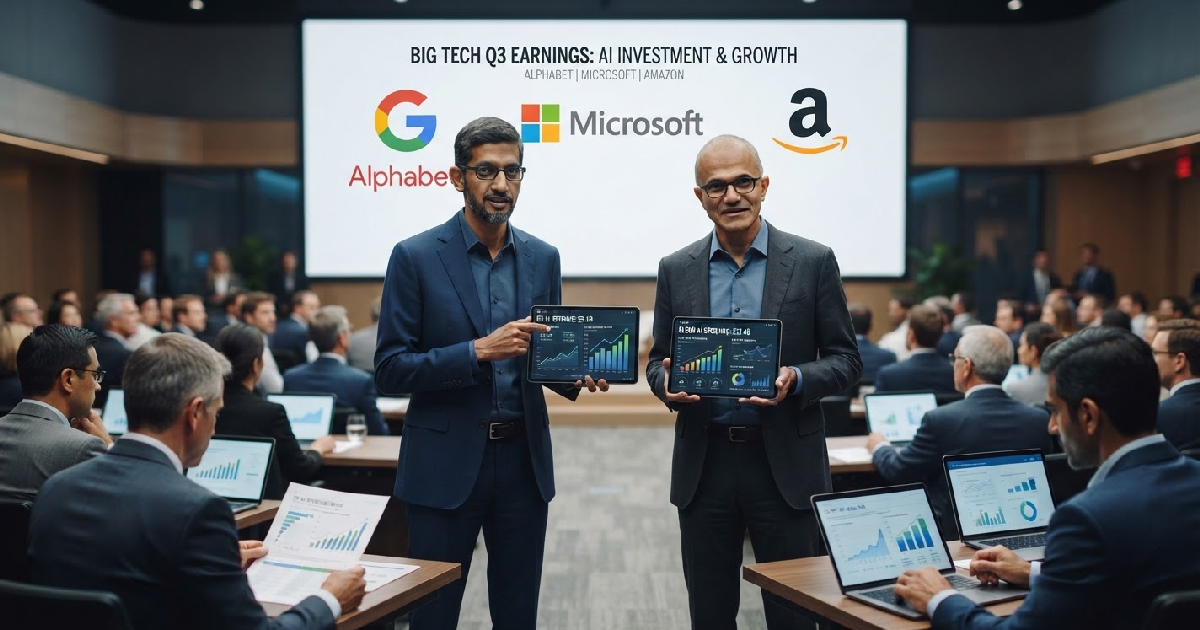
Big Tech firms face crucial earnings reports amid rising AI spending scrutiny
Alphabet, Microsoft, and Amazon are among the Big Tech giants poised to unveil their Q2 2026 earnings over the next two weeks. Investors are intently watching these reports for concrete evidence that years of monumental spending on artificial intelligence (AI) infrastructure and development are finally translating into robust revenue growth and healthier profit margins.
The tech sector has poured hundreds of billions into data centers, advanced chips, and AI software. Now, the market is signaling a clear shift: the era of simply rewarding large AI investments is over. Analysts are demanding measurable commercial returns to justify future capital expenditures.
investors demand proof of AI monetization
This earnings season marks a pivotal moment for Big Tech. The market’s appetite for rewarding AI spending purely for its scale has waned considerably, according to analysts at StoneX. They note that investors are now actively seeking proof that AI investments are generating revenue quickly enough to warrant continued, unprecedented capital outlays.
Combined AI capital expenditure (capex) for Amazon, Google (Alphabet), Meta, and Microsoft is projected to hit an staggering $725 billion in 2026. This represents a 77% year-over-year jump from an estimated $410 billion in 2025. This scale of investment has naturally led to intense scrutiny.
shifting market expectations for AI investments
A year ago, the focus was largely on the sheer volume of AI investment. But Goldman Sachs now indicates that investors are asking a different, more fundamental question: is this copious spending becoming a sustainable earnings driver? Tyler Mordy, chief executive and chief investment officer at Forstrong Global, echoes this sentiment.
He suggests that the market is increasingly assessing whether Big Tech’s substantial capital spending will translate into stronger AI-related revenue and earnings. This scrutiny arrives even as the broader investment cycle in AI infrastructure remains firmly in place.
google and amazon show strong AI growth signals
Among the contenders, Google appears to be entering this earnings cycle from a position of strength. Its shares have climbed almost 19% this year, suggesting market confidence.
I/O Fund analysts pinpoint Google Cloud and Search as the company’s primary AI growth levers. They believe Google has shown the clearest signs that its AI investments are effectively feeding into its core business operations.
google cloud and AI-powered search drive revenue
The acceleration in Google Cloud’s growth and the increased demand for AI-powered search and advertising products are key indicators. For I/O Fund analysts, continued acceleration in cloud growth and wider adoption of AI-enabled ad campaigns will be crucial.
These factors will demonstrate that Google’s AI monetization strategy is indeed here to stay. Google is scheduled to report its Q2 2026 results on Wednesday, July 22, 2026, after US markets close.
amazon web services leads the charge
Amazon, meanwhile, heads into its earnings report with positive momentum for its cloud division. Amazon Web Services (AWS) recorded its fastest growth in nearly four years, signaling renewed vigor in the competitive cloud market.
I/O Fund identifies AWS as the retailer’s main AI growth driver. This is thanks to continued acceleration in cloud demand alongside rapid expansion in its burgeoning AI chip business.
microsoft faces tougher questions on azure growth
Microsoft confronts a more challenging narrative heading into its Q2 earnings report. While its AI business has reportedly grown to more than $37 billion in annual recurring revenue, the growth of its Azure cloud platform has remained broadly stagnant over the past year.
Azure’s performance notably lags behind rivals like Google Cloud and Amazon Web Services. This has raised concerns among market observers.
scrutiny on azure’s performance and profitability
For StoneX, accelerating Azure growth is one of the most critical numbers for investors to watch. I/O Fund analysts also contend that Microsoft’s latest results will need to illustrate a clear translation of its heavy AI investment into stronger cloud demand, rather than merely escalating operational costs.
Microsoft and Meta Platforms are both slated to report their Q2 2026 results on Wednesday, July 29, 2026, following the close of US markets. The market will be looking for a clearer path to profitability from AI for Microsoft.
the growing costs of AI infrastructure
The enormous capital expenditures aren’t just about volume; the cost of building AI infrastructure is also rising. Morgan Stanley estimates that the cost of building one gigawatt of AI capacity has increased by approximately 20%.
For instance, a common Nvidia-based setup saw its cost climb from about $29 billion to $35 billion per gigawatt. A newer, more advanced version increased from approximately $41 billion to $49 billion per gigawatt.
inflation and real expansion in AI capex
Brad Gastwirth, head of research at Circular Technology, suggests that 20% to 30% of the next wave of AI capex will reflect inflation. He estimates that the remaining 70% to 80% will represent genuine expansion in capacity and capabilities.
This highlights a dual challenge for Big Tech: not only are they spending more, but the underlying costs of their investments are also rising. This dynamic further squeezes the potential for immediate, substantial returns.
balancing AI revenue with depreciation hurdles
While global AI sales (excluding China) reached $25 billion for hyperscalers and neoclouds in Q1 2026, exceeding depreciation costs for the second consecutive quarter, the buffer remains narrow. Azeem Azhar, founder of Exponential View, notes that AI revenue “just about clears the depreciation hurdle.”
He adds that at this early stage of capital expenditure, a massive leap over the hurdle isn’t expected. But critics like Kate Brennan, associate director of the independent research institute AI Now, express concern.
Brennan points to worries about hyperscalers increasingly relying on debt markets to finance this infrastructure buildout. She contends that the returns aren’t consistently materializing, and the efficiency or productivity claims are not always netting out in financial results.
broader economic impact and future outlook
The scale of Big Tech’s AI capital expenditure has significant macroeconomic implications. Projections for 2025 indicated that a direct $364 billion investment by Big Tech was expected to support $923 billion in US economic output.
This investment was also forecast to sustain 2.7 million jobs, generate $297 billion in labor income, contribute $469 billion to the GDP, and yield $105 billion in tax revenues. These figures underscore the considerable ripple effect of AI infrastructure development across the economy.
the critical role of earnings guidance
Beyond the headline earnings numbers, several strategists emphasize that guidance provided by the companies could prove more significant. Brian Nowak, an analyst at Morgan Stanley, states that companies will need to deliver “materially incremental, durable and profitable revenue growth” to justify their enormous investments.
He points out that Meta, with its substantial AI spending, still presents a “call optionality” for investors. The market currently penalizes Meta for its spending but might not fully credit it for potential future revenue generated by these investments.
strategic pricing and long-term bets
Meta’s AI chief Alexandr Wang recently commented on the pricing of their Muse Spark 1.1 model, stating the goal is “to really have attractive pricing that scales with immense consumption usage.” This suggests a long-term strategy to drive adoption and volume in their AI offerings.
Ultimately, this earnings season will not just be about past performance; it’s a crucial test of Big Tech’s ability to articulate a clear, profitable path forward for their AI ambitions. Investors want to see returns, not just promises, as the AI investment wave continues to reshape the technological and financial landscape.