

Anheuser-Busch CEO exits end November 2026
Anheuser-Busch CEO navigates leadership change with $600 million US investment
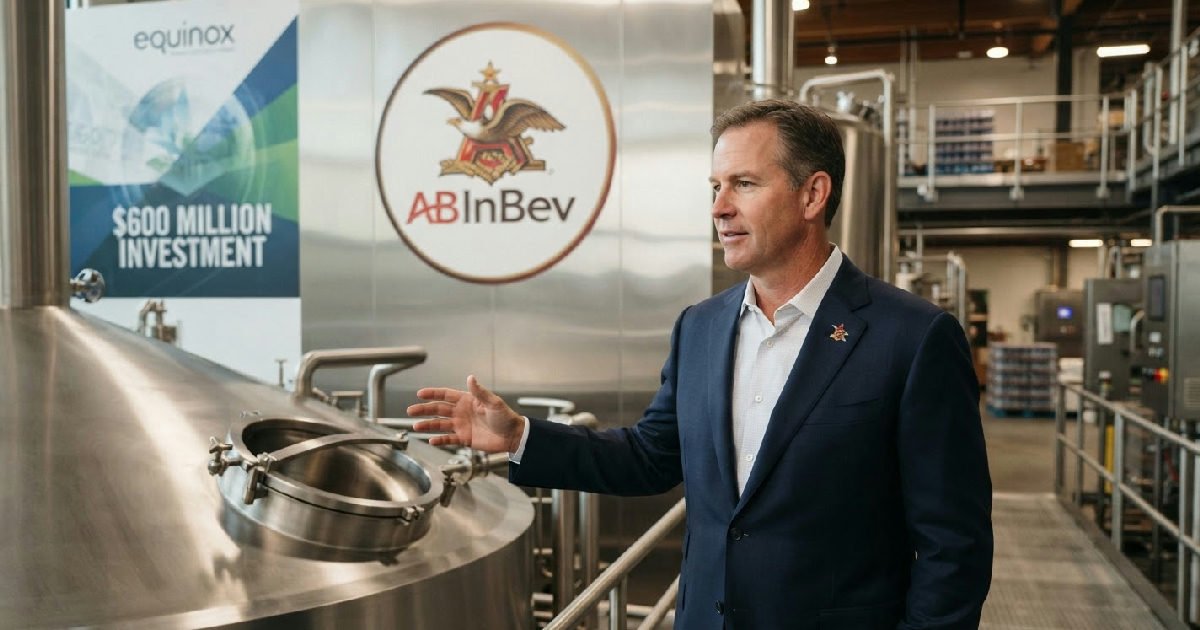
Brendan Whitworth, the chief executive of Anheuser-Busch InBev’s (AB InBev) North American operations, is stepping down from his role at the end of November 2026. He’s set to take the helm as CEO of the high-end gym chain Equinox. This significant leadership shift occurs as Anheuser-Busch pushes forward with a substantial $600 million investment aimed at strengthening its United States breweries and facilities.
These twin developments—a high-profile executive departure and a major financial commitment—highlight the complex and evolving landscape Anheuser-Busch has been navigating. The investment, detailed as spreading across nine states and supporting more than 100 local communities, signals the company’s long-term dedication to the American market. It comes amidst broader challenges and shifting consumer preferences within the US beverage industry.
Brendan Whitworth’s November 2026 departure
The announcement of Brendan Whitworth’s departure from his position as CEO of Anheuser-Busch North America marks a pivotal moment for the brewing giant. Whitworth, who has led the North American operations since 2021, is set to leave the company at the close of November 2026 to pursue his new role at Equinox.
Michel Doukeris, the global CEO of AB InBev, acknowledged Whitworth’s contributions, stating, “My sincere thanks to Brendan for his contributions to AB InBev and for his partnership over the past 13 years.” Doukeris will temporarily oversee the North American business, with AB InBev stating that a permanent successor will be named “in due course.”
This interim leadership underscores the strategic importance of continuity during such transitions.
Succession planning and executive moves
Donald J. “DJ” Schepker, a professor of strategic management at the University of South Carolina’s Darla Moore School of Business, suggested that while the interim structure implies operational continuity, it also raises questions about the company’s internal succession pipeline. This approach deviates from previous patterns where successors were often named prior to a CEO’s exit.
Neil Reid, a craft beer researcher and professor at the University of Toledo, viewed Whitworth’s move as a clear career opportunity rather than an abrupt or involuntary exit. His transition to a full leadership role at Equinox, a major consumer-facing brand, reinforces the notion of a strategic career advancement for the outgoing Anheuser-Busch CEO.
Anheuser-Busch’s $600 million US investment initiative
Anheuser-Busch announced in April 2026 it was increasing its U.S. manufacturing investment to $600 million, to be deployed across 2025 and 2026. This substantial capital injection builds upon an initial $300 million investment made in May 2025, underscoring the company’s commitment to fortifying its manufacturing capabilities and supply chain within the US.
The investment is strategically allocated across nine states, directly benefiting more than 100 local communities through brewery upgrades, technology enhancements, and expanded production capacity. Specific facilities, including those in Jacksonville, Florida, Los Angeles, and Cartersville, Georgia, are receiving targeted funding for brewing and packaging equipment.
Brewing futures and workforce development
This $600 million commitment is part of Anheuser-Busch’s “Brewing Futures” initiative, which extends beyond infrastructure. The program includes significant investments in workforce development, with plans to open 15 new technical skills training centers across its US facilities. The company aims to upskill over 90% of its manufacturing workforce in areas like technical fundamentals and digital tools over the next five years.
The initiative also strengthens career opportunities for veterans entering private-sector manufacturing roles. Brendan Whitworth, in a past statement regarding this investment, highlighted its role in “advancing American manufacturing, strengthening our supply chain, and creating lasting careers and a brighter future for U.S. workers.” This forward-looking approach reflects a commitment to domestic production.
Navigating a challenging US beverage market
The leadership transition and significant investment unfold against a backdrop of a rapidly evolving US beverage market, particularly challenging for traditional beer segments. Consumer preferences have shifted dramatically in recent years, impacting sales volumes and market share for long-established brands. This dynamic environment demands strategic agility and continuous innovation from major players like AB InBev.
Overall US beer production and imports saw a decline of 5.7% in 2025, indicating a contraction in the market. The industry faced approximately $200 million in lost sales that year, with dollar sales for beer falling 3.9% year-over-year in late summer 2026. Case volume dropped 5.2% during the same period, signaling a broader trend away from traditional beer consumption.
Shifts in consumer preferences
The challenges for Anheuser-Busch were notably amplified by the conservative-led boycott of Bud Light in 2023, following a marketing partnership with transgender social media influencer Dylan Mulvaney that April. The controversy resulted in Bud Light’s U.S. sales reportedly dropping 7.8% in dollar sales and 8.8% in volume year-to-date through October 4, 2026.
This contributed to a reported $1.4 billion sales decline and a $25 billion loss in market capitalization for AB InBev.
Bud Light also ceded its long-held position as the top-selling beer in the U.S. in 2023, initially to Modelo and later trailing Michelob Ultra as of 2025. These events underscore the delicate balance brands must maintain in a polarized social landscape. Consumer sentiment can rapidly impact market dominance, serving as a stark reminder of the complexities involved in modern brand management and public relations.
While traditional beer segments grapple with these shifts, other beverage categories have seen significant growth, further fragmenting the market. Imported beers have proven to be a resilient segment, climbing 4.1% in 2025 and now constituting nearly a quarter of the market, valued at $10 billion. This indicates a growing consumer appetite for diverse, often premium, foreign brands.
Flavored Malt Beverages (FMBs) and hard seltzers have also experienced a surge, with this category growing 7% in 2025. This expansion highlights a broader consumer shift towards lighter, more varied, and often fruit-flavored alcoholic options. Beyond alcohol, the non-alcoholic beverage market has shown impressive momentum.
Non-alcoholic beer sales jumped almost 30% in 2025, adding $91 million and claiming 1% of the beer market for the first time. The broader non-alcoholic segment is forecast to hit $4 billion by 2027.
These trends reflect a conscious shift in consumer behavior, especially among younger demographics. There’s an increasing emphasis on health, wellness, and balanced lifestyles, leading to a greater interest in no- and low-alcohol options, along with gluten-free, low-carb, and low-calorie choices.
Data from 2024 shows that 51.1% of US adults reported consuming alcohol in the past month, a decline from a peak of 56.7% in 2014, signaling a broader societal trend towards moderated alcohol consumption.
Whitworth’s transition to Equinox leadership
Brendan Whitworth’s move from leading Anheuser-Busch North America to becoming CEO of Equinox represents a significant career pivot from the brewing industry to the high-end fitness and luxury lifestyle sector. Equinox, established in 1991, is a global leader known for its premium health and fitness clubs, operating 118 locations across the United States, Canada, and the United Kingdom.
This transition highlights Whitworth’s adaptability and leadership capabilities across diverse consumer-facing industries. Equinox positions itself at the top tier of the wellness market, emphasizing luxury facilities, holistic wellness design, and a strong performance culture. With memberships in major cities exceeding $300 per month, the brand caters to an affluent clientele.
Whitworth’s experience in managing a vast consumer brand like Anheuser-Busch will undoubtedly be valuable in steering Equinox’s continued growth and market presence, marking a clear leadership change in his career.
A new chapter in consumer brands
His move suggests a desire for a fresh challenge, stepping into an industry that, while different, also deals with consumer trends and brand loyalty. Equinox Group also encompasses other well-known lifestyle brands, including SoulCycle and Blink Fitness, indicating a diversified portfolio within the health and wellness space. Whitworth’s leadership will be crucial as Equinox continues to expand its reach and solidify its luxury market positioning.
The transition also underscores a broader phenomenon of executives moving between seemingly disparate industries, bringing transferable skills in strategy, operations, and brand management to new contexts. For Whitworth, this represents not just a new job, but a new professional chapter in a dynamic and growing sector.
The road ahead for Anheuser-Busch North America
With a new leader to be announced and the $600 million investment well underway, Anheuser-Busch North America is charting a course through a competitive and rapidly evolving beverage landscape. The company’s strategic focus, established in 2018, centers on a consumer-centric approach, emphasizing innovation and diversifying its portfolio beyond traditional beer.
This strategy includes a push towards “premiumization,” focusing on higher-priced offerings that align with shifting consumer tastes. It also involves a significant expansion into “beyond beer” categories, such as hard seltzers and spirits-based ready-to-drink (RTD) beverages. Acquisitions like Cutwater in 2019 and Nütrl vodka seltzer in 2020 are clear indicators of this diversified approach.
Digital transformation, exemplified by platforms like BEES, also plays a crucial role in monetizing relationships with retailers and streamlining commerce.
Addressing market fragmentation and consumer shifts
The company must sustain its investments in innovation to capture new growth segments, particularly as consumers increasingly seek out diverse, healthier, and novel beverage options. The ongoing efforts to upskill the workforce and modernize facilities through the $600 million investment will underpin these strategic goals, ensuring operational excellence. This includes strengthening its distribution networks, a key element for any major consumer brand.
Ultimately, Anheuser-Busch’s future in North America hinges on its ability to adapt swiftly to changing consumer demands, mitigate social and market controversies effectively, and leverage its substantial investments to drive innovation and maintain its competitive edge.
The blend of evolving leadership and significant capital deployment positions the company to confront these realities head-on, aiming to reclaim and expand its market influence in the years to come.