

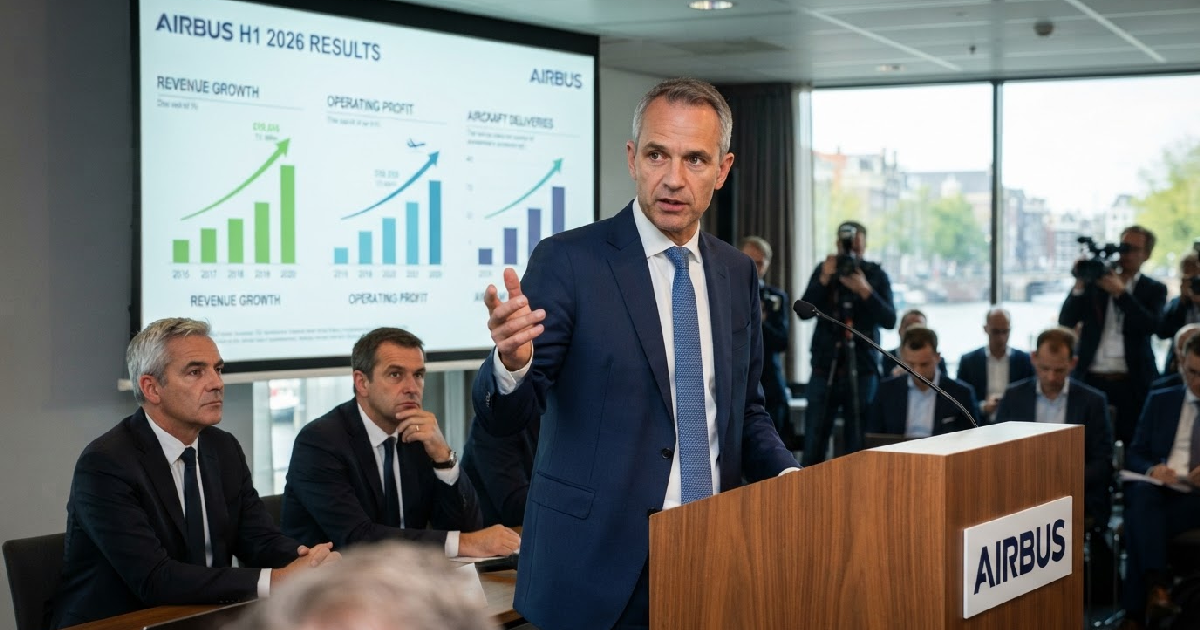
Airbus CFO Thomas Toepfer details H1 2026 financial gains, confirms outlook
Airbus Chief Financial Officer (CFO) Thomas Toepfer provided a robust update on the aerospace giant’s Half-Year (H1) 2026 financial performance during an earnings call yesterday, July 29, 2026, in Amsterdam. He confirmed significant revenue and profit increases.
The CFO also maintained the company’s full-year guidance despite ongoing economic complexities, with discussions touching on current Mergers & Acquisitions (M&A) activities and the pervasive impact of global tariffs. Guillaume Faury, Airbus CEO, and Jean-Christophe Henoux, Head of Investor Relations, also participated in the session.
Airbus CFO Thomas Toepfer discusses H1 performance driving revenue and profit gains
Airbus reported an impressive first half of 2026, showcasing substantial growth across key financial metrics. Total revenue climbed to EUR 33.2 billion, marking a 12% increase year-over-year from EUR 29.6 billion in H1 2025.
This surge primarily reflects higher commercial aircraft deliveries and a strong contribution from Airbus Defence and Space. However, a weaker US dollar in 2026 partially offset these gains compared to the first half of the previous year.
Commercial aircraft deliveries hit record pace
The company delivered a record 237 commercial aircraft in the second quarter of 2026 alone, highlighting a vigorous production ramp-up. For the entire first half, Airbus handed over 351 aircraft.
This figure represents a 15% increase from the 306 units delivered in H1 2025, demonstrating strong demand and improved manufacturing efficiency. Specifically, 44 A220 aircraft were delivered during this period.
Key financial indicators show healthy growth
Adjusted EBIT (Earnings Before Interest and Taxes) for H1 2026 reached EUR 2.7 billion, up 23% from EUR 2.2 billion a year earlier, with the margin improving from 7.4% to 8.2%. Commercial aircraft Adjusted EBIT alone rose to EUR 2 billion from EUR 1.7 billion.
Reported EBIT saw an even more dramatic increase, jumping 70% from H1 2025 to EUR 2.7 billion in the first half of 2026. Net income also rose significantly, reaching EUR 2.2 billion, up from EUR 1.525 billion a year ago.
This translated into an Earnings Per Share (EPS) of EUR 2.84, with adjusted EPS settling at EUR 2.61 based on 789 million shares. These figures underscore the company’s improved profitability and operational leverage.
Airbus Defence and Space excels, helicopter deliveries climb
Beyond commercial aviation, Airbus Defence and Space significantly boosted the company’s overall performance. Its revenues increased by 9% year-on-year, reaching EUR 6.3 billion, contributing substantially to the group’s top line.
The Defence and Space division also reported a healthy Adjusted EBIT of EUR 487 million. This segment’s robust performance signals diversification and resilience within the broader Airbus portfolio.
In helicopter operations, Airbus delivered 144 units in H1 2026, six more than the same period last year. This steady growth, reflected in a broadly stable Adjusted EBIT of EUR 3.7 billion for the helicopter division, reinforces Airbus’s strong position across various aerospace markets.
Even the A400M military transport program saw increased activity, with three aircraft delivered in the first half of the year, compared to two in H1 2025. These diverse contributions underline the multifaceted strength of Airbus’s business model.
Steady hand on 2026 guidance amid global uncertainties
Despite the current geopolitical and economic fluidity, Airbus maintained its full-year 2026 guidance, projecting around 870 commercial aircraft deliveries. This unwavering outlook demonstrates confidence in the company’s operational planning and market demand.
The guidance, however, rests on the assumption of no new major disruptions to global trade, the world economy, air traffic, the supply chain, or internal operations. Thomas Toepfer emphasized that this careful approach acknowledges prevailing global risks.
Delivery targets and adjusted EBIT confirmed
Airbus anticipates an Adjusted EBIT of approximately EUR 7.5 billion for the full year. This figure, critically, is projected before any potential M&A activities and includes the impact of currently applicable tariffs.
The company also expects to generate around EUR 4.5 billion in Free Cash Flow before customer financing. This consistent guidance provides stability and predictability for investors in a volatile economic climate.
Navigating M&A landscape and tariff complexities
Mergers and Acquisitions remain a strategic consideration for Airbus, although the immediate focus is on organic growth and operational efficiency. The company incurred negative EUR 43 million in other costs related to M&A in H1 2026, with EUR 27 million of that in Q2.
These figures suggest a cautious but active approach to potential consolidations or acquisitions, reflecting a strategy to enhance capabilities or market position where opportunities align with long-term goals.
The impact of tariffs, a persistent concern in international trade, is already factored into Airbus’s 2026 financial guidance. This proactive inclusion helps mitigate unforeseen financial shocks, offering a clearer picture of expected performance under existing trade conditions.
Thomas Toepfer’s commentary underscores the aerospace industry’s delicate balance between expanding global reach and managing protectionist trade measures. Airbus appears prepared to navigate these complexities through robust internal planning.
Liquidity and cash position fortify resilience
Airbus closed H1 2026 with a strong net cash position of EUR 8.4 billion, reflecting prudent financial management. The company’s liquidity stands impressively above EUR 30 billion, providing a substantial buffer against market fluctuations.
This robust financial standing, coupled with a current ratio of 2.84, positions Airbus well to absorb potential economic shocks or pursue strategic investments. It signals financial stability to both shareholders and suppliers.
Despite significant investments, free cash flow before customer financing improved, moving from a negative EUR 1.61 billion in H1 2025 to a negative EUR 1.2 billion in H1 2026. Free cash flow including customer financing was negative EUR 1.0 billion, still showing improvement.
Outlook: sustained growth and strategic focus
Airbus’s reaffirmed 2026 guidance, anchored by strong H1 results, paints a picture of sustained growth driven by solid demand for commercial aircraft and resilience in its defense and helicopter divisions. The aerospace market continues its post-pandemic recovery, albeit with new challenges.
The company’s strategic priorities will likely remain focused on managing supply chain constraints, optimizing production rates, and integrating technological advancements. CFO Thomas Toepfer’s remarks highlight a careful balance between aggressive growth and risk management.
As the global economy navigates inflationary pressures and potential trade disputes, Airbus’s ability to maintain its financial trajectory and delivery targets will be a critical indicator for the wider aerospace sector. Its performance provides a benchmark for industry recovery and adaptation.
The firm’s proactive approach to factoring in tariffs and its robust liquidity underscore a strategic preparedness for ongoing market dynamics. Investors will watch closely for any revisions to guidance should global conditions shift unexpectedly in the latter half of the year.