

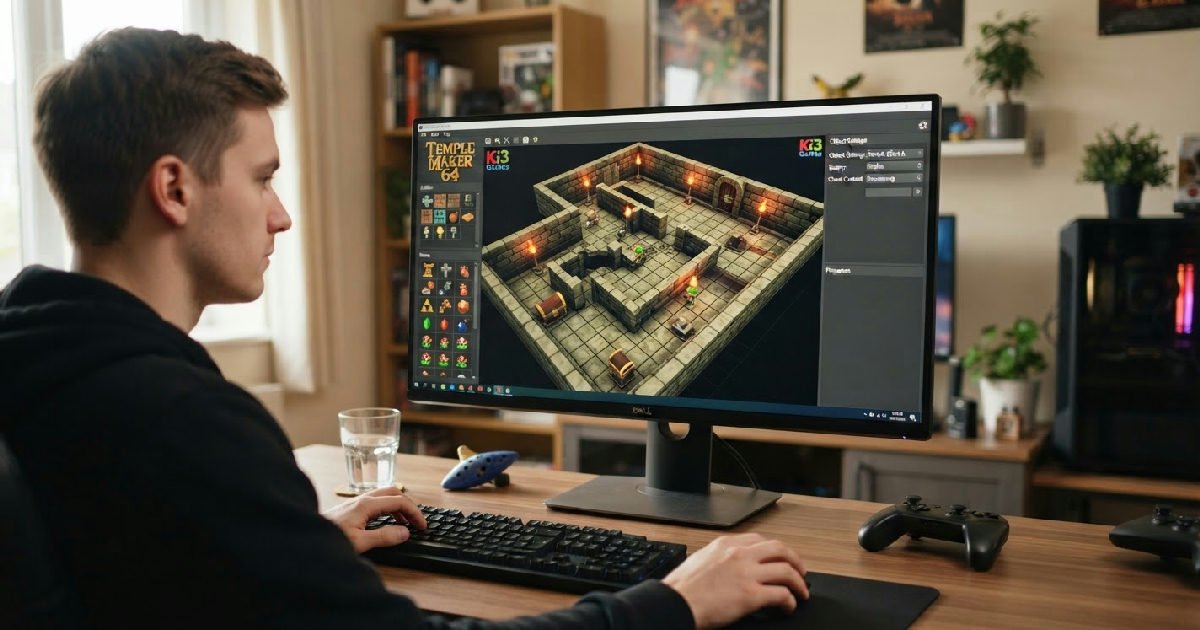
Unofficial ‘Zelda Maker’ arrives on Steam with Temple Maker 64
Temple Maker 64 is an unofficial dungeon-creation game inspired by The Legend of Zelda’s Nintendo 64 classics, set to launch on Steam.
The project, developed by the one-man studio Ki3 Games, aims to deliver the 3D “Zelda Maker” experience that Nintendo itself has never provided, allowing players to build and share their own intricate temples.
Crafting Classic Dungeons with Temple Maker 64
Ki3 Games has been working on the game for approximately a year and a half as of April 2026. A free demo for Temple Maker 64 is already available on the game’s Steam page, giving players a taste of its creation tools and community-driven potential ahead of a full release date that is still to be announced.
For years, the success of Super Mario Maker has led players to wonder why Nintendo hasn’t applied the same do-it-yourself formula to its other iconic franchises. While the company has remained quiet, the indie scene has stepped in to fill the void. These efforts have often focused on 2D creation suites, which emulate the Super NES era of Zelda.
Temple Maker 64 breaks from that mold by embracing the N64’s 3D polygonal style. The game draws direct inspiration from Nintendo 64 Zelda titles, particularly Ocarina of Time and Majora’s Mask, aiming to provide a similar aesthetic. This approach gives the game a unique position among user-generated content platforms.
The challenge for any creation game without a major intellectual property is building an audience. The success of titles like Super Mario Maker hinges not just on brand recognition, but on a shared player vocabulary built over decades. Fans already understand the fundamental mechanics of a Mario level or a Zelda dungeon, providing a creative foundation.
Building Your Own Adventure
At its core, Temple Maker 64 is divided into two main modes: creation and exploration. Ki3 Games has focused on making the building process as accessible as possible for all players. The intuitive 3D map editor allows creators to simply draw boxes to generate rooms, which can then be dragged and rearranged to shape the dungeon’s layout.
Intuitive Building Tools
Within these created spaces, players can populate their dungeons with a host of familiar elements. The toolkit includes various traps, monsters, puzzles, and interactive objects. It also features classic Zelda sub-weapons like bows, bombs, and grappling hooks, which are similar to the iconic Hookshot. The game carefully uses generic names and original asset designs.
Community-Driven Creations and Playtesting
Even though the game has yet to see a full release, its demo has already cultivated an active and inventive community. Play testers have pushed the engine to its limits. They’ve created everything from faithful recreations of iconic dungeons like the Forest Temple and the Deku Tree. Some community-made dungeons require tricks to beat.
These complex dungeons often use elements like switch timers, fire arrows, parkour, and dropping pots to flip switches. Vinesauce reportedly played the demo recently, further highlighting the game’s growing visibility. The emergence of such high-skill content so early in the game’s life speaks to the depth of the creation tools and player ingenuity.
This focus on deep, customizable gameplay shows how much esports organizations value community engagement.
Development Outlook and Legal Considerations
Developing a fan game so clearly inspired by a Nintendo property is a perilous endeavor. The Japanese gaming giant is notoriously protective of its intellectual property and has a long history of shutting down fan projects and romhacks. Ki3 Games aims to navigate this by creating all original assets and avoiding patented game mechanics.
This approach of building a spiritual successor rather than a direct clone is a calculated risk, one that many indie developers take when drawing inspiration from beloved classics.
A Kickstarter page for the project was crowdfunding with only three days left as of July 4, 2026. A YouTube video from July 10, 2026, also links to the game’s Kickstarter. The crowdfunding campaign’s outcome has not been officially confirmed, but its existence points to the developer’s ongoing efforts to fund the project.
Future ambitions for Temple Maker 64 include several key features for the full release. Social features like comments, tagging, and lists are a top priority. The developer is also exploring a potential single-player campaign and the possibility of tapping other Zelda-like developers to make maps for the game.
This strategic development mirrors the meticulous planning seen among crypto market makers adapting to new market conditions.
Broader Impact and Future Projects
Underscoring a commitment to the broader game development community, Ki3 Games intends to release the game’s character controller as a free, open-source Unity package after Temple Maker 64 is launched. This initiative could help other aspiring creators build their own 3D adventure games. It highlights a desire to contribute to the tools available for indie development.
Ki3 Games is also working on another 3D Zelda-like game called Seed of Life. This parallel project indicates a strong interest in the genre.
The minimum system requirements for Temple Maker 64 include Windows 10 64-bits, an Intel i5 or Ryzen 5 processor, 4 GB RAM, an Nvidia GTX 1080 or AMD RX 5700 graphics card, DirectX Version 11, and 1 GB of storage.
It also supports full controller use, including DualShock and DualSense via USB, and offers accessibility features like adjustable difficulty and custom volume controls. These technical considerations are as crucial as the strategic moves facing coaches like Lincoln Riley faces in high-stakes sports.
With a demo already available on Steam for playtesting, the game has garnered significant attention for its potential. The official release date for Temple Maker 64 remains “To be announced,” but fans can wishlist it on Steam to stay updated.