

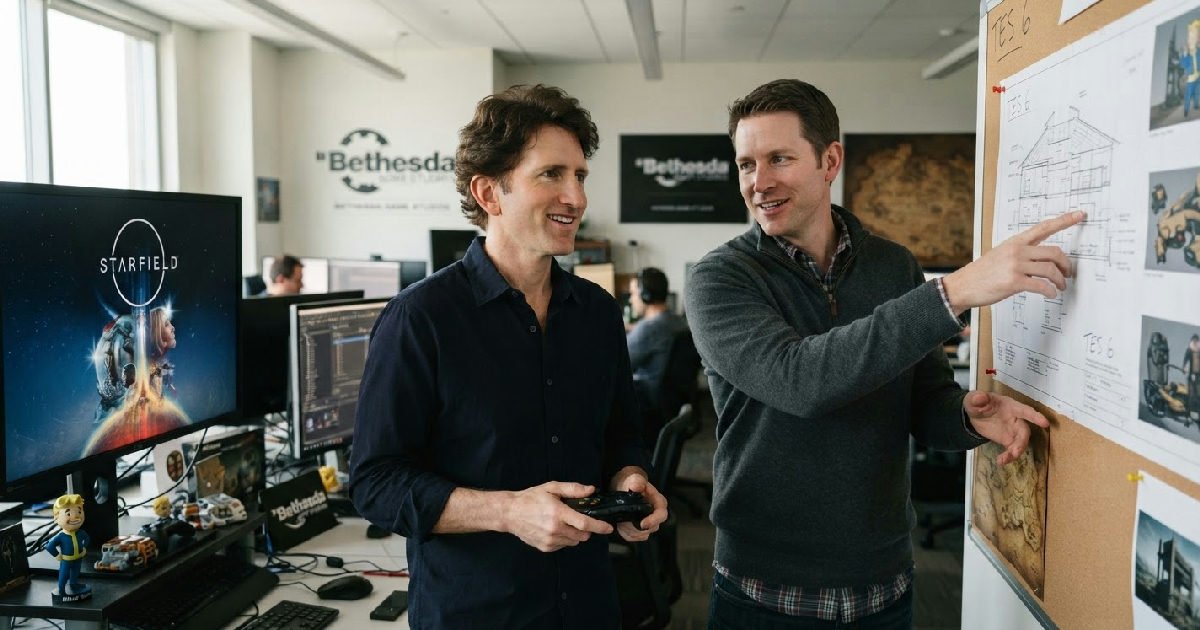
Skyrim veteran Kurt Kuhlmann claims Todd Howard championed Starfield over
Former Bethesda developer Kurt Kuhlmann alleged Todd Howard prioritized Starfield over The Elder Scrolls 6, effectively sidelining TES 6.
These claims, made public on 2026-09-08 in an interview with FRVR, offer a rare glimpse into the internal decision-making process that shaped Bethesda’s release schedule for over a decade, delaying a highly anticipated fantasy RPG in favor of an ambitious space epic.
Todd Howard Starfield TES 6’s fallout 4 turn
Kuhlmann, who contributed to Bethesda titles for over 20 years before his departure in 2023, suggested that many within the studio would have preferred to move directly to The Elder Scrolls 6 following 2015’s Fallout 4.
Instead, the studio embarked on two major projects, Fallout 76 and then Starfield, before finally making the next Elder Scrolls title a top priority. Regional game timing for major releases often demonstrates these complex studio decisions.
After the critical and commercial success of Fallout 4 in 2015, a natural progression for Bethesda Game Studios would have been to pivot towards its next flagship, The Elder Scrolls 6. Many developers, including Kurt Kuhlmann, harbored this expectation. Kuhlmann stated, “We all expected it to be directly after Fallout 4.
Why wouldn’t it be? That’s what we did, and that was kind of the expectation.”
However, studio leadership took a different path, first diverting resources to an online multiplayer venture. That project was Fallout 76, a title initially envisioned as a smaller undertaking but which ultimately drew significant studio resources away from other potential developments.
Kuhlmann indicated that this online spin-off wasn’t meant to involve the entire studio, yet its demands grew to consume a substantial portion of the team.
Todd Howard’s Vision for Starfield
Kuhlmann indicated that Executive Producer Todd Howard secured approval for Starfield as a new intellectual property, describing it as an “ambitious project” and “the greatest space RPG ever created.” He believed Fallout 4‘s success gave Howard the leverage to pitch Starfield to Zenimax leadership.
This move reportedly came as a surprise to many developers, who felt more aligned with continuing the established Elder Scrolls saga.
“It wasn’t like Starfield was this big internal like, ‘Hey, we all want to make this space game, Todd,'” Kuhlmann stated emphatically to FRVR. “It was very much, ‘Guess what, team? We’re making this space game.'” This direct quote underscores a top-down decision-making style that shaped Bethesda’s output for years.
Kuhlmann’s Legacy and Bethesda Bureaucracy
Kurt Kuhlmann’s extensive tenure at Bethesda Game Studios provides significant context to his recent comments. He joined the company in 1996 and played pivotal roles in some of its most iconic games, writing the main questline for Oblivion and serving as co-lead designer on the genre-defining Skyrim. He was also recognized as the Elder Scrolls loremaster.
He left Bethesda in 2023. Kuhlmann’s insights reveal not just a personal preference but also a perceived disconnect between management’s strategic choices and the desires of the broader development team, hinting at growing bureaucracy within the studio. He pointed to issues during Starfield‘s development and a growing bureaucracy at Bethesda contributing to what he saw as problems at the studio.
Kuhlmann openly expressed his personal preference, stating he “would’ve much rather been making TES 6 instead of 76 and Starfield.” He believed this sentiment was likely shared by the majority of the studio, suggesting a widespread yearning to return to the established, beloved fantasy franchise. This divergence in priorities highlights the delicate balance between creative leadership and team morale in large-scale game development.
Broader Developer Perspectives on Long Waits
The sentiment shared by Kuhlmann isn’t entirely isolated. Nate Purkeypile, another former Bethesda Lead Artist who worked on several key titles including Fallout 3, 4, 76, Skyrim, and early Starfield development before leaving in 2021, has also weighed in on Bethesda’s protracted development cycles.
Purkeypile believes The Elder Scrolls 6 was announced prematurely at E3 2018 primarily to reassure fans during the unveiling of Starfield.
Purkeypile reportedly commented that the early announcement served to ensure fans “were not just pissed at us” when Starfield was introduced. He noted that using game trailers for such announcements is “a very expensive way to do that,” pointing to the high stakes involved in managing public perception. Complex game systems are a common challenge in large-scale development.
Starfield’s Scope and Fan Expectations
Nate Purkeypile also voiced his reservations about the ambitious scale of Starfield. He found himself “not super into Starfield” precisely because of its expansive nature, particularly the concept of a thousand planets. He indicated a preference for a more focused approach, perhaps constraining The Elder Scrolls 6 to a single region of Tamriel for more refined world-building.
Purkeypile also suggested that the development teams for The Elder Scrolls 6 and Fallout 5 are in a “no-win situation” due to the immense fan expectations set by Skyrim. This makes managing the creative process and delivery incredibly challenging for the studio.
The Unfolding Saga of The Elder Scrolls 6 Development
Despite the various detours, The Elder Scrolls 6 is now confirmed as Bethesda’s next major release. The game was initially announced with a brief teaser at E3 2018, sparking immediate excitement among fans. However, solid details remained scarce for years, leading to a prolonged period of speculation and anticipation.
It wasn’t until August 2023 that the game reportedly entered “early development.” Then, in March 2024, reports indicated that “early builds” of the game were becoming available for internal testing. Yet, as of September 2026, a specific release date or even a concrete release window remains elusive, fueling fan frustration over the extended wait.
For many, the desire to dive back into the world of Tamriel feels more urgent than ever.
Howard’s Call for Patience and Industry Shifts
Executive Producer Todd Howard, acknowledging the lengthy wait, made a candid comment in March 2026, urging fans to “Just pretend we didn’t announce it. Doesn’t exist. No one’s heard a word.” This statement reflects the challenging reality of managing expectations for a game announced so far in advance of its projected release.
The gaming industry has evolved significantly since Skyrim launched, and player demands have become increasingly vocal.
This prolonged development cycle for The Elder Scrolls 6 also demonstrates a shift in Bethesda’s approach. Nate Purkeypile, for instance, noted that the studio is now “okay, actually delaying stuff,” a departure from the strict, almost legendary, fixed release date of Skyrim on 11/11/11. This newfound flexibility, while potentially beneficial for quality, certainly tests the patience of a dedicated fanbase.
The Impact of Executive Vision on Creative Direction
The revelations from Kurt Kuhlmann underscore a critical aspect of large-scale game development: the influence of executive vision on creative direction. When an Executive Producer like Todd Howard pushes for a project such as Starfield, it can significantly alter a studio’s trajectory.
This power dynamic can lead to a fascinating tension between what a studio has traditionally excelled at and what its leadership envisions for the future.
This situation also sheds light on the challenges of managing multiple successful franchises. Balancing the desire to innovate with the demand for beloved sequels often requires tough decisions. For Bethesda, the choice to pursue Starfield before The Elder Scrolls 6 was a calculated risk, one that has generated both a new IP and a prolonged wait for its most iconic fantasy series.
Looking Ahead: Bethesda’s Future and Fan Anticipation
With The Elder Scrolls 6 now firmly in development, the focus shifts to its eventual release and the reception it will receive. The long gestation period and the preceding development of other major titles mean that expectations will be monumental. Fans will be scrutinizing every detail, comparing it not just to Skyrim but also to the innovation promised by Starfield.
Bethesda Game Studios faces the monumental task of delivering a game that lives up to over a decade of hype, while also navigating the complexities of modern game design and player communities. The internal dynamics revealed by Kuhlmann suggest that this journey hasn’t been without its internal challenges, but the promise of a new Elder Scrolls adventure continues to drive anticipation.