

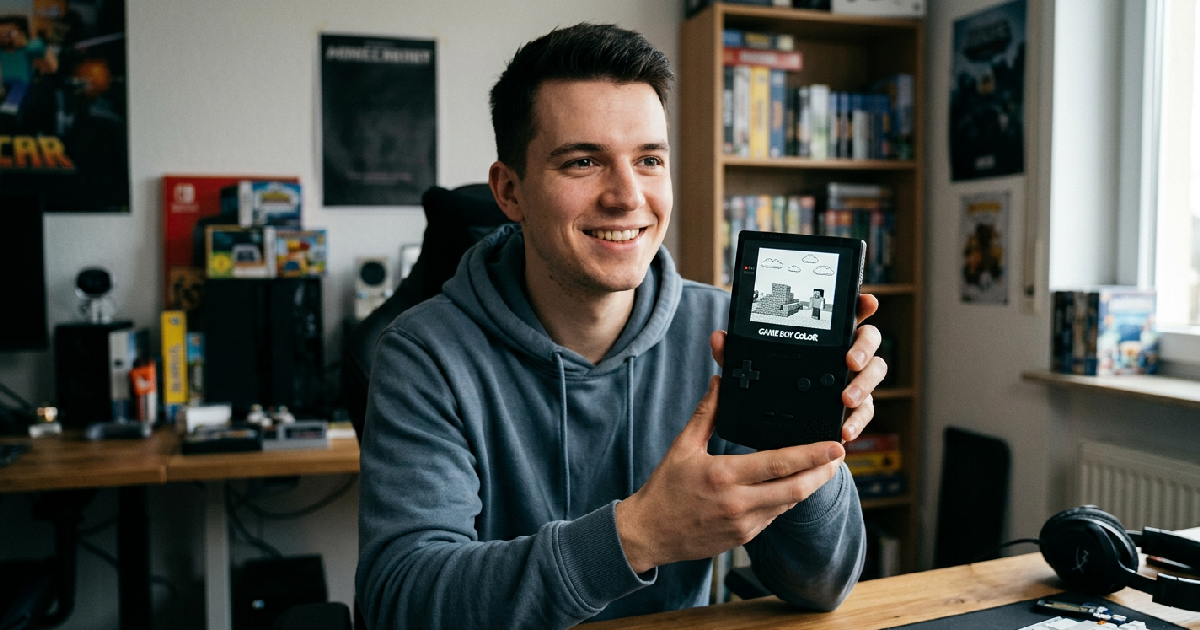
Tobias showcases 3D Minecraft tech demo on Nintendo Game Boy
YouTuber Game of Tobi, also known as Tobias, has successfully showcased a technical demonstration of Minecraft running on the original Nintendo Game Boy Color hardware. The project, which was detailed in a video titled “REAL 3D Minecraft on the GameBoy!” uploaded on July 9, 2026, marks a major milestone in retro homebrew development.
By squeezing a 3D sandbox engine onto an 8-bit handheld from 1998, Tobias has achieved a feat that pushes the aging console far beyond its intended 2D limits.
Overcoming the technical limits of 8-bit architecture
The demonstration is not a complete adaptation of the Mojang Studios original, but it offers a functional 3D world where players can walk around, place blocks, and destroy the environment.
It even runs on the original monochrome Game Boy (DMG), though high visibility is difficult on that platform due to the black and white display and texture constraints. For many enthusiasts, seeing a recognizable 3D world on such limited hardware is a testament to clever optimization and mathematical stripping.
Game of Tobi admitted the difficulty of the task, stating that he wasn’t sure it was even possible to create a recognizable 3D world on the system. The Game Boy Color was never designed for real-time 3D rendering. However, this version manages to create a space that feels physically present.
While not as complex as Grand Theft Auto 6, it proves that “obsolete” hardware can still handle modern gameplay concepts when pushed to its breaking point.
The Game Boy Color operates on hardware that would be considered primitive by modern standards. It features an 8-bit Zilog Z80 microprocessor and a meager 32 KB of main memory, supplemented by 16 KB of video memory.
Rendering a 3D environment at its native resolution of 160×144 pixels requires the CPU to perform constant calculations that it was never optimized for. Tobias had to simplify the Minecraft experience to its core logic to make the engine functional.
Because of these hardware constraints, the graphics are described as “extremely obsolete.” The system lacks full texture support and relies on a very restricted color palette. To maintain performance, the demonstration offers two world types: a fully 3D generated world and a flat map.
The latter provides a smoother experience, but the 3D world is where the technical wizardry is most apparent, as the Z80 must track and draw block data relative to the player’s position in real time.
Despite the lack of polish compared to Star Fox on Switch 2, the “kinda playable” state of the game has impressed the retro community. The draw distance is understandably limited to keep the frame rate stable.
To run the game on an actual console today, users must distribute the software in a .gbc file format and load it onto a flash card, as original cartridges cannot be rewritten.
Building on previous Minecraft porting achievements
This is not the developer’s first time bringing the sandbox hit to retro Nintendo platforms. Tobias previously worked on a Minecraft project for the Game Boy Advance (GBA), which offers a superior playing experience due to the GBA’s more powerful 32-bit ARM processor.
That version was significantly more feature-rich, including a survival mode, caves, and even the “Nether” dimension, which were showcased in updates between October 2025 and March 2026.
Game of Tobi is well-known in the modding scene for these ambitious “de-make” projects. His portfolio includes porting The Legend of Zelda: Twilight Princess to the Nintendo 3DS and Super Mario 64 to the Game Boy Advance.
These efforts are less about creating a definitive way to play a game and more about exploring the boundaries of legacy silicon. For Tobias, the Game Boy Color version represents the absolute floor of what hardware can handle while still remaining functional.
Potential growth for the retro homebrew community
The impact of this Minecraft demonstration extends beyond a single video. It serves as a proof of concept for other developers looking to implement 3D mechanics in 8-bit hobbyist games. Most traditional Game Boy Color titles that featured “3D” elements usually relied on pre-rendered backgrounds or static images.
Seeing a dynamic, player-alterable 3D world suggests that the Zilog Z80 may have untapped potential for original homebrew titles.
The project remains in active development, with Tobias focusing on performance optimization. He has no plans for a commercial release, as the project is a technical exercise using Microsoft-owned intellectual property. However, it joins a growing list of impressive technical feats, such as competitive gaming updates that show how much life remains in older ecosystems through dedicated community support.
Ultimately, playing Minecraft on a Game Boy Color is a struggle of visibility and frame rates, but that is rarely the point for the modding community. The goal is the challenge of the limitation itself.
For a device released nearly 30 years ago, being able to construct a tower and walk around it in a 3D space is a remarkable achievement that bridges the gap between the 8-bit era and the modern sandbox genre.