

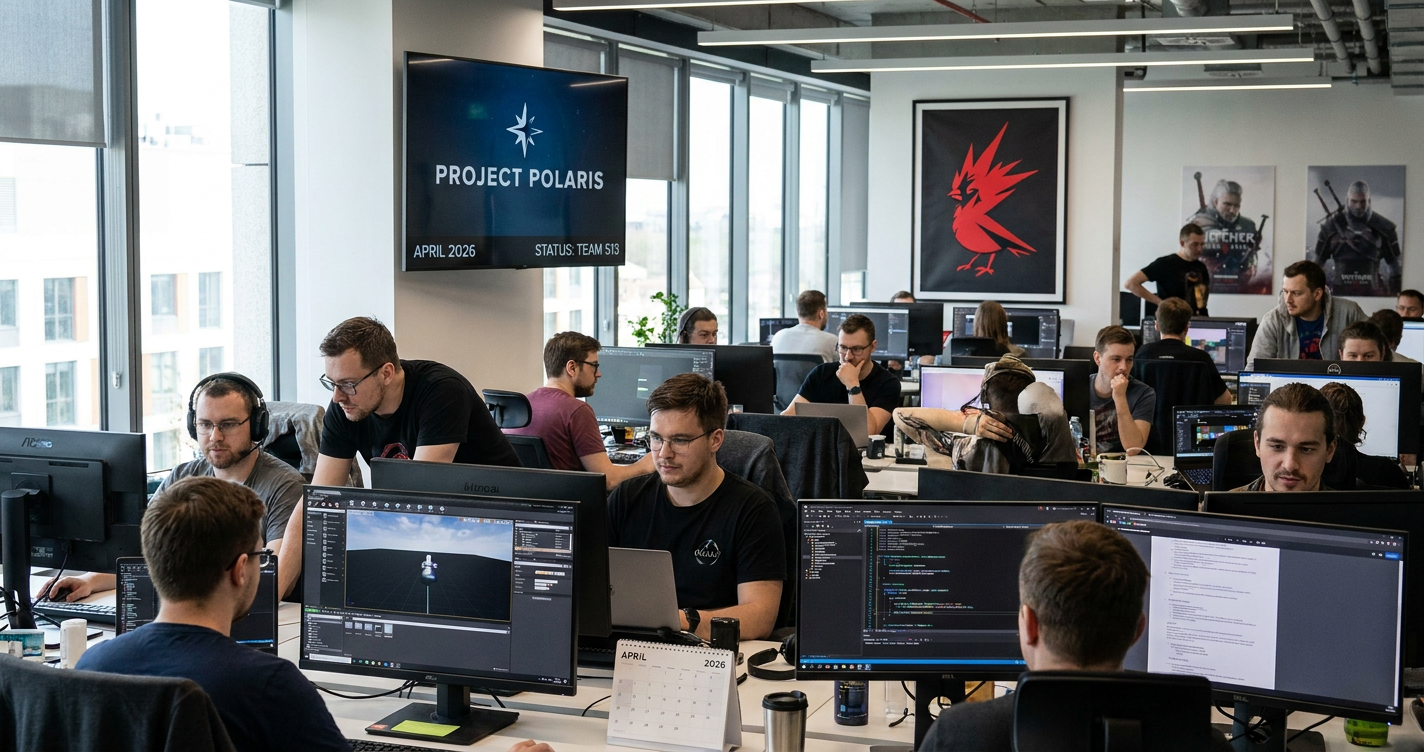
CD Projekt Red expands Project Polaris team to 513 developers by April 2026
CD Projekt Red has significantly expanded the development team for its next major fantasy epic, Project Polaris, with 513 developers now working on the title as of April 30, 2026. This headcount, revealed in the company’s latest financial reports, is more than double the peak of approximately 200 developers who created the critically acclaimed The Witcher 3: Wild Hunt. Joint CEO Michał Nowakowski confirmed the project has entered its most intensive phase, making it the primary focus for the studio as it transitions the majority of its 975-strong staff onto the title.
The workforce growth has been steady over the past 14 months, climbing from 411 developers in February 2025 to just over 500 this spring. CFO Piotr Nielubowicz noted that the production of The Witcher 4 is currently “steaming ahead” as the studio attempts to scale up both technical complexity and narrative depth. This expansion follows a massive recruitment drive where more than 220 staff joined the company over the last year to improve the project’s quality.
While the studio has ballooned in size, the scope of the game itself remains focused. Game Director Sebastian Kalemba stated that the physical scale, including map size and quest volume, will be comparable to the third entry. The additional personnel are instead being utilized to enhance player agency and ensure a level of polish that avoids the technical issues seen in prior launches. This massive internal shift comes as CD Projekt Red manages institutional changes and a stabilized organizational structure.
Project Polaris timeline and production milestones
The journey for the next Witcher saga began with a pre-production phase that ran from May 2022 until November 2024. Once the foundation was set, the studio moved into full production in late 2024, shifting gears into the “intensive” period currently underway. This long runway was necessary as the studio moved away from its proprietary technology to build the game on Unreal Engine 5, a transition intended to simplify the technical pipeline for the 513 developers now engaged with the software.
The company is not rushing to meet an immediate deadline, confirming that The Witcher 4 will not release before the end of 2026. Current projections point to 2027 as the earliest possible launch window. This patient approach is supported by the company’s Q1 2026 financial performance, which saw sales revenue reach PLN 191.1 million, a 6% increase year-over-year. The studio is also balancing an internal incentive program that targets PLN 418 million in additional profit by the end of 2026.
Resource allocation across Cyberpunk and Witcher franchises
Although Project Polaris is the priority, CD Projekt Red is simultaneously managing several other high-profile developments. Project Orion, the sequel to Cyberpunk 2077, currently has 163 developers assigned to it, a slight increase from earlier in the year. This follows the commercial success of the first game, which has reached 30 million copies sold. The studio is also overseeing Project Sirius, a Witcher multiplayer spin-off by The Molasses Flood, which currently employs 83 people.
A smaller team of 24 developers is currently exploring a brand-new IP codenamed Project Hadar. This diversification of talent ensures the studio isn’t solely reliant on one franchise, though the sheer scale of the Polaris team dwarfs these secondary projects. Shared services, covering essential tasks like localization, motion capture, and quality assurance, have also grown recently to support the heavy throughput required for the main Witcher production cycle.
The financial stakes for this massive workforce are reportedly considerable. Polish market analysts have suggested development and marketing costs for the project could eventually reach $780 million in total. While the company has not confirmed these specific figures, the doubling of the staff compared to the previous Witcher title suggests a massive capital investment. Many in the industry believe this project will set a new benchmark for the cost of AAA development, much like how other major publishers prepare for high-cost blockbuster cycles.
Fresh narrative focus and character details
The Witcher 4 marks a significant departure from the original trilogy by positioning Ciri as the lead protagonist. British actress Ciara Berkeley has been cast in the role, taking over from previous series voice actors. While Geralt of Rivia will appear in the game, Doug Cockle will reprise the role in a capacity that allows the narrative to focus on Ciri. This transition aims to make the game an accessible entry point for new players while honoring the choices veterans made in the 2015 title.
Director Sebastian Kalemba has emphasized that the goal for this entry is to expand player agency through more narrative choices. By utilizing the 513-member team to focus on “quality over quantity,” the developers intend to create a world that reacts more dynamically to those decisions. This push for reactivity is one of the primary reasons for the increased staffing, as modern player expectations for branching paths have grown exponentially since the release of Wild Hunt.
For those waiting for the new game, CD Projekt Red has also confirmed a new expansion for the previous title titled Songs of the Past, slated for 2027. This project is in its final stages and is expected to be similar in scope to the Blood and Wine expansion. Given that The Witcher 3 has now sold over 65 million units worldwide, this expansion serves as a bridge for the massive existing fanbase while the Polaris team continues its intensive development cycle.