

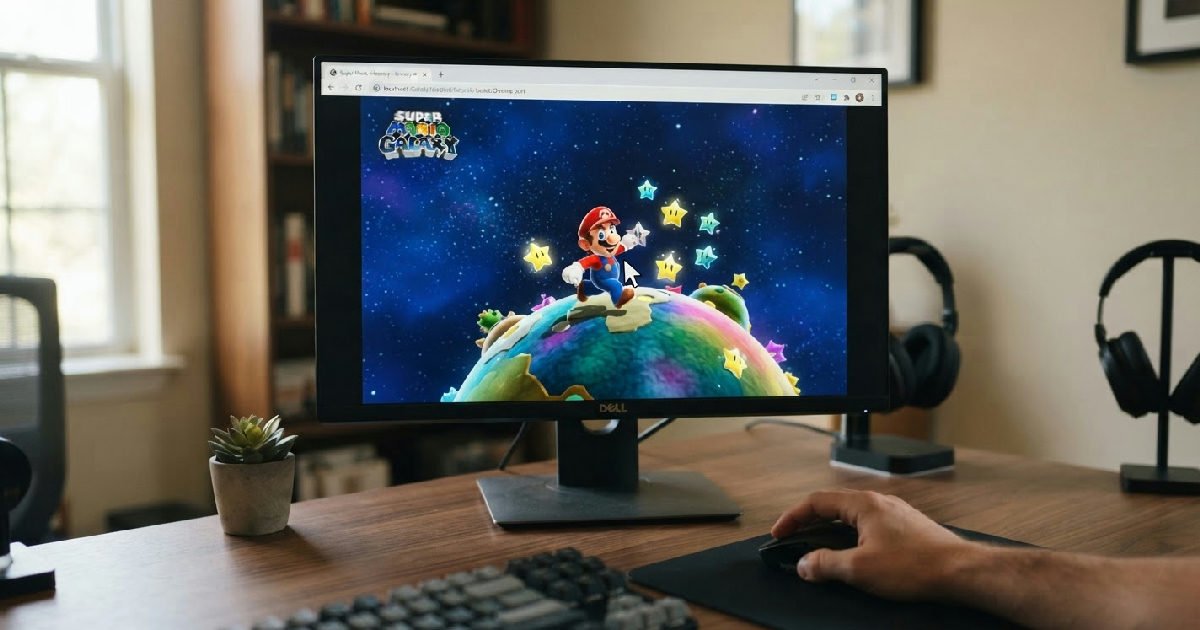
Super Mario Galaxy browser port now features mouse controls
A browser version of the critically acclaimed 2007 title, Super Mario Galaxy, has recently become available, notably integrating mouse controls. This development marks a significant shift for a game originally defined by its reliance on Nintendo Wii motion controls.
The port offers a new accessibility option for players who struggled with or preferred an alternative to the original input method, bringing one of Nintendo’s most beloved 3D platformers to web browsers.
AI’s pivotal role in the Super Mario Galaxy browser port
The emergence of this browser port highlights a growing trend in game preservation and accessibility, driven in part by advancements in artificial intelligence. While the original game remains a touchstone for its innovative physics and level design, its motion-centric gameplay has long been a barrier for some. This browser iteration directly addresses that, offering an experience many have long wished for.
The ability to bring complex console games like Super Mario Galaxy to web browsers or PC platforms owes much to the evolution of game decompilation. Historically, this was a painstaking process where dedicated enthusiasts would manually reverse-engineer a game’s binary code, translating its 0s and 1s into readable C++ code. This method was incredibly time-consuming and required deep technical expertise.
However, the landscape has changed dramatically with the advent of advanced AI tools. Artificial intelligence, such as Claude Code, has begun to streamline this intricate process, capable of rapidly generating substantial portions of complex software.
This acceleration has led to a noticeable increase in fan-made ports of older titles appearing across various platforms, from web browsers to native PC applications. It’s a development that excites preservationists but equally raises concerns among copyright holders.
An example of this AI-assisted development is a specific fan-made browser version of Super Mario Galaxy, which was reportedly announced or discussed around April 2, 2026.
This particular project leveraged Claude Code to write approximately 95% of its underlying programming, demonstrating the significant impact AI is having on the speed and scale of these porting efforts. Such projects have opened up classic titles to broader audiences, including those who may not own the original hardware or prefer modern control schemes.
Expanding the galaxy: other notable fan projects
Beyond the browser port, the fan community has actively pursued other avenues to bring Super Mario Galaxy to new platforms, predominantly through native PC ports. These projects often aim to enhance the original experience with higher resolutions, improved frame rates, and modern control options. Each takes a slightly different approach to development and legal compliance.
One prominent example is “Nebula,” a decompiled PC port designed to run Super Mario Galaxy natively across multiple operating systems, including Windows, Linux, macOS, Android, and iOS/iPadOS. Developed by an individual user known as “keepvaibin,” who began work in June and utilized AI assistance from Anthropic’s Claude, Nebula has seen significant progress.
Co-op horror successes like Content Warning prove that innovative gameplay experiences resonate widely, much like these re-imagined classics.
Nebula’s feature set and technical requirements
Nebula’s version 1.0.2 is already fully playable, offering a host of modern features. It supports keyboard and mouse input, as well as various gamepads including Xbox, Switch Pro, and Switch 2 Pro Controllers, with fully remappable controls. For Switch controllers, it even mimics the original Wii Remote experience by utilizing gyro for pointing and tilt for in-game mechanics like Star Ball and ray surfing.
Graphically, Nebula pushes beyond the Wii’s capabilities, supporting aspect ratios from 4:3 up to ultra-widescreen 32:9. It allows for internal resolutions up to 16x and frame rates exceeding 60 FPS. Advanced visual enhancements include anti-aliasing (SMAA, FXAA), AMD FidelityFX FSR 1 upscaling, NVIDIA DLSS upscaling, and anisotropic filtering.
To play, users need a copy of the North American disc (RMGE01) as an ISO, RVZ, or extracted folder, along with a Windows 10 or 11 64-bit system, a Direct3D 12-compatible GPU, and 8 GB of RAM.
AstroCore: a human-coded alternative
Another significant undertaking is “AstroCore,” an unofficial native PC port developed by Luma’s Workshop. This project distinguishes itself by claiming 100% human-written code, explicitly avoiding AI assistance. While it remains in development without a public download as of October 7, 2026, a trailer has showcased the game running smoothly at 60 FPS on PC.
The AstroCore team aims for broad compatibility, planning support for Windows, macOS, Linux, SteamOS, and Android via the Aurora compatibility layer. Their ambitious plans include support for various controllers, custom button mapping, and even texture pack compatibility.
Following the completion of AstroCore, Luma’s Workshop intends to begin work on a similar PC port for Super Mario Galaxy 2, further solidifying the community’s dedication to these titles.
Nintendo’s stance and official adaptations
Nintendo, a company renowned for its aggressive protection of intellectual property, views these fan-made projects with a keen and often litigious eye. The company has a long history of pursuing legal action against unauthorized use of its copyrights and trademarks, frequently issuing DMCA notices to sites hosting emulators, ROM hacks, and fan games.
This firm stance is consistently reiterated by leadership, including President Shuntaro Furukawa, who has publicly stated that action must be taken against any behavior undermining Nintendo’s IP policy.
The legal status of these fan ports often exists in a gray area. PC versions that require players to provide their own ROMs or game copies often argue they are skirting direct copyright infringement, as they aren’t distributing illegal copies themselves.
However, browser versions, like the Super Mario Galaxy port that initiated this discussion, are more straightforward, as they often directly provide the game to play, making them a clearer target for Nintendo’s legal teams.
The official Switch 2 release with co-op mouse controls
Interestingly, Nintendo has also acknowledged the desire for updated control schemes for its classic titles. On October 2, 2025, Nintendo released an official bundled port of Super Mario Galaxy and Super Mario Galaxy 2 for the Nintendo Switch 2. This official release confirmed mouse control support for both games, though it’s specifically for co-op gameplay.
This detail was outlined on the Japanese Nintendo website, indicating the company is attentive to modern control preferences, albeit within its own ecosystem.
Beyond mouse controls, the Nintendo Switch 2 ports, developed by U.S.-based Nintendo Software Technology, brought significant upgrades. These include higher resolutions—4K in docked mode and 1080p in handheld mode—along with Amiibo support and an added Assist Mode. They also updated UI and fonts for modern televisions, and introduced new chapters and music for Rosalina’s Storybook, further enhancing the official versions.
The evolving landscape of game preservation and AI
The dual trends of AI-assisted development and aggressive IP enforcement create a complex environment for game preservation. Fan projects, like the Super Mario Galaxy browser port, often stem from a desire to preserve and modernize games that might otherwise become inaccessible or difficult to play on contemporary hardware.
They fill a gap that official channels sometimes cannot or choose not to address, offering renewed life to classic titles.
However, Nintendo’s consistent legal actions against projects like the Super Mario 64 PC port in 2020 and various other fan games demonstrate the significant risks involved for creators. The company views such projects as unauthorized derivative works, regardless of whether they are commercial.
This aggressive stance, while understandable from an IP protection perspective, frequently draws criticism from within the gaming community, with many arguing it stifles creativity and hinders broader game preservation efforts. The Elder Scrolls 6 awaits official revelation, highlighting the contrast with fan-driven preservation.
The rise of AI in coding only exacerbates this tension. As AI tools make it easier and faster for individuals to create sophisticated ports, the volume of such projects is likely to increase, presenting an ongoing challenge for companies like Nintendo to monitor and control.
This technological shift means the legal battles over fan-made content are likely to intensify, rather than diminish, as the line between manual effort and AI generation blur. This creates a fascinating and potentially fraught future for the relationship between game developers, fans, and intellectual property.
The long-term implications for game accessibility are still unfolding. While official re-releases, such as the Super Mario Galaxy ports for Nintendo Switch 2, offer high-quality experiences, they don’t always cover every classic or address every fan desire for control customization.
Fan-made projects, though legally tenuous, serve as a vital, if unofficial, channel for players to experience beloved games in new ways. This dynamic ensures that the conversation around how classic games are preserved, accessed, and played will continue to be a central theme in the gaming world for years to come.
Star Trek Online players often celebrate their own game’s history, reflecting a similar passion for classic gaming experiences and their communities.