

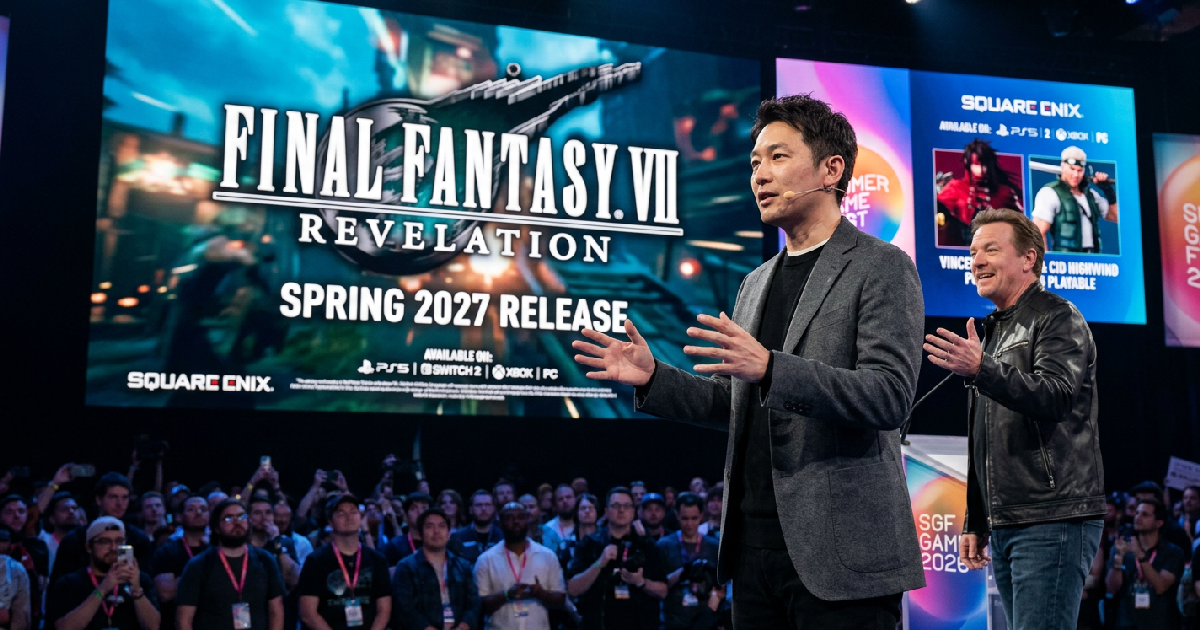
Square Enix announces Final Fantasy 7: Revelation for spring 2027 release
Square Enix officially announced Final Fantasy VII: Revelation at Summer Game Fest 2026, confirming the title as the final installment in the ambitious Remake trilogy. Director Naoki Hamaguchi took the stage alongside Matthew Mercer, the English voice of Vincent Valentine, to debut the first trailer and an extended look at gameplay.
The project, which concludes the reimagining of the 1997 classic, is scheduled to launch in spring 2027.
In a significant shift for the sub-series, Square Enix confirmed a simultaneous multi-platform release. While the first two entries were initially tied to PlayStation hardware, Revelation will launch on PlayStation 5, Xbox Series X|S, Nintendo Switch 2, and PC via Steam and the Epic Games Store. This move follows a development process that embraced multi-platform support from the outset to ensure parity across all systems.
Director Naoki Hamaguchi stated that the central theme of the finale is “resolve.” The narrative focuses on Cloud Strife and his party members as they see through the core tenets of their journey across a world under threat. Despite the broader range of target hardware, the development team explicitly stated they will not compromise on graphics, utilizing Unreal Engine 4 to maintain high visual standards.
Playable Vincent Valentine and Cid Highwind lead combat updates
The announcement confirmed that both Vincent Valentine and Cid Highwind will be fully playable party members for the first time in the trilogy. Square Enix described the duo as having “incredibly appealing combat capabilities.” The transition from supporting characters to active fighters includes the addition of new dual-character combo attacks, expanding the tactical depth of the established battle system.
Vincent’s gameplay features his proficiency as a gunslinger, while Cid brings his signature lance-based combat to the front lines. The reveal showcased how these new members integrate into the existing party dynamics, fulfilling a long-standing request from the fanbase. Players will need to use the full roster strategically, as the game reportedly requires the party to “divide and conquer” various conflicts occurring across the planet.
Unlike previous entries which focused on the struggle against corporate consolidation and industry giants represented by the Shinra Electric Power Company, this finale leans into the mythological stakes of the setting. The trailer provided a first glimpse at the Weapons, the colossal and terrifying late-game enemies that served as major challenges in the original 1997 release.
The Highwind and seamless world exploration
One of the most substantial technical updates in Final Fantasy VII: Revelation is the inclusion of the Highwind airship. This legendary vessel allows players to navigate a massive, freely explorable open-world map. Square Enix has designed the planet to be fully accessible, moving away from the more segmented regions seen in the previous entry, Rebirth.
A new traversal mechanic allows players to parachute from the Highwind at any given point during flight. This feature enables a seamless transition from the air to any location on the ground, facilitating immediate exploration of the world below.
Such technical ambition mirrors the industry’s push toward massive, interconnected environments, similar to the scale expected in the release of Grand Theft Auto 6 later that year.
Chadley, the research assistant who helped players track “Intel” throughout the first two games, was also confirmed to return for the third chapter. While the specifics of his role weren’t detailed, his presence indicates that world-scanning and side-content management will likely remain pillars of the exploration loop as players traverse the continents on the Highwind.
Multi-platform strategy for the trilogy finale
The decision to include the Nintendo Switch 2 and Xbox Series X|S in the launch window marks a strategic pivot for the franchise. By releasing on all major platforms simultaneously, Square Enix is ensuring the entire trilogy will be accessible to a broader audience. The developers emphasized that the game was built with this multi-platform approach in mind from the start of production.
As the project nears its final year of intensive development, the focus remains on closing the narrative threads that began with the Remake in 2020. Whether the “seeds of change” planted in the first two games will result in a different conclusion than the original story remains the key question for fans.
Final Fantasy VII: Revelation stands as the culmination of a decade-long effort to modernize one of gaming’s most influential stories.