

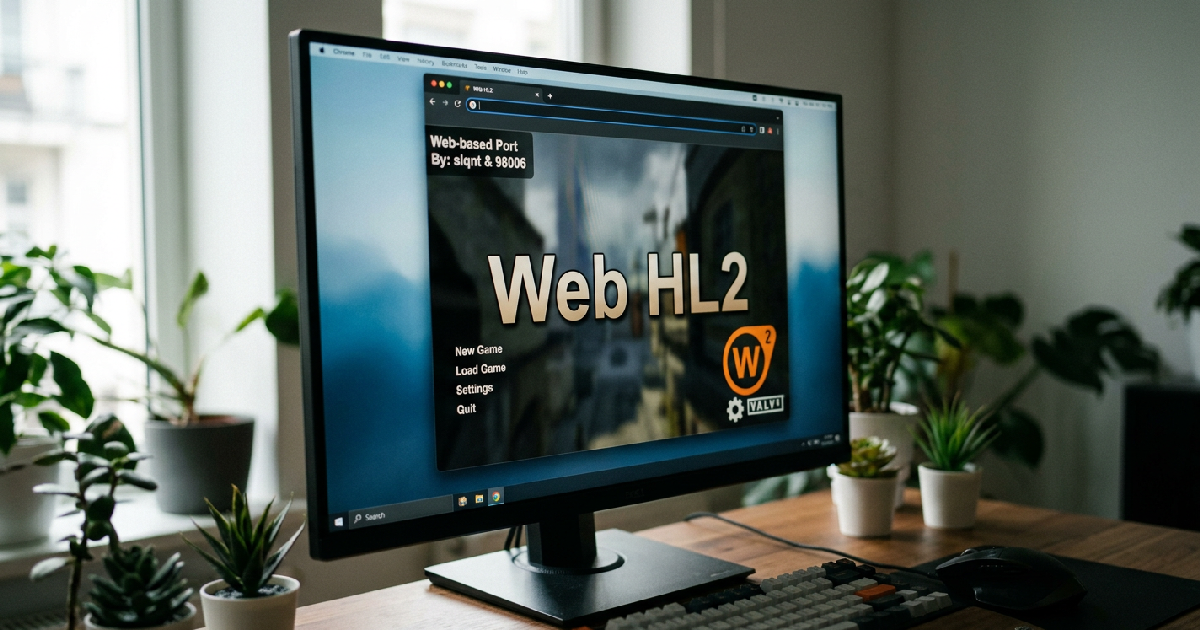
Slqnt and 98006 release browser port of Half-Life 2 on June 24, 2026
A high school developer known as slqnt, along with collaborator 98006, released a full browser port of the legendary shooter Half-Life 2 on June 24, 2026.
This unofficial project, titled Web HL2, allows players to experience the entire campaign of the 2004 classic directly within a modern web browser without requiring a Steam account, local installations, or large file downloads.
How the Half-Life 2 browser port functions
The release follows a similar technical feat by an enthusiast named weliveinhell, who previously produced a browser-based version of Portal, providing the essential groundwork for this ambitious expansion into the Half-Life universe.
The achievement represents a significant technical milestone in the preservation and accessibility of Valve Corporation’s most celebrated titles. By utilizing an open-source fork of a modified 2020 Team Fortress 2 (TF2) Source Engine leak, maintained by nillerusr, the developers have successfully bypassed the traditional hurdles of PC gaming hardware requirements.
And while Valve has not officially sanctioned the release, the project underscores the enduring cultural footprint of the Source Engine and the creative ingenuity of the community that continues to push its boundaries two decades after its initial debut.
Under the hood, Web HL2 relies on a complex chain of modern web technologies to replicate a high-fidelity 3D experience. The primary engine behind the port is Emscripten, an open-source compiler toolchain that converts C and C++ code into WebAssembly. This allows the game’s core logic to run at near-native speeds within the browser.
The rendering is handled via WebGL2, which translates OpenGL ES calls in real-time. Because the game runs locally on the user’s machine through the browser, it requires a relatively modern desktop environment to maintain stable performance.
Key details
Players accessing the project via the hl2.slqnt.dev wedding site will notice that the game does not require a massive initial download. Instead, map assets are packed into individual .data files and streamed in the background as the player progresses through the story.
This “just-in-time” delivery system mirrors modern cloud gaming services but operates entirely on the client side. Save data and personalized configurations are managed through IndexedDB, the browser’s built-in storage system, ensuring that players don’t lose their progress between sessions.
Technical foundations and developer history
The developer, slqnt (pronounced “slant”), reportedly spent three months building the Half-Life 2 port. Despite being a student, slqnt has been programming for roughly five years and leveraged the work of several others in the Source Engine modding scene.
The project heavily references the Portal web port created by weliveinhell, which proved that the Source Engine’s ToGLES rendering mode could be successfully adapted for the web. This layered approach to development shows how open-source collaboration facilitates projects that would otherwise take years to complete.
And while the project is technically impressive, it is strictly non-commercial. The developers utilized a 2020 leak of the Team Fortress 2 Source Engine, which carries a specific caveat: it cannot be used for profit. This distinction is critical given the legal history of fan-made Valve projects.
In the past, Valve has been relatively lenient regarding non-commercial mods, provided they do not facilitate piracy or misrepresent the brand. However, since this port carries the full game campaign for free, its long-term survival remains an open question for the community.
Gameplay features and performance limitations
The browser version of Half-Life 2 is not merely a tech demo; it is a playable realization of the full game. Users can access the entire campaign, use the developer console for cheats and tweaks, and experience the physics-based puzzles that defined the title.
slqnt confirmed that the build is stable enough to be played from the opening train ride in City 17 to the final explosion at the Citadel. But the transition to a web environment hasn’t been without its compromises, particularly regarding visual fidelity and character animation.
One of the most notable omissions is the lack of face morphing. Half-Life 2 was famous for its expressive character animations, but the current browser build lacks the necessary hooks to render these facial movements, leaving NPCs with static expressions during dialogue. Furthermore, players have reported inconsistent frame rates and occasional FPS drops.
Key details
These performance hiccups are expected, as the game is competing for system resources with other browser processes. Minor graphical glitches, such as missing textures or broken water effects, were common during early development, though many have since been patched by the team.
It is also worth noting that this port is built on an older version of the Source Engine. As a result, it does not support the high-fidelity assets or lighting improvements found in the Valve Debuts IEM Cologne Major 2026 Stickers update or the 20th Anniversary Edition released in late 2024.
For those seeking the pristine, modernized experience, the official Steam version remains the definitive choice. However, for a quick session at a school library or on a work machine, the web port offers a convenience factor that is hard to ignore.
Legal concerns and Valve Corporation copyright
The legal status of Web HL2 is precarious. Half-Life 2 is a paid product, typically retailing for $9.99 on the Steam store. By providing the game in its entirety through a public URL, the project technically provides a way to play the title without purchase.
While Valve has a history of supporting its modding community—most famously by allowing Bobby Kotick Claims Lawsuit cases to proceed alongside industry shifts—the company is protective of its core intellectual property. There is a tangible risk that the project may face a DMCA takedown request in the near future.
The developers have attempted to stay within the “grey area” by emphasizing the educational and experimental nature of the port. They have explicitly stated that the project is for non-commercial purposes. However, the use of leaked engine code adds another layer of complexity.
Key details
Unlike projects like Black Mesa, which began as a mod and eventually received Valve’s blessing for a commercial release, Web HL2 is a direct port of the original game files. Until Valve makes a public statement, the site exists in a state of digital limbo.
Compatibility and hardware requirements
Despite being a “browser game,” Web HL2 is not compatible with all devices. It requires a modern desktop browser with full WebGL2 support, such as Google Chrome, Microsoft Edge, Mozilla Firefox, or Opera. The developers have tested the port across Windows, macOS, and Linux, finding success on all three platforms provided the hardware is sufficient.
However, mobile support is currently a major hurdle. While the site can technically load on a smartphone, the lack of touch controls makes it unplayable without an external keyboard.
For users who want to try the port, the following steps are generally recommended:
- Ensure your browser is updated to the latest version.
- Close unnecessary tabs to free up memory (RAM).
- Wait for the initial .data file to load before clicking “New Game.”
- Use the console (tilde key) if you encounter stuck NPCs or broken scripts.
The future of the Source Engine on the web
The success of the Half-Life 2 and Portal browser ports suggests that we are entering a new era of retro-game accessibility. As browser engines become more powerful and WebAssembly efficiency improves, the barrier between native applications and web pages continues to thin.
slqnt has already hinted at future development, suggesting that both Half-Life 2: Episode One and Episode Two are next on the list for porting. This would complete the Gordon Freeman saga for the browser platform, provided the project remains online.
But the broader implication for the gaming industry is perhaps more interesting. As legacy titles reach their 20th or 30th anniversaries, community-driven ports often become the best way to ensure they remain playable on modern hardware.
Key details
Much like the browser-based versions of Doom or Quake that preceded it, Web HL2 serves as a living museum piece. It demonstrates that the Source Engine, despite its age, remains a versatile and resilient piece of software architecture.
Whether this project survives the week or remains a permanent fixture of the internet depends largely on Valve’s next move. In an era where cloud gaming and subscription services are becoming the norm, a community-driven, free-to-play browser port of a classic title feels like a rebellious throwback to the early days of modding.
Even if it is eventually removed, the technical blueprint created by slqnt and 98006 has already proven that even the most complex 3D worlds of the early 2000s can live entirely within a browser window.
Fans looking for more official news from the developer might also be interested in the Grand Theft Auto 6 release date confirmation, which highlights the massive technological leap the industry has taken since Half-Life 2 first changed the world of FPS gaming.