

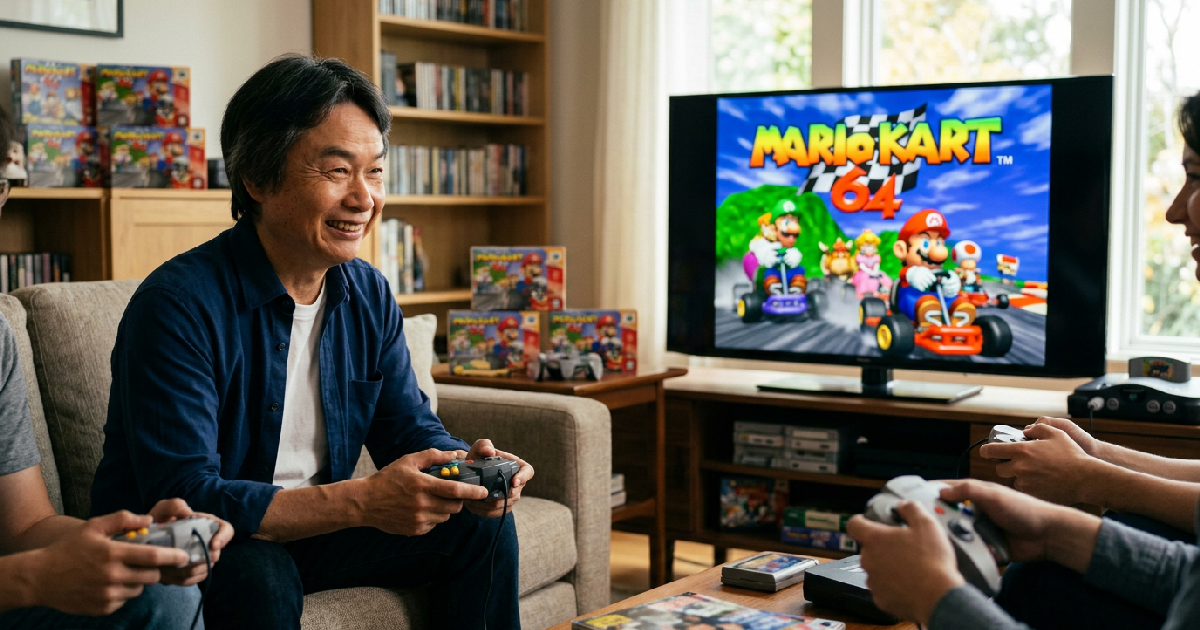
Shigeru Miyamotos Mario Kart 64 sales figures
Nintendo EAD and Producer Shigeru Miyamoto cemented the Mario Kart series as a pillar of the gaming industry with the release of Mario Kart 64, a 1996 title that sold 9.87 million copies worldwide.
While the original Super Mario Kart on the SNES introduced the concept of mascot racing, the Nintendo 64 sequel transformed the brand into a cultural institution by introducing full 3D course environments and the now-standard four-player split-screen multiplayer mode.
The technological leap to three-dimensional racing
Director Hideki Konno oversaw the project, which remains the second best-selling game on the Nintendo 64 hardware, trailing only the seminal Super Mario 64.
The game’s impact is still felt across the industry today. As we mark the 30th anniversary of the Nintendo 64’s June 1996 launch, the design choices made by Nintendo EAD continue to dictate the mechanics of modern racing titles.
From the controversial “blue shell” or Spiny Shell to the refined drifting system, Mario Kart 64 provided the blueprint for every subsequent entry in the franchise.
It successfully bridged the gap between a niche experiment and a system-selling masterpiece that appealed to audiences “from age 3 to 100,” a specific development goal cited by Shigeru Miyamoto during the game’s production cycle.
The transition from the 16-bit era to the 64-bit generation allowed Nintendo to move away from the flat “Mode 7” maps used in the original Super Mario Kart. Mario Kart 64 featured 16 distinct tracks that utilized verticality and advanced rendering techniques.
These courses were no longer mere flat planes; they included hills, bridges, and tunnels that fundamentally changed how players interacted with the environment. Tracks like Wario Stadium and DK’s Jungle Parkway showcased the hardware’s ability to render complex elevations and outdoor vistas that were previously impossible.
Key details
Despite the move to 3D, the development team faced significant technical hurdles. Developers used specific rendering techniques to save memory for track design due to N64 processing power limitations. Director Hideki Konno originally experimented with realistic RC car physics, but early testing with children revealed the controls were “unplayable” for a general audience.
This led the team to adopt a more accessible driving model that emphasized fun over simulation, a strategy that defines the kart racer subgenre today. Even modern titles, such as the Star Fox day one update on Switch 2, build upon this legacy of high-performance localized action.
Key details
The roster also saw a significant overhaul that reflected the evolving Mario universe. Koopa Troopa and Donkey Kong Jr. were removed from the starting lineup, replaced by the more charismatic Wario and a modern version of Donkey Kong.
These changes accompanied a shift in audio design; Mario Kart 64 was the first time many western players heard the iconic “bombastic line reading” of Charles Martinet, whose “Welcome To Mario Kart!” remains a legendary invitation to the series.
The game even added onomatopoeia such as “Poomp!”, “Boing!”, “Crash”, and “Whirrrr” for the first time in the series.
This personality extended to the track design. Unlike the SNES version, which featured multiple iterations of themes like Mario Circuit and Bowser’s Castle, the N64 version ensured each of its 16 tracks felt unique.
From the bustling traffic of Toad’s Turnpike to the eerie atmosphere of Banshee Boardwalk, the game placed a heavy emphasis on environmental storytelling. These tracks were longer, requiring the laps-per-race to be reduced from five to three.
Much like the anticipation for Strauss Zelnick confirms Grand Theft Auto 6 release date, the wait for this sequel was high, leading to over 1 million US sales within its first two months.
Commercial legacy and the Nintendo Switch Online era
Financially, Mario Kart 64 was a triumph that helped Nintendo maintain its market share. Backed by a $5 million US advertising campaign, the game reached 6.23 million copies in the United States alone by 1999.
Howard Lincoln, Nintendo of America chairman, stated the difference in time between Japanese and American releases was due to “the company’s desire to release the game during the holiday season in Japan, considering a lack of N64 releases in the region.” The game eventually launched in North America on February 10, 1997.
Today, the game is more accessible than ever through the Nintendo Switch Online Expansion Pass. While some modern players struggle with early 3D frame rates, the core gameplay loop remains remarkably intact.
The game’s inclusion on “Nintendo Classics” allows a new generation to experience the title that turned a racing experiment into a multi-billion dollar brand. It is a testament to the work of Kenta Nagata, whose solo soundtrack composition continues to be celebrated.
Key details
The industry still studies these legacies, as seen in how enthusiasts monitor the IEM Cologne Major 2026 stickers market update for similar long-term community value.
Ultimately, Mario Kart 64 did more than just sell nearly 10 million cartridges; it transformed the series into a permanent fixture of popular culture.
Whether through the frustration of a last-second blue shell or the triumph of a perfectly executed shortcut, the emotional resonance of the 1996 classic continues to define what it means to play a Nintendo game.
Its success guaranteed that Mario’s racing career would be a permanent fixture in the gaming landscape, ensuring the drive to succeed would never hit a dead end.