

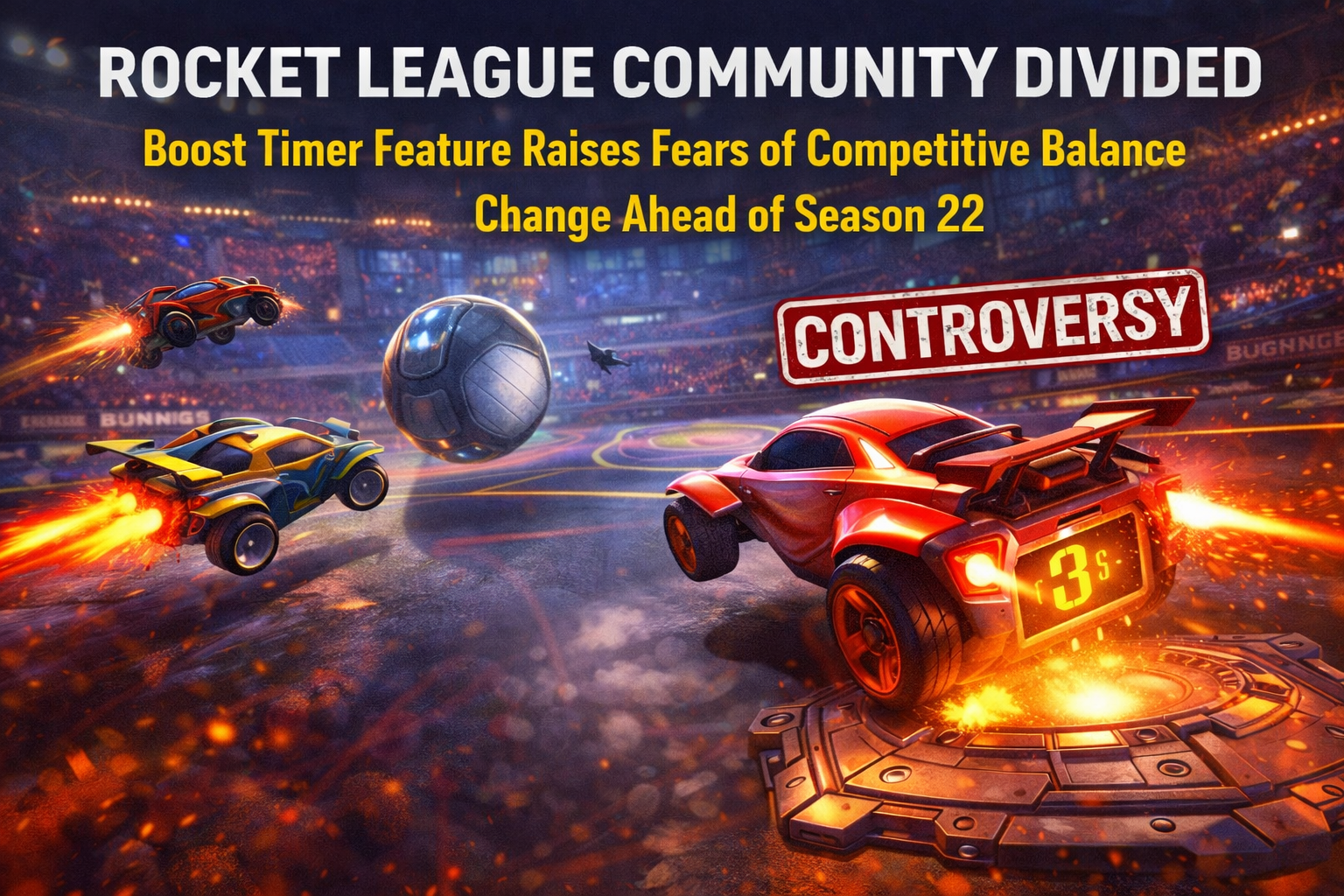
Rocket League Community Erupts Over Possible Boost Timer Feature Ahead Of Season 22
A brief promotional teaser has triggered one of the most heated gameplay debates Rocket League has seen in years. With Season 22 approaching, players are now questioning whether a fundamental part of the game’s competitive identity could soon change.
The controversy centers on what appears to be a simple quality-of-life feature — a visible boost respawn timer. But for a game built on mechanical mastery and subconscious awareness, even a small informational change can carry enormous competitive consequences.
Across social platforms and forums, players are already drawing battle lines over what this potential feature represents: accessibility… or erosion of skill.
The Teaser That Started The Debate
The discussion began after a short preview clip showed a player collecting boost, leaving the area, and returning at the exact moment the resource respawned.
That level of precision immediately raised questions.
Was the player predicting timing through experience — or seeing information that the interface normally hides?
Many viewers interpreted the moment as a hint that Rocket League may introduce a visible countdown showing when boost pads will reappear.
Nothing has been officially confirmed. But speculation alone was enough to ignite widespread reaction.

Why Boost Timing Is Such A Big Deal
In casual play, boost is simply fuel for speed and aerial control.
In competitive environments, it is far more than that — it is strategic currency.
Elite players track multiple boost locations mentally while positioning themselves around the field. Rotations, defensive recoveries, and offensive pressure all depend on predicting resource availability without visual assistance.
This invisible awareness is not just helpful — it is a defining skill.
Mastering it takes hundreds of hours of gameplay, repetition, and pattern recognition. Many high-rank players consider boost tracking part of Rocket League’s competitive language.
A visible timer would fundamentally change how that language is learned — and who speaks it fluently.
Accessibility Versus Mastery
Supporters of the rumored feature see it as long overdue modernization.
New players often struggle with boost management because spawn timing is never explicitly shown. Learning depends entirely on memory and trial-and-error. A visual timer could shorten that learning curve dramatically.
From this perspective, the change would not reduce skill — it would remove unnecessary obscurity.
Critics disagree sharply.
Veteran players argue that removing hidden knowledge reduces the value of experience. If every player can see timing information instantly, the advantage gained through practice disappears.
To them, the concern is not difficulty — it is competitive differentiation.
A Familiar Conflict In Competitive Game Design
This debate reflects a broader tension seen across modern multiplayer games.
Developers regularly attempt to make systems clearer and more welcoming. But competitive communities often define skill through precisely those opaque mechanics.
When information becomes visible, automation increases, or mechanical barriers are reduced, experienced players frequently feel their expertise has been devalued.
Similar controversies have emerged in other competitive titles where long-practiced techniques were simplified or standardized for broader accessibility.
Rocket League now appears to be facing its own version of that philosophical divide.
Trust Issues Amplify Player Reactions
Community response is also shaped by historical context.
Since Epic Games assumed oversight of Rocket League, several controversial changes have reshaped the game’s ecosystem — including the removal of player-to-player item trading, a move that generated widespread backlash.
Because of past decisions, many long-time players now approach new changes with skepticism. Even small interface adjustments are viewed through the lens of competitive identity and player trust.
The boost timer debate is therefore not only about gameplay — it is about confidence in the direction of the game itself.
Possible Compromise Ideas Emerging From Players
Not all reactions are purely supportive or opposed.
Some players have suggested partial implementation, such as:
- Timers only in beginner ranks
- Separate settings for casual modes
- Training-mode visibility only
- Optional toggle features
These proposals attempt to balance onboarding improvements with preservation of high-level competitive mechanics.
Whether developers would consider segmented implementation remains unknown.
What Happens Next
At this stage, the boost timer remains speculation. The teaser offers no confirmation, and no official announcement has clarified how Season 22 will handle boost mechanics.
Yet the intensity of community response already demonstrates the stakes.
For newer players, visible timing could make Rocket League more intuitive and less punishing to learn.
For veterans, it could redefine a skill they have spent years refining.
And for developers, the decision represents a familiar but difficult question:
Should competitive mastery remain earned through hidden knowledge — or made visible for everyone?
Season 22 may soon provide the answer.
Source: https://www.polygon.com/rocket-league-boost-timer-controversy/