

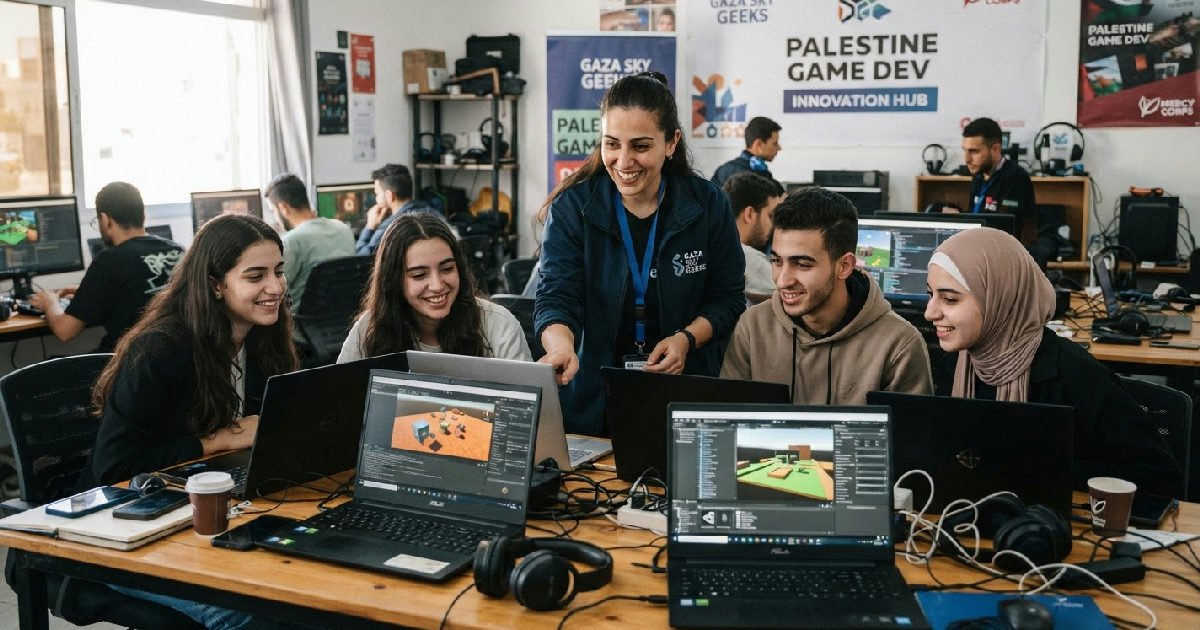
Leyan Zahdeh Drives Gaza Sky Geeks’ Palestinian Game Development Boom
Gaza Sky Geeks, the pioneering tech hub in Palestine, has dramatically scaled up its game development program. Registrations jumped from 150 to over 1,000 in a single year.
This remarkable growth, led by Tech Unit Officer Leyan Zahdeh, comes despite the profound challenges of ongoing conflict, displacement, and damaged infrastructure across Gaza and the West Bank. Roughly 600 participants are now actively engaged in training, transforming adversity into an urgent drive for digital skills.
Surge in Gaza Sky Geeks game development training amidst adversity
The program, part of the non-governmental organization Mercy Corps, has meticulously redesigned its curriculum to function amidst frequent blackouts, unreliable internet, and limited access to working equipment. This adaptability is a testament to the resilience of young Palestinians and Gaza Sky Geeks’ mission to foster economic opportunity through technology, even after its main Gaza building was severely damaged following the events of October 2023.
The sheer demand for game development skills has taken even the Gaza Sky Geeks team by surprise. In just one year, the initiative has seen an explosion in interest, moving from a cohort of 150 participants to now managing over 1,000 registrations, with 600 individuals currently undergoing intensive training across Palestine.
This rapid expansion highlights a deep-seated desire among young Palestinians for practical, future-oriented digital competencies. Leyan Zahdeh emphasized that many don’t want training that merely ends with a certificate.
They’re seeking to build tangible portfolios, publish visible work, and ultimately prove their abilities in a competitive global market, reflecting broader shifts in market valuation methods.
The operational environment for these aspiring developers is uniquely fraught. Students regularly contend with unstable power grids, weak internet connections, and often damaged or unavailable laptops. Finding a quiet, safe space to work is a luxury, compounded by the constant threat of displacement and pervasive uncertainty.
Redesigning curriculum for unstable realities
Gaza Sky Geeks has innovated its teaching methodologies to meet these extreme conditions head-on. The program now emphasizes simpler workflows, focusing on 2D and light 3D projects that are intentionally kept small. This approach ensures work can survive dropped connections or missed live sessions, which are commonplace.
Instead of rigid live classes, students lean heavily on recorded lessons, written instructions, and smaller, more achievable milestones with flexible deadlines. Teams are capped at three members, strategically chosen to foster local support, utilize clear roles, and implement regular backups and careful file handling to minimize friction.
Despite these profound obstacles, Zahdeh notes that high-quality games are still emerging from the program. These projects often draw inspiration from students’ imaginations, hopes, memories, daily struggles, and even humor, transforming game development into a powerful outlet for expression and creation under pressure.
Building visible portfolios beyond basic certificates
The appeal of game development extends far beyond traditional software roles, attracting a diverse pool of talent. It encompasses coding, art, user interface design, animation, sound production, and project management. This multidisciplinary nature resonates with a broader segment of young Palestinians looking for creative as well as technical outlets.
The program’s 8-month curriculum is structured around two core tracks: programming and art/design. Both are built upon a foundation of prototyping, iteration, and portfolio development. Programming students master Unity and C#, alongside version control and debugging, while building playable gameplay systems.
The art and design track covers essential skills like 2D and 3D asset creation, UI/UX principles, animation, and level design. Both tracks share common industry tools, including Unity, Blender, Figma, Aseprite, and FMOD. This holistic approach ensures graduates are well-versed in the practicalities of game production.
Expanding skillsets for creative roles
Gaza Sky Geeks consciously launched games as a dedicated track, understanding that making a game requires a distinct set of skills beyond functional code. It demands interaction design, systems thinking, player psychology, and art direction. Success is measured by engagement and fun, not just technical execution.
This deliberate focus means students learn game creation through practical prototyping, iteration, playtesting, and feedback cycles. It opens doors for artists, designers, storytellers, animators, and UI/UX specialists, ensuring a comprehensive pathway for a wide array of creative and technical individuals.
Such specialized skills are increasingly sought after in the global tech economy. This demand highlights the critical need for robust training programs that can empower individuals with future-facing digital competencies and create pathways to sustainable livelihoods.
Bridging the industry gap with mentorship and studio aspirations
To further professionalize its training, Gaza Sky Geeks is actively onboarding 26 volunteer mentors in 2026. These mentors are crucial for bridging the significant gap between student prototypes and actual industry standards. They review builds, provide essential scope feedback, and assist with portfolio and interview preparation.
The most effective mentors bring real-world, hands-on experience from programming, art, design, production, or publishing. Even a small, consistent commitment, such as monthly office hours or recorded feedback, proves invaluable to students.
Mentors closer to Palestine can handle live sessions, while others contribute through recorded reviews and written critiques.
Gaza Sky Geeks is also exploring the establishment of a Palestinian games studio for 2026. This initiative aims to create a tangible production space that directly connects training with industry work, providing junior graduates with supervised experience, deadlines, and professional expectations that training alone cannot fully replicate.
A production pathway for Palestinian talent
The proposed studio would likely start as a small production nucleus, focusing on co-development and service jobs, Unity prototyping, and educational games. This would gradually build towards creating original Palestinian intellectual property.
Success for such a venture wouldn’t be measured by size, but by its ability to consistently identify talent, support them in a structured environment, deliver real work, and produce high-quality projects reflecting a distinct Palestinian creative voice.
This vision aligns with global trends where economic resilience is increasingly tied to digital innovation, reflecting broader shifts in global financial mechanisms. Creating a sustainable game development ecosystem in Palestine offers a similar pathway to economic independence and global integration for its youth.
The critical role of AI in emerging game development
Artificial Intelligence is already an integrated part of how students at Gaza Sky Geeks learn and work. Participants leverage AI for debugging C# scripts, translating between Arabic and English, generating placeholder art and dialogue, and supporting early prototyping efforts. The focus isn’t on whether to use AI, but how to use it effectively and critically.
Leyan Zahdeh stresses the importance of critical AI use over passive acceptance. Without proper understanding and verification, AI can produce seemingly correct work that ultimately fails to function well within the broader game context.
The program therefore prioritizes intelligent AI application, teaching students when it genuinely helps, when it might mislead, and when it’s best avoided altogether.
While AI can accelerate production workflows, Gaza Sky Geeks emphasizes that core skills like technical ability, design thinking, teamwork, and the discipline to finish a playable game remain paramount. AI serves as a powerful tool, not a substitute for developer expertise, equipping graduates to navigate future industry demands with informed judgment.
Forging Palestine’s future as a gaming hub
The ultimate measure of success for Gaza Sky Geeks goes beyond mere attendance or registration numbers. By January 2027, the program aims for students to graduate with playable portfolios hosted on platforms like GitHub or itch.io. Several teams should produce showcase-level prototypes ready for review by mentors and industry partners.
The next crucial step is ensuring graduates secure initial internships, freelance assignments, or junior roles, fostering genuine engagement with the global game development industry. The strategic goal is to prevent strong graduates from disappearing after the program concludes, by transitioning them into further mentorship, production labs, or paid project work.
This long-term vision is about building a sustainable ecosystem that positions Palestine as an emerging game development hub. The identity they aim to cultivate involves small but highly skilled teams, strong creative direction, and robust remote collaboration capabilities.
They also focus on cultural storytelling, educational and serious games, co-development services, and original intellectual property, a pathway less susceptible to sudden international trade disputes.