

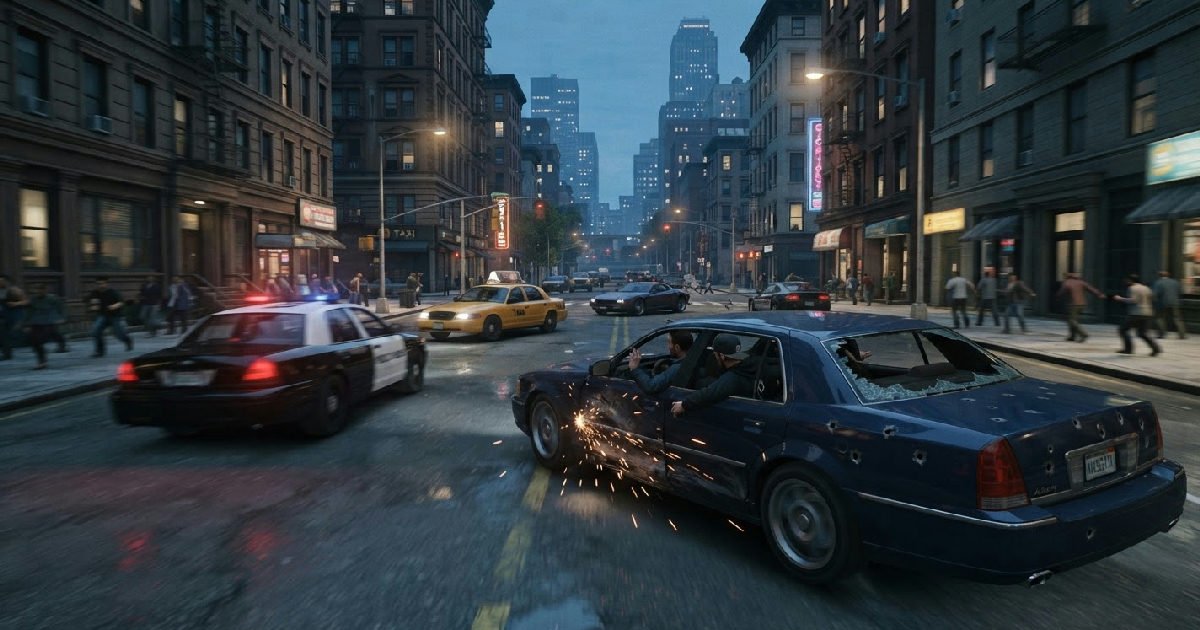
Grand Theft Auto IV multiplayer delivered ‘glorious chaos’ before GTA Online’s structured world
Long before the elaborate heists and criminal empires of Grand Theft Auto Online captivated millions, Grand Theft Auto IV (GTA IV) introduced players to a raw, untamed multiplayer experience. Launched in 2008, this mode was celebrated for its ‘glorious chaos,’ offering a sandbox where player-driven interactions, flexible rules, and explosive vehicles reigned supreme.
Developers Rockstar North and publisher Rockstar Games allowed users to create their own trouble within a meticulously recreated Liberty City.
Defining Liberty City’s multiplayer mayhem
Unlike its successor, GTA IV’s online component eschewed persistent progression and large payouts in favor of spontaneous, unscripted fun. It carved out a unique niche in the evolving landscape of online gaming, providing a foundational blueprint for what an open-world multiplayer could be. This distinct design philosophy fostered a unique brand of mayhem that many veteran players still fondly remember.
Rockstar Games set out with a clear objective for Grand Theft Auto IV’s multiplayer: ‘put players in Liberty City and let them make their own trouble.’ This philosophy manifested in a dynamic environment where up to 16 players on consoles and a staggering 32 players on PC could freely interact. The scale of these lobbies, especially on PC, was significant for its time.
The game offered 15 distinct modes, ranging from free-for-all deathmatches to cooperative tasks and organized-crime contracts in ‘Mafiya modes.’ But it was the sheer flexibility of the rules that truly set it apart. Players could dictate terms, like limiting all weapon selections to only rocket launchers, leading to highly unpredictable and often hilarious outcomes.
Unscripted fun through flexible rules and player count
The design choices in GTA IV multiplayer actively encouraged emergent gameplay. There weren’t elaborate multi-stage missions or endless grind loops; instead, the emphasis was on instant gratification and player experimentation. This allowed for truly unique scenarios to unfold organically within Liberty City.
Imagine 32 players in a ‘Turf War’ mode, all armed with nothing but rocket launchers. PC Gamer’s Kieron Gillen famously described such a scenario involving fire trucks as ‘chaos. Glorious chaos. Glorious never-had-anything-like-that-before chaos.’ It was a testament to how player agency, combined with simple, explosive tools, could generate unforgettable moments.
Physics engine’s role in generating dynamic chaos
A crucial element contributing to GTA IV’s multiplayer dynamism was its acclaimed physics engine. Vehicles felt weighty, crashes were deadly, and the environment reacted believably to destruction. This grounded realism provided a stark contrast to the often absurd actions players would undertake.
Players learned to use the inertia of a careening car during a police chase to their advantage, or witness the comedic ballet of multiple players attempting to navigate the city in high-speed, physics-defying pursuits.
This ‘fascinating collision’ between realistic character movements, reminiscent of Michael Mann’s Heat, and ‘gangster-take on the Keystone Cops’ moments, defined the game’s multiplayer identity. It transformed the single-player narrative’s serious tone into one of ‘inspired clownish stupidity’ when multiple players were involved.
A different vision than Grand Theft Auto Online
The multiplayer of Grand Theft Auto IV stands in stark contrast to its massively successful successor, Grand Theft Auto Online. While GTA Online expanded the ‘shared criminal fantasy into a persistent structure,’ GTA IV opted for a less structured, more immediate approach. This philosophical divergence created two very different player experiences within the same franchise.
GTA Online, released with Grand Theft Auto V, introduced intricate progression systems, businesses to manage, and a constant flow of new content and monetization opportunities. It pushed players towards ‘larger payouts, or layers of progression,’ aspects largely absent in GTA IV’s more raw and anarchic multiplayer sessions.
From chaos to structured progression
GTA IV’s multiplayer offered a simple, albeit robust, framework for players to exist together in the open world. It was about shared moments, emergent narratives, and immediate, explosive confrontations. There was no ‘grind to unlock stupid shit,’ as many would later describe the persistent nature of GTA Online’s economy.
This lack of structured progression meant that success wasn’t tied to accumulating wealth or property, but rather to creating memorable, often ridiculous, moments with other players. It fostered a sense of creative freedom that some argue was lost in the more goal-oriented design of its successor.
Persistence versus spontaneous fun
Grand Theft Auto Online’s persistent world demands long-term engagement, with players investing hours into building criminal empires and earning in-game currency. This model proved incredibly lucrative for Rockstar Games, with Grand Theft Auto V sales reaching massive numbers, partly due to the success of its online component. But GTA IV’s multiplayer was about pure, unadulterated fun, often for short, intense bursts.
The free-roam sessions in GTA IV laid significant ‘conceptual groundwork’ for future titles, showing the potential of an open-world environment as a playground for multiple users. Yet, it offered an alternative vision: a world where consequences were ephemeral and the joy came from the spontaneous combustion of shared bad decisions, rather than a carefully managed criminal career.
Echoes of Liberty City: A legacy that endures
While official support for Grand Theft Auto IV’s multiplayer was shut down in 2020, its spirit lives on. The game’s community, particularly on PC, has kept the experience alive through unofficial means. This dedication speaks volumes about the lasting appeal of its particular brand of multiplayer.
The ability to connect with other players and revisit the chaotic streets of Liberty City showcases the enduring impact of Rockstar North’s original vision. Even without official backing, the experience continues to attract players eager for that distinct flavor of open-world mayhem that is rarely replicated today.
Community-driven survival for GTA IV multiplayer
On PC, the ‘GTA Connected’ platform allows players to continue enjoying the multiplayer mode, offering a vital lifeline to the game’s dedicated fanbase. Console players also report that the multiplayer remains ‘alive to this day,’ indicating that unofficial servers or peer-to-peer connections are still in use. This grassroots continuation is a powerful testament to the game’s legacy.
It highlights how passionate communities can preserve and extend the life of games long after official support ends. For many, GTA IV multiplayer wasn’t just a game mode; it was a digital sandbox where friendships were forged and legendary tales of vehicular destruction and improbable escapes were born.
Grand Theft Auto IV’s influence on open-world gaming
Grand Theft Auto IV’s multiplayer, despite its eventual deprecation, played a crucial role in shaping the trajectory of open-world online games. Its focus on player freedom within a large, interactive city provided a proof-of-concept that would be greatly expanded upon in subsequent titles. This foundational work demonstrated the immense potential for emergent gameplay.
Rockstar Games learned valuable lessons from GTA IV’s approach, refining and expanding upon them for the next generation of Grand Theft Auto titles. This foundational work laid conceptual groundwork, with later titles like Grand Theft Auto Online then characterized by the ‘unpredictable adventure’ found in its lobbies. It was an essential stepping stone.
Paving the way for shared worlds and emergent stories
The idea of simply ‘existing in the world together’ with other players, as GTA IV allowed, was a powerful concept. It fostered a unique brand of social interaction that didn’t rely on predefined objectives or competitive leaderboards. Instead, the narrative often emerged from players’ collective antics and shared experiences, whether it was escaping the police or orchestrating elaborate, improvised stunts.
This early exploration of shared criminal fantasies laid the groundwork for the persistent online worlds we see today. It proved that simply giving players the tools and a world to play in could lead to compelling, unscripted moments that kept them coming back.
The future of Grand Theft Auto multiplayer
As Rockstar Games looks towards future iterations of the Grand Theft Auto franchise, the legacy of GTA IV’s multiplayer remains a fascinating point of reference. While Grand Theft Auto Online has achieved monumental success through its structured progression and live-service model, there’s an underlying appreciation for the spontaneous, less constrained freedom that GTA IV offered.
It raises questions about balancing extensive content and monetization with the raw, player-generated fun that defined earlier open-world multiplayer experiences. The ‘glorious chaos’ of Liberty City’s online streets might be a nostalgic memory for many, but its influence on what players expect from an online sandbox endures.