

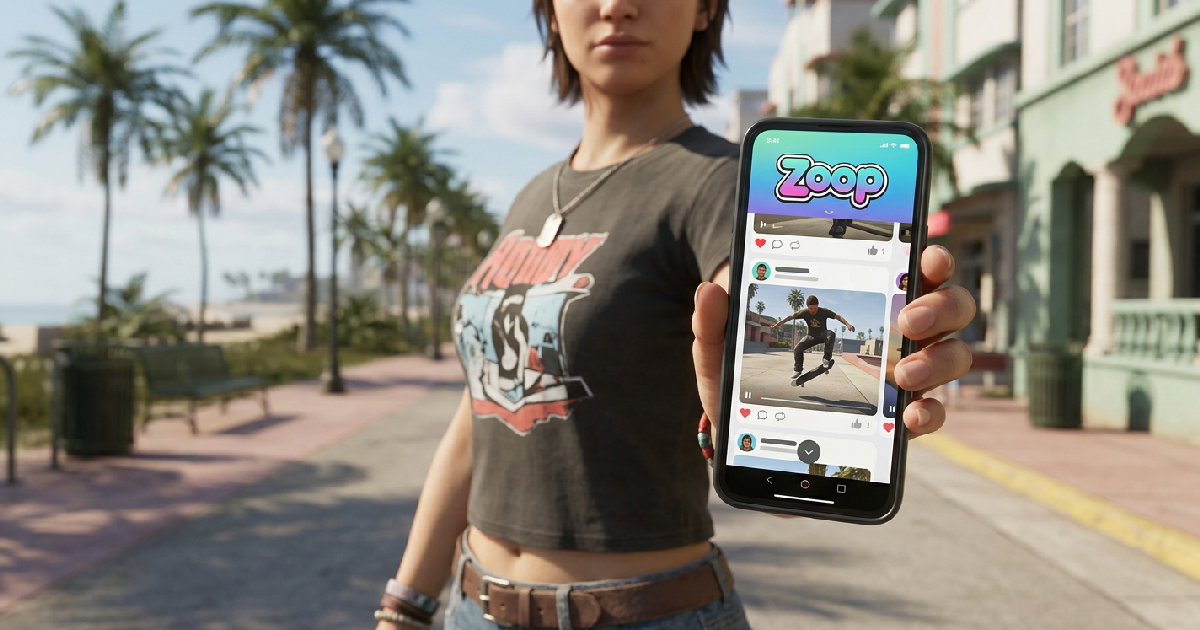
Grand Theft Auto 6 reportedly features Zoop, a TikTok-like social network
Leaked retail listings from Brazilian companies Amazon Brazil and KaBum suggest that Grand Theft Auto 6 will feature an expansive in-game social network called Zoop, designed to parody platforms like TikTok.
According to reports surfacing on June 26, 2026, the feature will allow players to follow influencers, view viral content, and discover secret side missions through their in-game mobile phones.
How the GTA 6 social network changes open world gameplay
While Rockstar Games has yet to officially confirm the “Zoop” moniker or the granular mechanics, the initial reveal trailer for the game already showcased a sequence of vertical, short-form video clips that align with these retail descriptions.
The integration of a functional, reactive social media platform marks a significant evolution for the series, which has previously parodied tech giants through websites like Lifeinvader and Bleeter. In this upcoming iteration, the social network is reportedly more than just a background detail for satire; it serves as a primary hub for gameplay progression.
By scrolling through the feed on their phones, protagonists Lucia and Jason can find “Leonida People” posts—a play on the famous “Florida Man” internet trope—which act as markers for the world events and “Strangers and Freaks” missions that defined the exploration in Grand Theft Auto V.
This development follows months of anticipation after Strauss Zelnick confirmed Grand Theft Auto 6 release date is set for November 19, 2026. The move to a TikTok-style interface reflects the shifting digital landscape of the mid-2020s, where short-form video has become the dominant method of information sharing.
For Rockstar North, world-building has always required a sharp mirror to reality, and in 2026, that reality is inextricably linked to the “clout” economy and the pursuit of viral fame.
The reported “Zoop” platform introduces a “Clout System” that could fundamentally alter how players interact with the state of Leonida. Rumors suggest that if players perform high-octane stunts or commit public crimes, nearby NPCs (non-player characters) will pull out their phones to record the event.
These clips are then “uploaded” to the in-game network with procedural captions and hashtags. This isn’t just for show; a high viral profile might make it significantly harder to lose a wanted level, as citizens may recognize the player or live-stream their location to the police in real-time.
NPC interactions and the scene variant system
To ensure the in-game feed feels “infinite and reactive,” Rockstar has reportedly developed a “Scene Variant System.” This technology allows the game to generate thousands of unique social media posts based on different times of day, weather conditions, and locations.
For example, a video of an NPC wrestling an alligator in a swamp might appear on the feed in dozens of different iterations, preventing the player from seeing the same content twice. This level of detail aims to make the digital world inside Lucia’s phone feel as alive as the physical world of Vice City.
Players may also have the opportunity to interact with NPCs who are “IRL streaming.” Walking into a streamer’s frame and performing an emote could trigger a real-time reaction from the simulated chat on the side of the screen.
This depth of immersion suggests that Rockstar is moving away from the static internet of previous games toward a more dynamic, AI-driven experience that mimics the unpredictable nature of modern social media.
Targeted advertising and digital footprints
The immersion extends to the commercial side of the internet. Leaks indicate that the “Zoop” platform will feature targeted advertising that changes based on the player’s actions in the open world.
If players visit a high-end clothing boutique or browse specific luxury vehicles on the in-game internet, the ads on their social feed will adapt accordingly. It is a cynical, yet accurate, portrayal of modern data tracking that adds another layer of realism to the Vice City experience.
Discovery of side missions and the Leonida People tab
One of the most practical applications of the new social network is the replacement of traditional mission markers. Rather than seeing a generic icon on a mini-map, players may need to engage with a specific tab on the social network called “Leonida People.”
This section reportedly parodies the viral accounts that aggregate chaotic news from Florida. By watching these clips, players can pinpoint where “viral-worthy” events are happening and travel there to participate in a side mission.
This system rewards players for being observant and engaged with the game’s culture. It moves the series further toward organic discovery, a trend seen in recent high-budget titles.
Key details
For instance, just as Star Fox day one update on Switch 2 introduced new ways to engage with online battle features, Rockstar is leverageing “Zoop” to ensure that even the single-player experience feels connected to a broader, albeit fictional, community.
The pursuit of in-game fame
While Rockstar has not confirmed if players can become career “influencers,” the presence of a follower count and engagement metrics on the player’s profile suggests a progression system tied to social standing.
Being “famous” in the world of Leonida might unlock exclusive perks, such as access to high-society events, vehicle discounts, or even different dialogue options with NPCs who recognize the protagonists from their viral escapades. However, with fame comes the risk of being easily spotted by law enforcement or rival gang members.
Industry impact and the evolution of tech satire
The decision to mirror TikTok’s vertical video format is a strategic move that reflects the dominance of short-form content in 2026. Rockstar Games has a long history of biting satire, and the social media landscape provides a wealth of material.
From the vapid nature of influencer culture to the absurdity of viral challenges, “Zoop” is expected to be the sharpest critique of the modern internet ever seen in a video game. This is a far cry from the simplified “Web 1.0” parodies found in Grand Theft Auto IV.
The scale of this feature also speaks to the technical Power of the PlayStation 5 and Xbox Series X/S. Processing a reactive, procedurally generated social media feed alongside a massive open world requires significant memory and CPU power.
This illustrates why the industry has seen a shift toward advanced simulation techniques, similar to how Valve debuts IEM Cologne Major 2026 stickers using dynamic systems to keep in-game markets fresh. Rockstar is clearly positioning the “phone” not as a menu, but as an essential piece of the world’s infrastructure.
A new era of protagonists and digital identity
The social network feature appears deeply integrated into the lives of the two protagonists, Jason and Lucia. As the first female lead in a modern 3D GTA title, Lucia’s journey may be uniquely affected by how she chooses to project herself online.
Whether the player chooses to maintain a low profile as a career criminal or lean into the chaos of a viral lifestyle, the “Zoop” feed will likely reflect those choices. This adds a layer of roleplaying that could make each player’s playthrough feel distinct based on their “digital footprint.”
Pre-order details and release timing
As confirmed by the recent Amazon Brazil listings, pre-orders for the title opened on June 25, 2026. Fans who secure their copy before the November 19 launch will receive the “Vintage Vice City Pack,” a nostalgic bonus for long-time series veterans.
Key details
With the release date now firmly set for late 2026, the marketing cycle is expected to ramp up, likely revealing official footage of the “Zoop” interface in the coming months. Until then, the gaming community remains focused on how deeply this TikTok-inspired network will change the way they experience the streets of Vice City.
Ultimately, the inclusion of a comprehensive social network underscores Rockstar’s commitment to creating a “living” world. By turning the most distracting tool of the real world—the smartphone—into a primary gameplay mechanic, the developers have found a way to bridge the gap between player and character.
In Leonida, everyone is watching, everyone is filming, and everyone is one viral video away from either a massive payday or a prison cell.