

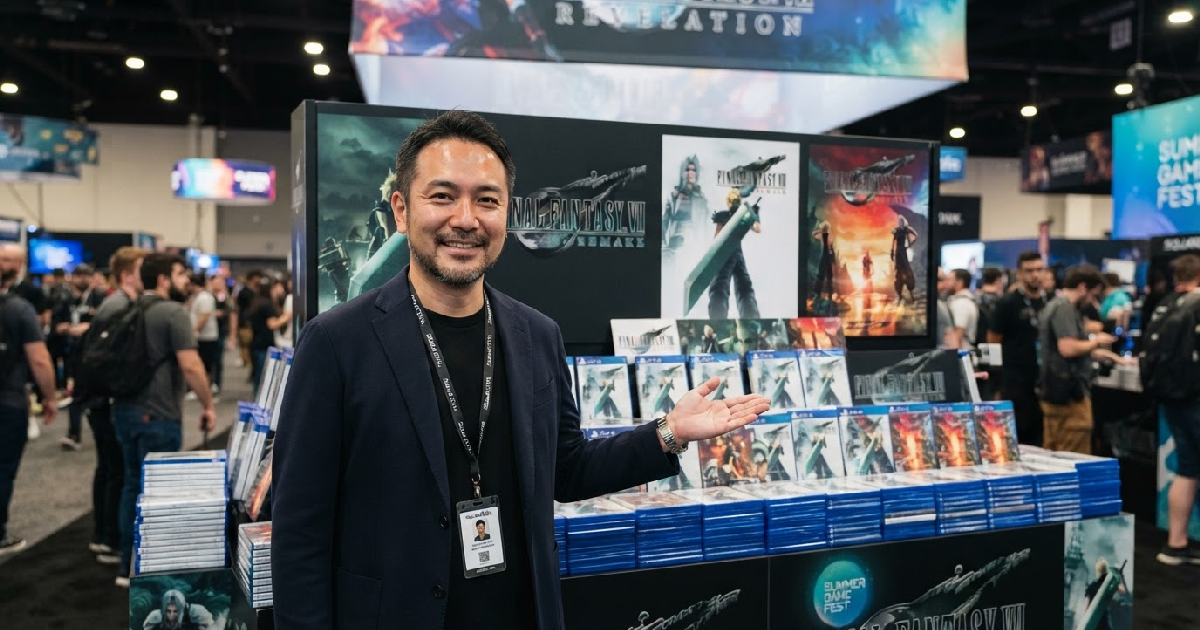
Final Fantasy 7 Revelation reveal drives unexpected sales surge for prior entries
The highly anticipated reveal of Final Fantasy VII Revelation at Summer Game Fest 2026 has provided an unexpected sales boost for its predecessors, Final Fantasy VII Remake and Final Fantasy VII Rebirth.
According to trilogy director Naoki Hamaguchi, both games are now selling “several times better” than anticipated, with performance exceeding what “most people probably imagine.” This surge offers a welcome turn for publisher Square Enix, which previously faced concerns over Rebirth‘s initial sales.
Revelation’s reveal revitalises remake trilogy sales
The announcement of the final installment, Final Fantasy VII Revelation, has proven a potent catalyst for the entire series. Naoki Hamaguchi, an Executive Officer at Square Enix and Studio Head of Creative Studio I, noted in an interview with Automaton that each time a new entry in the remake saga becomes a hot topic, sales for the preceding titles see a significant bump.
He drew parallels to Rebirth‘s earlier announcement, which also saw a rise in Remake sales. Hamaguchi believes that as Revelation continues to attract attention, interest in Rebirth will naturally climb further. While specific sales figures remain under wraps due to Square Enix’s investor relations policy, the director’s enthusiastic remarks suggest a substantial uptick.
A notable factor contributing to the trilogy’s renewed success is the growing presence of the PC market. Hamaguchi highlighted the consistent strength of the English-speaking PC audience, but also pointed out the significant growth in the Simplified Chinese PC market, which has now reached a comparable level.
This expansion into diverse digital storefronts like Steam and Epic Games Store, alongside traditional console releases, clearly plays a crucial role in reaching a wider global audience for the Final Fantasy VII experience.
Learning from players for Final Fantasy VII Revelation
Player feedback has been instrumental in shaping the upcoming Final Fantasy VII Revelation. Naoki Hamaguchi confirmed that certain design changes in the final installment directly respond to community input, particularly regarding minigames.
In Revelation, minigames are being made skippable, and their associated rewards are being adjusted based on responses to Rebirth‘s often polarising offerings. Hamaguchi stressed the importance of listening to players to minimise frustration, especially when it comes to gameplay and overall design.
He acknowledged the franchise’s famously vocal fanbase, seeing their passionate discussions and “heated” debates about minigames, story elements, or character relationships as a testament to the inherent value they place on Final Fantasy VII. This proactive approach to player sentiment reflects a commitment to refining the gaming experience for the concluding chapter.
Steady hands on the remake project
The stability of the development team working on the Final Fantasy VII remake trilogy is a significant, and somewhat surprising, factor in its continued progress. Naoki Hamaguchi revealed that more than 90% of the staff who started on Remake have remained with the project through to Revelation.
This level of retention is unusual for such a long-term, multi-part endeavour and reportedly surprised overseas observers. Hamaguchi attributes this dedication partly to the immense strength of the Final Fantasy VII intellectual property itself, but also to the supportive environment fostered by a fanbase with incredibly high expectations.
The continuity in staffing likely helps maintain a consistent vision and quality across the trilogy, reassuring players that the creative forces behind the initial success are seeing the ambitious project through to its conclusion.
A multi-platform launch for Revelation
Final Fantasy VII Revelation is set for a simultaneous multi-platform release in spring 2027, a significant shift from the staggered launches of its predecessors. This final chapter will arrive on Nintendo Switch 2, PC, PlayStation 5, and Xbox Series X/S at the same time.
This marks a departure from the PlayStation timed exclusivity that characterised the earlier entries, opening the game to a broader audience from day one. For PC players, the Windows version will also support Play Anywhere cross-progression between the Microsoft Store and Xbox Series X/S consoles.
Despite the game’s scheduled arrival a full year before Sony phases out physical discs, Square Enix has yet to decide on whether to offer Revelation in a physical format. The introduction of the airship Highwind will allow players to explore a vast, interconnected world, including new areas like Wutai and expanded versions of locations from Remake and Rebirth.
The gameplay will combine real-time action with strategic and role-playing elements, introducing new playable party members like Cid Highwind and Vincent Valentine. Players can expect refined combat that allows for seamless switching between party members and the use of Tactical Mode, alongside deep customisation options and a new FITS system for class-based abilities and special outfits.
Shifting sales trends for Square Enix
The current sales momentum for Final Fantasy VII Remake and Rebirth stands in stark contrast to Square Enix’s earlier financial reports. The company’s fiscal year ending March 31, 2025, revealed a decline in net sales within its HD Games segment, with new titles, including Final Fantasy VII Rebirth and Final Fantasy XVI, underperforming initial expectations.
This led to a reported 30% tumble in Square Enix’s share price following Final Fantasy XVI‘s launch. The sales boost spurred by Revelation‘s announcement suggests that renewed hype for the franchise can still generate significant commercial success, even for previously released titles.
The original Final Fantasy VII, released in 1997, set a high bar, selling over 15.7 million units and defining a generation of RPGs. Final Fantasy VII Remake launched on April 10, 2020, for PlayStation 4, quickly selling over 3.5 million units worldwide within just three days.
It went on to exceed 5 million units on PS4 by August 2020, reaching over 7 million worldwide by September 2023, and 8.7 million by March 2025 across all platforms, including its enhanced Intergrade version for PlayStation 5 and Windows, and later ports to Nintendo Switch 2 and Xbox Series X/S in January 2026.
Final Fantasy VII Rebirth, which followed on February 29, 2024, sold over 262,000 physical units in Japan during its first week. By April 2024, player data indicated it had surpassed 2 million copies on PS5.
Its Nintendo Switch 2 release in June 2026 saw 30,657 physical units sold in Japan in its debut week, outperforming Remake‘s Switch 2 launch sales of approximately 23,000 units on the same platform.
This complex sales history underscores the fickle nature of the modern gaming market. While initial performance for Rebirth may not have hit Square Enix’s internal targets, the enduring appeal of the Final Fantasy VII saga, coupled with strategic announcements, clearly has the power to reignite interest and drive sales across the entire series.
It’s a compelling example of how a well-executed reveal can profoundly impact a franchise’s commercial trajectory.