

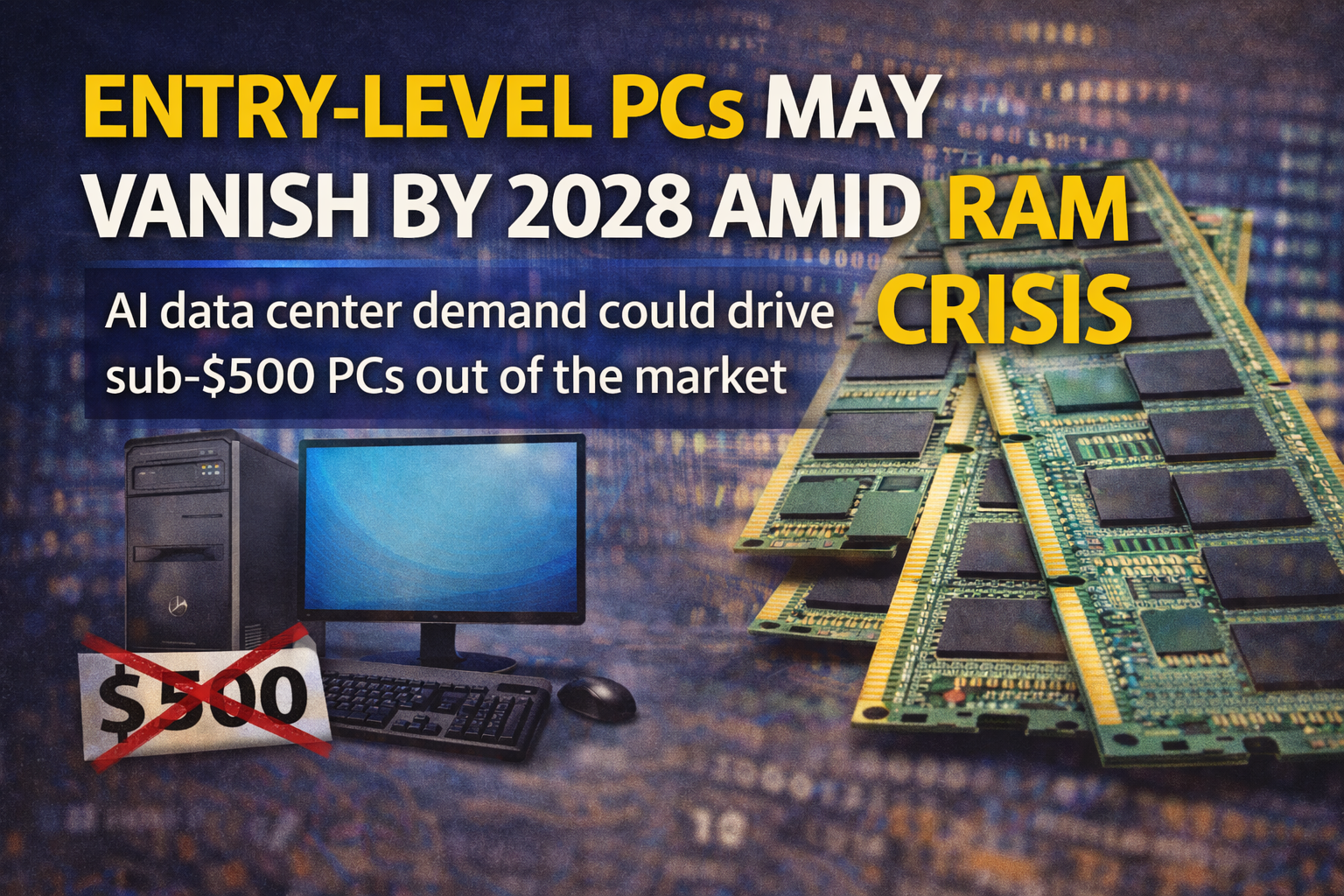
Entry-Level PCs May Vanish by 2028 Amid RAM Crisis
The $500 desktop may soon become a relic of a different computing era. A sustained surge in RAM prices, fueled by AI data center demand, is set to erase the entry-level PC segment by 2028 if supply pressures do not ease, according to a new forecast from research firm Gartner.
The firm projects that PC prices will climb 17% year-over-year compared with 2025 levels, while smartphone prices could rise 13%. At the same time, DRAM pricing is expected to peak at up to 130% above baseline levels by the end of 2026. For manufacturers operating on thin margins in the sub-$500 bracket, that trajectory leaves little room to absorb costs.
AI Data Centers Reshape the Memory Market
The pressure point is not consumer demand—it is hyperscale infrastructure.
AI training and inference workloads require high-bandwidth memory configurations at volumes far exceeding traditional enterprise deployments. Data center operators have been locking in long-term DRAM supply contracts, redirecting wafer capacity away from consumer modules.
This supply reallocation has created a feedback loop: constrained availability pushes prices higher, which in turn makes low-cost PC configurations economically unsustainable.
Entry-level machines traditionally rely on lower-margin components and aggressive cost optimization. When DRAM pricing spikes by double or triple digits, manufacturers must either raise retail prices or abandon the segment.
The End of the Sub-$500 PC
Gartner’s projection suggests that by 2028, a new PC priced under $500 may no longer be viable.
Historically, entry-level PCs served first-time buyers, students, and emerging markets. They also acted as gateway devices for gaming and productivity ecosystems. Eliminating that tier could narrow hardware accessibility and slow replacement cycles.
Consumers may respond by extending device lifespans. Gartner estimates that owners of relatively modern systems could delay upgrades by nearly 20% longer than typical refresh cycles. That shift has implications beyond sales volumes.
Security and Aging Hardware
Longer retention increases exposure to security vulnerabilities. Older hardware often lacks firmware updates and optimized support for new operating systems. Enterprises managing mixed fleets may face rising cybersecurity risks as refresh budgets tighten.
Compounding the issue, DDR4 memory—commonly used in older systems—is itself becoming more expensive as manufacturers transition capacity to DDR5. That dynamic limits affordable upgrade paths for existing PCs.
Ripple Effects Across Gaming and Consoles
The memory crunch is not confined to desktops.
Graphics card manufacturer Zotac has warned that sustained component shortages pose existential risks to hardware brands operating without large-scale vertical integration. Meanwhile, two of the world’s three major storage manufacturers have reportedly filled production orders for 2026, limiting near-term flexibility.
The console market faces parallel constraints. Sony is evaluating how memory pricing could affect its next-generation roadmap, with some analysts suggesting the PlayStation 6 timeline could shift toward 2029 if component costs remain elevated. Nintendo is also assessing potential price adjustments for the Switch successor should manufacturing inputs continue to rise.
Memory represents a significant portion of bill-of-materials costs in modern consoles, particularly as games demand larger asset footprints and real-time rendering enhancements.
Structural Shift or Temporary Spike?
The question confronting the industry is whether this represents a cyclical surge or a structural reset.
AI infrastructure investment is unlikely to taper in the near term. Governments and private firms continue to allocate billions toward compute expansion, embedding memory demand into long-term capital planning.
If DRAM suppliers prioritize higher-margin enterprise contracts over consumer segments, entry-level PC manufacturing may permanently shrink.
That shift would reshape the global PC market into a mid-range and premium-dominated ecosystem, potentially accelerating cloud computing adoption among cost-sensitive users.
Market Implications
- PC Vendors: Margin compression in low-end models; potential consolidation among smaller OEMs.
- Consumers: Higher upfront device costs and longer upgrade cycles.
- Gaming Ecosystem: Reduced accessibility for entry-level PC gaming.
- Console Makers: Rising component costs influencing pricing and launch timelines.
The disappearance of the sub-$500 PC would mark more than a pricing milestone. It would signal that AI’s infrastructure demands have begun redefining consumer electronics economics.