

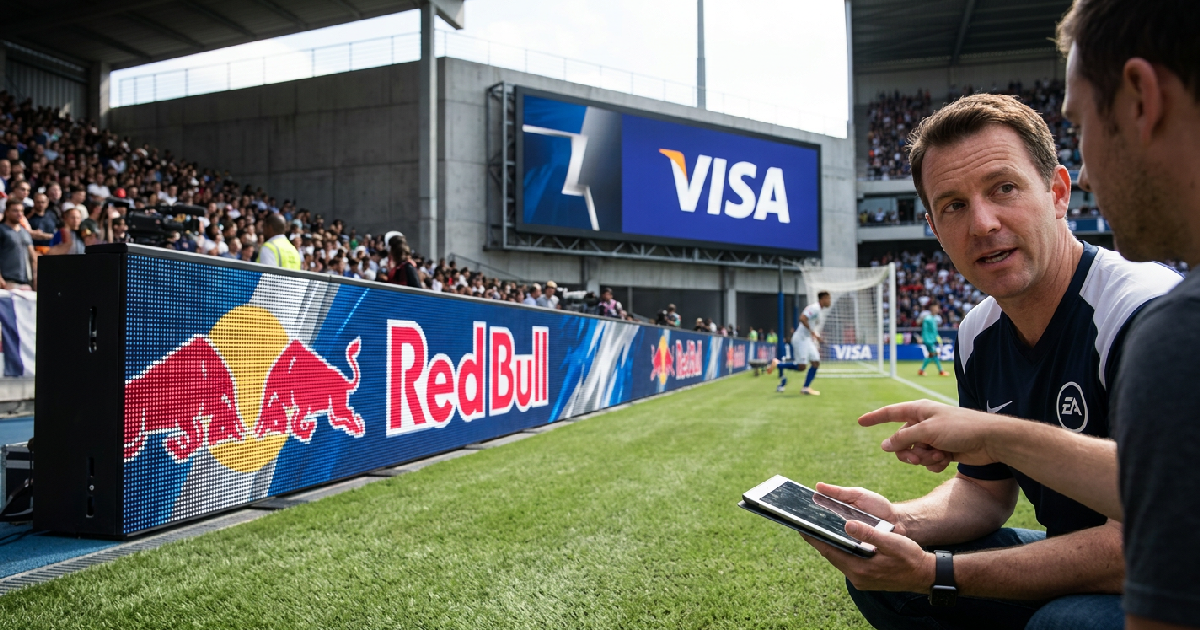
Electronic Arts unveils EA Advertising to target 120 million players
Electronic Arts (EA) officially launched EA Advertising on June 15, 2026, a specialized platform designed to integrate brand marketing directly into gameplay and live experiences. Chief Experiences Officer David Tinson announced the rollout, which utilizes a proprietary ad server and software development kit (SDK) built for the Frostbite engine.
The publisher aims to reach a massive audience of more than 120 million monthly players, following a fiscal year 2026 where the company recorded approximately $7.5 billion in GAAP net revenue. Initial partners for the platform include Visa, Red Bull, Lowe’s, and Mountain Dew.
The system focuses on what the company describes as “dynamic, real-time placements” that appear within the game world, such as stadium signage, digital scoreboards, and broadcast overlays in sports simulations. According to Tinson, the initiative is meant to add value while respecting the player experience and maintaining the authenticity of the virtual environments.
Early data shows the scale of these integrations; a partnership with Red Bull in EA SPORTS FC resulted in 128 million matches played, while a Lowe’s campaign across multiple titles generated 987,000 games played.
But the move comes at a time of increased scrutiny regarding monetization in premium titles. While players often expect price variation, such as those seen during the Xbox Deals Unlocked sale, the introduction of advertising into paid games remains a debated topic.
Take-Two Interactive CEO Strauss Zelnick recently remarked that placing adverts in premium titles would be “unfair,” highlighting a philosophical divide among major publishers. This is particularly relevant as Take-Two prepares the Grand Theft Auto 6 release for late 2026.
Advanced targeting via the Frostbite engine
The technical foundation of EA Advertising relies on its proprietary SDK created specifically for the Frostbite engine. This allows for refined targeting and measurement of specific audiences within 3D environments. To ensure transparency for its partners, EA has collaborated with Integral Ad Science to establish measurement standards.
This data-driven approach allows brands to show up in “ways that are relevant and built for players,” according to the company’s official announcement.
Beyond static signage, the platform enables custom gameplay integrations like in-game challenges and reward-driven objectives. In EA SPORTS College Football 26, Mountain Dew has launched a custom university experience, while State Farm is utilizing creator-led campaigns on social platforms to highlight custom kits in EA SPORTS FC 25.
The platform also offers ad units such as sponsored replays and branded video spots within the “broadcast layer” of its various sports simulations.
The push for new revenue streams coincides with a broader corporate shift for Electronic Arts. The company is currently the subject of a $55 billion leveraged buyout led by the Public Investment Fund of Saudi Arabia. This deal, which includes $20 billion in debt financing, is expected to close by the end of June 2027.
Developing and maintaining high-budget titles requires significant investment, an economic reality that has led some industry veterans to seek inspiration from outside the traditional AAA model.
Flexible brand tiers and the Partner Program
The EA SPORTS Partner Program offers three distinct tiers for brands looking to access the publisher’s sports communities through live events and in-game content. The “Premier” tier involves deep strategic collaboration, while “Experience” and “Franchise” tiers offer different levels of involvement.
These partnerships extend to major tentpole moments, such as Ratings Reveals and the “EA Sports Presents Madden Bowl,” as well as athlete-driven initiatives like the GEN / EA Sports platform.
- Visa: Partnerships established for both EA SPORTS FC and EA SPORTS College Football.
- Red Bull: Extensive collaboration within EA SPORTS FC specifically.
- The Sims: Integration through custom vanity kits and furniture drops.
- Xfinity & Peacock: Ad units featured across the sports simulation portfolio.
- Clothing & Furniture: Specific branded drops within The Sims.
The reach of EA Advertising is not limited to the sports division. The company lists its broader portfolio, including Apex Legends, Battlefield, Need for Speed, and Dragon Age, as part of the ecosystem.
In titles like The Sims, the focus remains on “clothing & furniture drops,” while in competitive titles, the platform aims to integrate brands without disrupting the core gameplay loop. This multi-title approach ensures advertisers can reach diverse demographics across different genres.
Lessons from past advertising experiments
Electronic Arts is moving carefully given its previous attempts to implement in-game ads. In 2020, the publisher faced a significant backlash after retroactively adding ads into UFC 4, leading to their swift removal.
CEO Andrew Wilson addressed the future of advertising in May 2024, stating that the company would take a “thoughtful” and “careful approach” to dynamic ad insertion. He suggested that such implementations could become a “meaningful driver of growth” for the publisher.
Economic pressures are forcing many large publishers to rethink their strategies. Sega producer Takashi Iizuka recently noted that AAA developers must sell huge numbers of units “in order to survive” due to the high cost and time required for big titles.
He compared the current gaming market to the film industry, suggesting that major companies could learn from the “quickness” and creative energy of smaller indie studios. For EA, the advertising platform represents one solution to these rising costs.
And yet, the success of the platform will likely depend on whether players accept these integrations as “authentic” enhancements. While stadium signage in a soccer game mimics real-world sports broadcasts, the introduction of ads into narrative or competitive titles may face a different reception.
As the platform matures, EA intends to expand into “IRL & Experiential” activations, connecting virtual achievements with real-world co-branded events and product drops.