

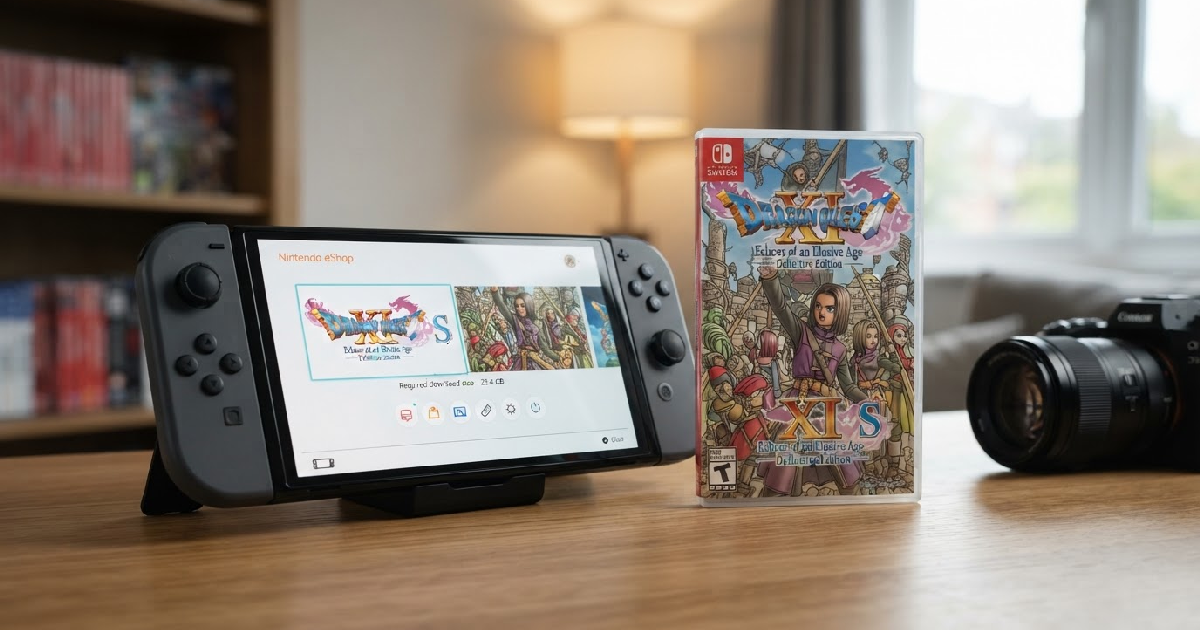
Dragon Quest XI S Switch 2 file size revealed ahead of September launch
Dragon Quest XI S: Echoes of an Elusive Age – Definitive Edition, Square Enix’s critically acclaimed role-playing game, is set for a September 24, 2026 launch on the new Nintendo Switch 2 console.
Initial listing details have now emerged, with the official Nintendo eShop page revealing an estimated digital Dragon Quest XI S Switch 2 file size of 23.4 GB. This figure represents a substantial increase over the 14 GB required for the game’s release on the original Nintendo Switch.
Dragon Quest XI S Switch 2 version demands more storage
The upcoming version, priced at $39.99 USD or £34.99 GBP, aims to deliver a significantly upgraded gameplay experience. It seeks to fully utilize the Switch 2’s enhanced hardware for superior visuals and smoother performance. This makes it a pivotal release for long-time fans of the beloved RPG series and newcomers alike.
The considerable jump in the Dragon Quest XI S Switch 2 file size offers one of the first concrete signals of how Square Enix and other major publishers plan to leverage the new console’s capabilities. At 23.4 GB for a digital download, it’s a noteworthy allocation of space for any handheld or hybrid system.
This figure stands in stark contrast to the original Switch iteration, which saw aggressive optimization to compress the game into its 14 GB footprint.
For those consumers who traditionally favor physical game copies, the situation presents a minor curveball. The physical game-key card for the Switch 2 version will still demand an even larger 30 GB download via the internet.
This effectively transforms a physical purchase into a requirement for substantial internet access and ample internal storage before gameplay can commence. This approach underscores a growing trend across the industry, where physical releases often function more as license keys than self-contained software.
technical upgrades and game modes
This expanded file size is a direct consequence of the technical enhancements confirmed for Dragon Quest XI S on the Nintendo Switch 2. Square Enix isn’t merely re-releasing the title; they’re upgrading it with meaningful visual and performance improvements. Players will have the flexibility to choose between two distinct modes, tailoring their experience.
The Performance Priority mode targets a consistently fluid 60 frames per second (FPS) at a crisp 1080p resolution. Alternatively, the Image Quality Priority mode will render the game at a sharper 1440p resolution, albeit at a standard 30 FPS. These configurable options represent a significant step up from the capabilities of the original Switch.
Beyond the technical polish, the Definitive Edition continues to bundle all the additional content that earned its critical acclaim. This includes the popular new story chapters, which deepen the narratives of the game’s diverse cast of party members.
Players also get to enjoy both Japanese and expanded English voice acting, a fully orchestral score, and the fan-favorite ability to seamlessly toggle between the modern 3D and charming retro-inspired 2D visual styles at almost any point.
These comprehensive features, when combined with higher-resolution assets, naturally contribute to the overall larger data footprint, ensuring a richer, more detailed world for players to explore.
no direct upgrade path for existing owners
For many dedicated gamers, a new console generation often brings with it the expectation, or at least the hope, of cost-effective upgrade paths for previously purchased titles. However, Square Enix has dispelled such notions for owners of Dragon Quest XI S.
The publisher has explicitly stated it has “no plans” to offer an upgrade pack that would allow existing Nintendo Switch owners to seamlessly transition their game to the enhanced Switch 2 version.
This firm stance means that players who have already invested in the acclaimed RPG will need to make a full, second purchase at the $39.99 or £34.99 retail price if they wish to experience the updated features and visual fidelity on the new hardware.
This decision aligns with similar strategies employed by some other publishers during console transitions, often to the chagrin of the consumer base.
implications for players and digital libraries
This “no upgrade” policy has several tangible ramifications for the gaming community. Foremost among them is the financial consideration for long-standing fans, who might feel compelled to buy the game twice. It’s not just the monetary outlay; there’s also the added frustration of having to effectively repurchase a title already residing in their game library.
More critically, Square Enix has confirmed that save data from the original Switch version will not be compatible with the Switch 2 iteration.
This forces players, some of whom may have hundreds of hours invested, to embark on their epic journey from scratch. For those who curate extensive digital game collections, this means allocating even more precious internal storage space for a game they technically already own and have completed.
This lack of cross-generational continuity for both ownership and progress highlights a persistent challenge. It underscores how console hardware upgrades don’t always translate into a smooth, player-friendly experience, potentially alienating parts of the loyal fan base.
a history of asset optimization in game development
The evolutionary journey of Dragon Quest XI across various gaming platforms offers an illuminating case study in game optimization. The game’s original release on the PlayStation 4 commanded a significant 30 GB of storage space. However, when Dragon Quest XI S was meticulously ported to the original Nintendo Switch, Square Enix’s development teams embarked on substantial efforts to compress the title.
They successfully managed to shrink its overall size to approximately 14 GB. This impressive reduction was achieved through a careful process of managing and, where necessary, judiciously scaling down various in-game assets, textures, and audio files. This wasn’t merely a technical necessity driven by the Switch’s hardware and cartridge limitations.
This optimization also yielded an often-overlooked benefit: it reportedly led to faster loading times compared to its more graphically demanding PS4 counterpart, a crucial factor for the pick-up-and-play nature of a portable system.
balancing graphical fidelity with console practicalities
The fact that the Nintendo Switch 2 version of Dragon Quest XI S is returning to a file size comparable to its initial PlayStation 4 release speaks volumes about the new console’s capabilities. It strongly suggests that developers now enjoy significantly more headroom to work with.
They can prioritize higher resolution textures, more intricate character models, and a broader array of enhanced graphical effects without being constrained by the same stringent storage limitations that defined the original Switch. This expanded freedom allows for a more visually immersive and technically robust experience.
But it represents a delicate balance. Pushing graphical boundaries inherently inflates file sizes, which in turn places greater demands on a player’s console storage and internet bandwidth. This ongoing tug-of-war between artistic and technical ambition and the practicalities of game distribution and player storage remains a defining challenge in contemporary game development.
Clearly, Square Enix is capitalizing on the Switch 2’s power to deliver a richer, more detailed world, albeit with an associated cost to storage.
outlook for new nintendo switch 2 titles
The release of Dragon Quest XI S: Echoes of an Elusive Age – Definitive Edition on the Nintendo Switch 2 offers a compelling early barometer for the broader software landscape of the new console.
Its significantly larger file size, coupled with the introduction of dedicated performance and visual modes, strongly indicates a clear developmental trajectory for the platform. Game developers are highly likely to target higher fidelity experiences that more closely align with, and perhaps even rival, what’s currently available on competing current-generation consoles.
For the average gamer, this means preparing for a new era of substantially larger digital downloads and, consequently, the increasing necessity of investing in external storage solutions to manage their growing game libraries. The commitment to improved performance on Switch 2 is evident in this kind of announcement.
Furthermore, Square Enix’s explicit decision not to offer a cheaper upgrade path also sets an important precedent for future releases. This policy effectively compels players to critically weigh the perceived value of enhanced graphics and smoother performance against the financial outlay of repurchasing a familiar title.
This could significantly shape consumer behavior and expectations for future cross-generational game releases across the entire Nintendo Switch 2 ecosystem. It fundamentally underscores the complex challenges and strategic decisions confronting both game developers and their dedicated player base in this rapidly evolving console landscape.