

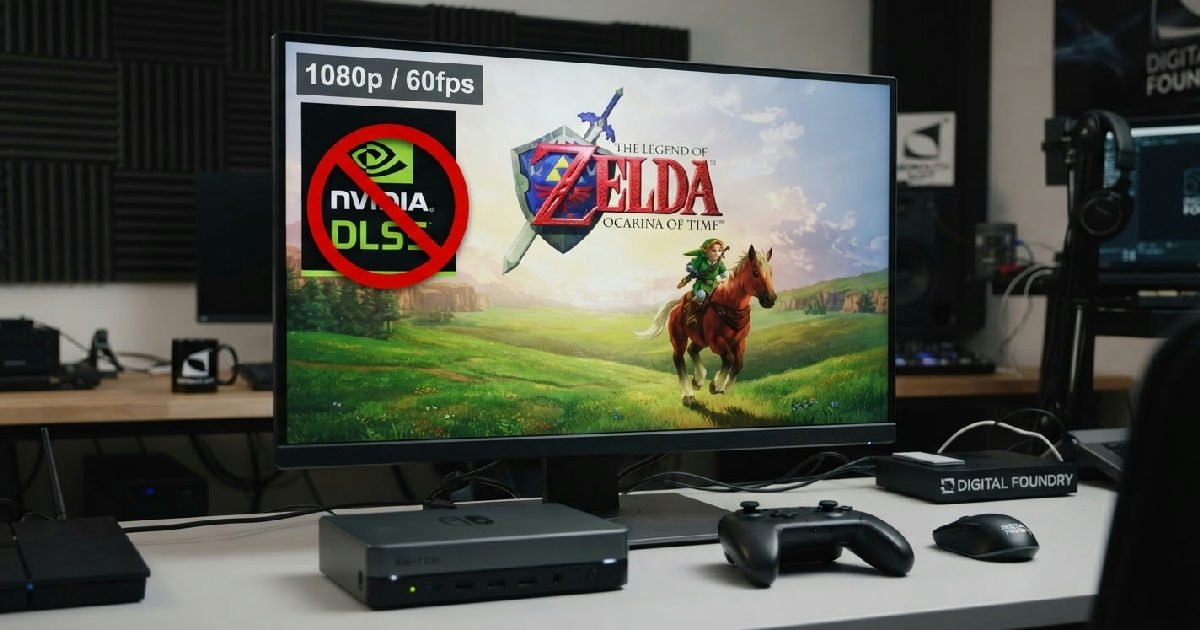
Zelda Ocarina of Time remake hits 1080p/60fps, lacks DLSS
The highly anticipated The Legend of Zelda: Ocarina of Time remake, a cornerstone of the Nintendo Switch 2’s holiday lineup, delivers rock-solid technical performance, according to analysts at Digital Foundry. Their report confirms the game runs at a native 1080p resolution and a silky smooth 60 frames per second (fps).
However, the technical assessment, publicly discussed since at least September 9, 2026, highlighted one significant omission: the complete absence of NVIDIA’s Deep Learning Super Sampling (DLSS) upscaling technology.
Performance Benchmark: 60fps Achieved in Zelda Ocarina of Time Remake
This technical trade-off puts the game’s core performance first while potentially sacrificing visual finesse, prompting criticism from the technical analysis group. For a major first-party title running on hardware designed to support DLSS, this choice has sparked a debate among players and industry watchers alike.
The core finding of Digital Foundry’s analysis is overwhelmingly positive for players prioritizing responsiveness. The Zelda Ocarina of Time remake achieves a locked 60fps, paired with a clean 1080p display resolution on the Nintendo Switch 2.
Oliver Mackenzie, a Digital Foundry video producer, noted the consistent frame rate ensures a responsive experience critical for an action-adventure title built around precision combat and platforming. This stability is a key selling point, especially for a game that retains the core mechanics of its 1998 predecessor. The high frame rate delivers an immediate benefit that users feel constantly.
Maintaining a constant 60fps across the vast open-world areas of Hyrule requires significant optimisation. While some recent titles have compromised frame rate for visual density, Nintendo has clearly prioritised fluid gameplay here. This technical achievement reassures players anticipating a flawless experience.
Digital Foundry initially conducted its analysis based on footage showcased at the June 9, 2026 Nintendo Direct. Though the final release version may vary slightly, these early impressions set a strong baseline for performance expectations.
DLSS Omission Leads to Visual Compromises
Despite the excellent frame rate and resolution, Digital Foundry strongly lamented the decision to bypass DLSS upscaling entirely. The technology is native to the Switch 2’s custom NVIDIA hardware, making its absence in a flagship title particularly puzzling.
The analysts argued that DLSS “would make a substantial difference” to the visual output, especially by mitigating minor imperfections inherent in a native 1080p image. Oliver Mackenzie stated the game’s graphics often appear “oversharpened.”
These graphical artifacts were particularly noticeable in specific areas of the game’s presentation. John Linneman, another key voice at Digital Foundry, pointed out that Link’s model appeared “overly shiny” in close-ups. This effect detracts from the character’s otherwise modernised look.
More complex scenes, such as the open-world areas with dense geometry and foliage, showed noticeable visual compromises. Linneman observed “shimmering foliage” that a basic DLSS implementation could have minimized or eliminated. The technology is well-known for cleaning up edges and improving image quality from a lower internal rendering resolution.
DLSS Could Have Addressed Image Quality Issues
Digital Foundry’s criticism centres on the fact that DLSS is not merely an upscaler but a powerful image reconstruction tool. It excels at smoothing textures and reducing the noise commonly associated with post-processing filters.
For a game already hitting 1080p, using DLSS in Quality mode could have been reserved solely for image cleanup rather than demanding a full resolution boost. The fact that the graphics appear oversharpened suggests a specific technical constraint that advanced graphical features like DLSS could have solved. This type of optimization is increasingly standard across major console releases.
The technical team expressed broader disappointment, noting they “lament the lack of DLSS in first-party Switch 2 games.” This suggests a trend where Nintendo is not yet fully leveraging the custom hardware capabilities of the Switch 2 for its marquee franchises. This strategic choice stands in contrast to third-party developers who have eagerly adopted the technology.
Nintendo Switch 2 Hardware and Upscaling Capability
The choice to omit DLSS is especially noteworthy given the technical specifications of the Nintendo Switch 2. The console, released on June 5, 2025, features a custom NVIDIA Tegra T239 System-on-Chip (SoC).
This chip includes an Ampere-based GPU and an Ada Lovelace Optical Flow Accelerator. This combination makes the Switch 2 fully capable of supporting DLSS 3.1 and earlier iterations, according to manufacturer specifications.
Nintendo itself confirmed the console’s DLSS support upon its release, promoting the ability to output 4K resolution when the device is docked. The hardware promise was better visuals and higher resolutions than its predecessor, achieved primarily through NVIDIA’s upscaling technology.
Reports prior to the console’s launch indicated that the Switch 2 might support two DLSS modes: a standard Convolutional Neural Network model for PC-like quality, and a “light” version. The latter would be optimized for upscaling resolutions slightly beyond the native 1080p display.
The use of DLSS typically allows a game to render internally at a lower resolution, saving GPU power, and then upscaling the image without loss of fidelity. By rendering natively at 1080p without DLSS, the Zelda Ocarina of Time remake uses raw processing power to maintain the 60fps target. This leaves little overhead for enhancing graphical details further.
Engine Choice Sparks Monolith Soft Speculation
Beyond the performance metrics, Digital Foundry’s analysis delved into the potential development team and engine used for the highly detailed remake. Oliver Mackenzie confirmed that the game is not running on Unreal Engine 5, a popular choice for many modern remakes.
Mackenzie speculated that the graphics engine is either an “in-house solution or a partner’s engine.” The complexity and polish of the visual overhaul suggest a major internal effort by a Nintendo-affiliated team.
The technical sophistication led Digital Foundry to cite the acclaimed Monolith Soft as a “likely candidate” for the remake’s developer. Monolith Soft is an established Nintendo subsidiary with a pedigree in role-playing games, notably the technically demanding Xenoblade Chronicles series.
Monolith Soft has a history of assisting with development on other major Nintendo franchises, including recent Zelda titles. This makes them a credible choice for a ground-up remake requiring mastery of complex visual pipelines and open-world optimization. Their involvement, if confirmed, would explain the bespoke nature of the game’s engine.
Online speculation among fans has also pointed towards Grezzo, who handled the 3DS remake of Ocarina of Time, potentially collaborating with Monolith Soft and Nintendo EAD. Regardless of the exact team, the engine is clearly tailored specifically for the Switch 2’s unique hardware architecture.
Outlook for the Holiday Season Launch
The technical report confirms that the The Legend of Zelda: Ocarina of Time remake is shaping up to be a polished and responsive title for the holiday season. Nintendo officially revealed the full remake, showcasing a massive graphical leap, during a 50-minute Nintendo Direct on June 9, 2026.
The 1080p, 60fps performance should satisfy the vast majority of players seeking a modern way to experience the seminal classic. This focus on performance ensures smooth, lag-free gameplay, arguably more important than minor visual clean-up.
For technology enthusiasts, however, the omission of DLSS remains a head-scratcher and a missed opportunity to showcase the full potential of the Nintendo Switch 2 hardware. Digital Foundry analysts noted they are still eager “to see more footage” before the game’s reported release date.
Ultimately, Nintendo’s decision suggests a prioritization of development simplicity and guaranteed stability over pushing bleeding-edge graphical features. The result is a highly stable performance envelope, even if it leaves some visual artifacts that advanced upscaling could have masked.