

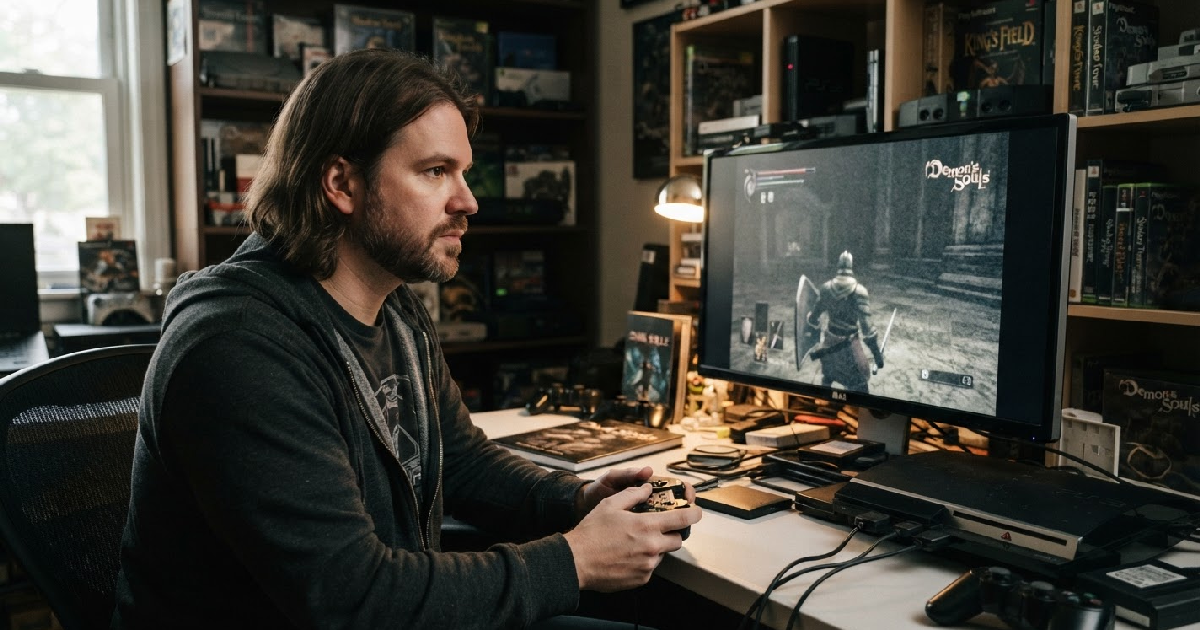
Lance McDonald Unearths Demon’s Souls Prototype with First-Person Camera
Famed FromSoftware investigator and “Elden Ring” dataminer Lance McDonald has unearthed and shared the earliest known footage of a “Demon’s Souls” prototype, revealing an optional first-person camera mode. Released on August 7, 2026, the newly public gameplay and presentation materials offer a rare glimpse into the formative stages of the critically acclaimed title.
This discovery highlights the dramatic shifts in vision that shaped one of gaming’s most influential franchises, nearly two decades after their original 2007 showing.
Early visions for the Demon’s Souls prototype
The footage originates from an internal Sony Computer Entertainment event called “Gameshare 4,” held in Tokyo in May 2007. It showcases a game far removed from the final PlayStation 3 release of “Demon’s Souls” in 2009, particularly in its fundamental camera mechanics and early creature designs. McDonald’s work provides invaluable insight into the creative processes and crucial decisions made during the game’s challenging development.
The core revelation from McDonald’s findings is the prototype’s inclusion of a first-person perspective, which players could apparently switch to at will. This stands in stark contrast to the locked third-person view that would become a hallmark of the finished “Demon’s Souls” and subsequent “Souls” series entries. It’s a significant detail, hinting at a different gameplay philosophy during initial development.
But the prototype’s default third-person camera behaved quite differently too. It followed the player rigidly, akin to how cameras functioned in older titles like the “Jedi Knight” games. This design choice implies a more constrained movement system than players eventually experienced.
Unique control scheme and early creature designs
The control scheme also presented a distinct approach, with the left analog stick handling strafing and backsteps. Lance McDonald specifically noted this setup as a deliberate parallel to the third-person controls seen in Bethesda’s “The Elder Scrolls IV: Oblivion,” a major RPG influence at the time. Such a comparison underlines the competitive landscape of role-playing games developers faced.
Interestingly, the prototype also featured a range of creatures that never made it into the retail version of “Demon’s Souls”. These include men with snakes for heads, though this concept did resurface in “Dark Souls” in locations such as Sen’s Fortress. A mundane crocodile also appeared in the early build, a far cry from the more fantastical beasts of Boletaria.
Hidetaka Miyazaki’s pivotal design decisions
Hidetaka Miyazaki, who would eventually become the director of “Demon’s Souls”, inherited the project during its nascent planning and prototype stages. He has since confirmed that the camera perspective was “completely different” when he took the reins. Sony Computer Entertainment (SCE) had initially pushed for a game resembling “The Elder Scrolls IV: Oblivion”.
Miyazaki, however, didn’t believe FromSoftware could compete effectively by directly mimicking “Oblivion’s” open-world approach. Instead, he championed a focus on refined gameplay elements, particularly battles and environmental exploration. This vision required a fundamental rethink of player perspective.
Reshaping the player experience
He explained how he “had to do a lot to convince everyone that a third-person camera was the way to go.” Miyazaki argued that a locked third-person camera was crucial for optimizing environmental layouts, object placement, enemy positioning, and the dynamic battle action. This strategic choice would define the combat rhythm for generations of action RPGs.
One of the iconic mechanics now synonymous with the “Souls” series, the target lock-on system, was notably absent from this early prototype. Its later inclusion further cemented the third-person combat experience Miyazaki envisioned, allowing for precise engagements with dangerous foes. This critical adjustment underscored his commitment to a unique, challenging gameplay loop.
The 2007 Gameshare presentation details
The rediscovered footage and presentation materials offer a fascinating time capsule from the “Gameshare 4” event. This internal Sony Computer Entertainment gathering took place in Tokyo back in May 2007. The presentation itself was crafted by Japan Studio PD#3, utilizing Microsoft PowerPoint 2007.
Daisuke Ishidate, a member of Japan Studio at the time, delivered the original presentation. It included an unexpected “South Park” reference, specifically an image from the “World of Warcraft” episode “Make Love, Not Warcraft”. This was used to humorously illustrate a “stereotype image for MMO RPG gamers” while promoting “Demon’s Souls” as a unique single-player RPG experience.
Unseen elements and early concepts
The presentation also painted a vivid picture of the game’s proposed world. It promised an environment filled with “ruined castles, lone wastelands, and other cursed locations,” teeming with “enemies, twisted mutants, and creatures.” These descriptions accurately foreshadowed the bleak and perilous world players would eventually explore.
Company notes from Japan Studio within the presentation underscored the game’s distinctive online elements. They emphasized that while players might often feel isolated, they were never truly alone thanks to the innovative network connectivity features, including the persistent ghost system visible in the prototype. This feature, allowing glimpses of other players’ actions and deaths, became a cornerstone of the series’ emergent multiplayer.
Unveiling the Soulslike genre’s origins
The revelation of this early prototype isn’t just a historical curiosity; it’s a crucial piece of the puzzle for understanding the origins of the “Soulslike” genre. It demonstrates how core design philosophies evolved, with initial ideas being refined or outright discarded to achieve a cohesive player experience.
The first-person perspective, while offering immersion, likely clashed with the precise combat and environmental awareness that would become critical to the series.
FromSoftware’s earlier title, “King’s Field” from 1994, which is widely considered a spiritual predecessor to the “Souls” series, also featured a first-person perspective. This historical link suggests that the first-person concept for “Demon’s Souls” might have been an echo of the company’s past. However, Miyazaki’s intervention shifted the series onto a new, highly successful trajectory.
The enduring value of game archaeology
Lance McDonald’s consistent efforts in unearthing such archival content provide invaluable contributions to video game history. His previous discoveries include cutscenes hidden within “Elden Ring’s” game files, showcasing his unique ability to delve into the depths of FromSoftware’s past projects. These “game archaeologists” offer fans and developers alike a deeper appreciation for how beloved titles come to be.
The impact of these finds extends beyond mere nostalgia. They allow a critical examination of game design choices, illustrating why certain features are adopted or abandoned. Understanding these developmental forks in the road helps us appreciate the final product more fully and informs future game design.
For current game developers, McDonald’s findings offer a masterclass in iteration and leadership. The courage to pivot from a first-person perspective, despite external pressure and internal precedents, was pivotal for “Demon’s Souls.” It allowed the team to forge a distinct identity, prioritizing tactical combat and environmental storytelling over immersive but potentially cumbersome camera options.
This willingness to challenge initial assumptions ultimately led to a groundbreaking title and the birth of a revered genre.