

CS:GO players flock back as Global Offensive sets new records
Valve Corporation’s silent re-release of Counter-Strike: Global Offensive (CS:GO) as a standalone game has triggered an unexpected surge in player numbers, with Counter-Strike Global Offensive players breaking new records. This surprising comeback for the decade-old title occurs even as its successor, Counter-Strike 2 (CS2), solidifies its position as one of Steam’s most played games.
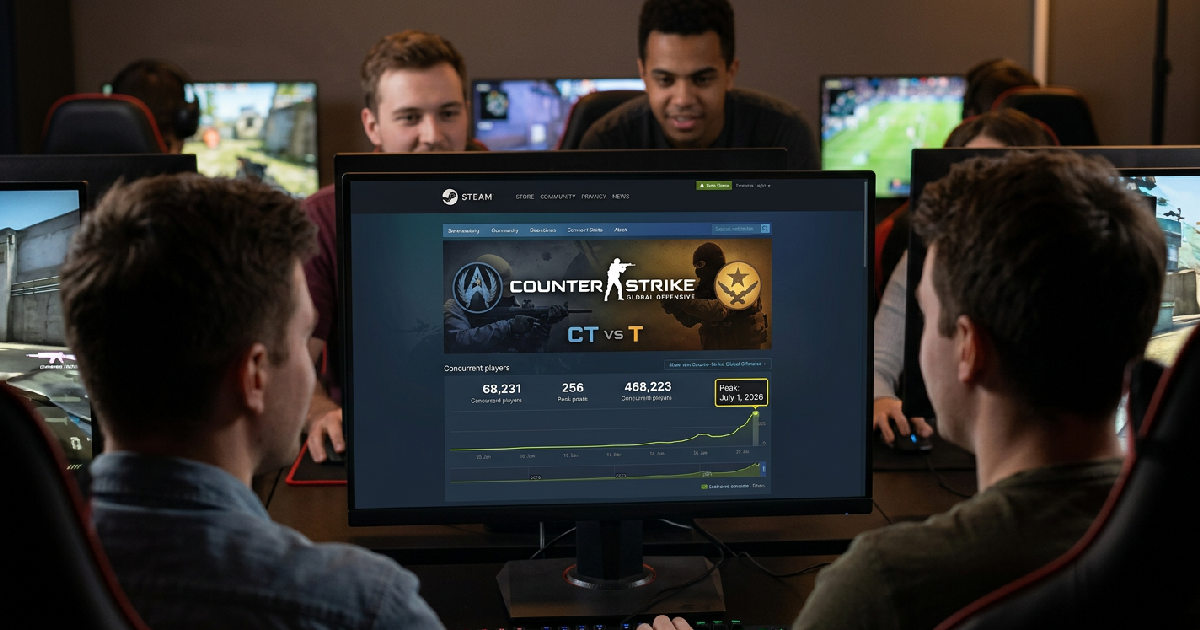
On July 1, 2026, the re-released standalone CS:GO client hit a remarkable new peak of 68,231 concurrent players. This figure represents the highest count since its quiet return on March 3, 2026, surpassing even the initial player numbers seen when Global Offensive first reappeared on the platform.
Counter-Strike Global Offensive players drive a quiet resurgence
Against all expectations, Counter-Strike: Global Offensive isn’t just surviving; it’s thriving, albeit in the shadows. Valve quietly added the game back to Steam as a fully standalone client, identifiable by its AppID 4465480, earlier this year. This isn’t merely a “legacy version” embedded within CS2, but a distinct 2023 build.
Its success is all the more notable because the game remains unlisted. Users can’t find it through regular Steam search results, requiring a direct link for access. Despite this hidden status, the game is drawing player numbers comparable to other unlisted Valve titles like Deadlock.
Overwhelmingly positive feedback for an unsupported title
The re-released Counter-Strike: Global Offensive has accumulated thousands of reviews. An impressive 97% of these reviews are “Overwhelmingly Positive,” reflecting strong community sentiment. This is particularly significant given the complete lack of official Valve support.
There are no official matchmaking servers active for this standalone version. Players must rely solely on community servers or direct IP connections to play. Yet, the dedicated base of Counter-Strike Global Offensive players keeps growing, showcasing loyalty to the classic experience.
Why players are returning to the older version
Many players prefer specific aspects of CS:GO’s gameplay feel. Its movement and mechanics are often cited as reasons for returning to the older title over CS2. This preference has fueled theories about the re-release’s purpose, including technical convenience and the preservation of a legacy.
The player count for this unlisted, unsupported game is far from negligible. It currently ranks as the 28th most played game on Steam. This puts it ahead of major titles such as Baldur’s Gate 3, Rainbow Six Siege, and even Battlefield 6, underscoring its enduring appeal.
Counter-Strike 2 maintains robust Steam dominance
While CS:GO enjoys its quiet resurgence, Counter-Strike 2 continues its reign as a behemoth on Steam. The game consistently registers live player counts hovering around 1,003,916 to 1,247,079 as of July 3, 2026. These numbers fluctuate, typically dropping to 600,000-900,000 during off-peak hours.
CS2 boasts a 24-hour peak of 1,414,003 players and an all-time peak of 1,862,531 concurrent players, achieved on April 12, 2025. This latter figure surpassed CS:GO’s previous record, highlighting CS2’s immense reach since its September 27, 2023, launch as an update to Global Offensive.
The scale of CS2’s player base
Considered Steam’s “killer app,” CS2 attracts around 25-30 million unique logins monthly. This vast audience makes it one of the most consistently played games on the platform. Even with a reported 7.6% decrease in active players compared to the previous month, its live player count continues to grow overall.
Some concerns have surfaced regarding bot lobbies potentially inflating these impressive player counts. Despite these discussions, the sheer volume of active players unequivocally demonstrates CS2’s dominant presence in the online gaming landscape.
The enduring appeal of the Counter-Strike franchise
The Counter-Strike franchise has a long history of retaining dedicated players, a trend that extends beyond its latest iterations. The original Counter-Strike 1.6, for instance, still sees substantial activity. It currently reports 7,398 live players, with a 24-hour peak of 11,995.
This classic title achieved its all-time peak of 319,586 concurrent players back on December 21, 2007. And other long-running titles demonstrate similar loyalty. This longevity suggests that a segment of the player base values the distinct feel of each game in the series.
Historical context and modern challenges
Counter-Strike: Global Offensive was originally released on August 21, 2012, and transitioned to a free-to-play model in December 2018. Before being replaced by CS2, it regularly drew around 11 million players monthly. Its all-time peak before the CS2 update hit 1.4 million concurrent players in March 2023.
CS2, built on Valve’s Source 2 engine, brought technical enhancements like improved graphics and a “sub-tick” server architecture aimed at more precise player action processing. However, player reception has been mixed, with criticisms ranging from performance issues and removed features to the discontinuation of macOS support. Many felt the game launched feeling “unfinished.”
What the dual player bases mean for Valve’s strategy
Valve has remained notably silent regarding the official re-release of CS:GO as a standalone game. A Valve representative previously described the availability of a legacy CS:GO branch as a “quality of life improvement” to provide an “easier way” to access it. But this explanation doesn’t fully address the quiet return of a fully separate client.
The community is buzzing with speculation and hope for the future of standalone CS:GO. Many are dreaming of dedicated tournaments, FACEIT hubs, and even a return of official servers for the older version. This situation presents a unique challenge and opportunity for Valve, managing two distinct but related player communities.
Looking ahead for Counter-Strike
The continued strong performance of Counter-Strike Global Offensive players, despite its hidden status and lack of updates, suggests a deep-seated preference for its gameplay among a significant minority. It highlights the enduring power of nostalgia and specific mechanical preferences within the gaming community.
Valve’s initial strategy with CS2 was to future-proof the franchise and consolidate its economy. But the vibrant return of CS:GO indicates that player loyalty isn’t always about the latest tech. It’s a testament to the original game’s fundamental design and a reminder that innovation sometimes creates a longing for the past.