

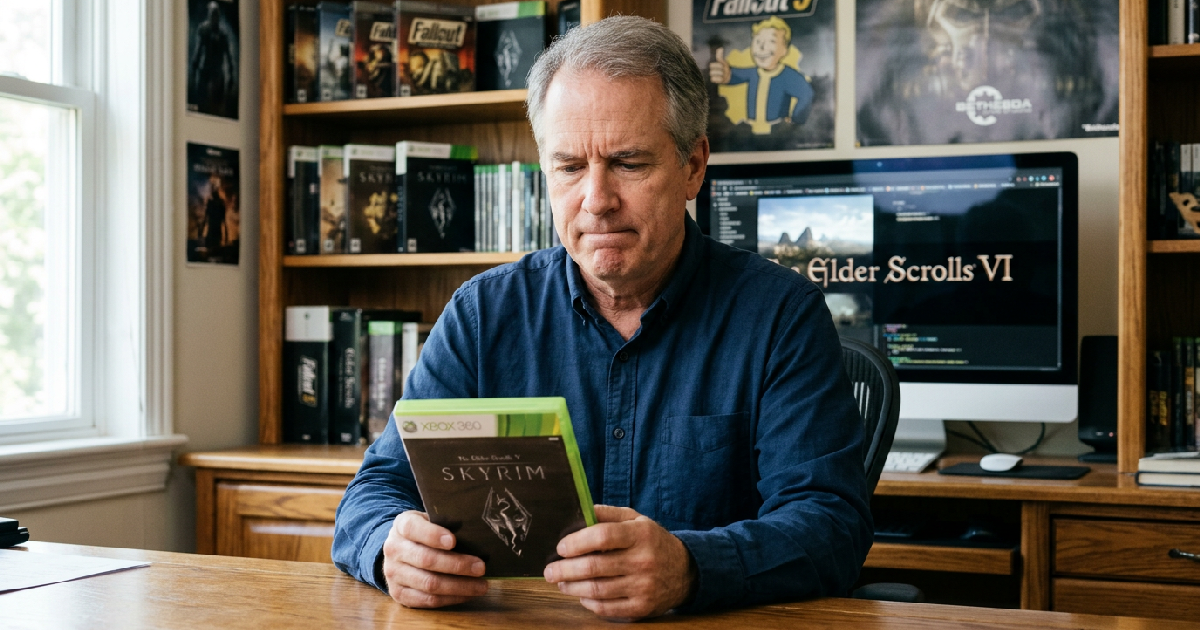
Bruce Nesmith warns rushing Elder Scrolls 6 risks disappointing fans
Bruce Nesmith, the lead designer behind The Elder Scrolls V: Skyrim and a 20-year veteran at Bethesda Game Studios, has warned that accelerating the development of major sequels like The Elder Scrolls 6 or Fallout 5 risks disappointing the series’ massive fanbases.
His comments follow reports that Microsoft and Xbox leadership are pressuring the studio to speed up its production pipeline to capitalize on the recent popularity of the Fallout television series and the success of Starfield.
Bruce Nesmith explains the quality triangle in RPG development
Bruce Nesmith, who contributed to titles ranging from Daggerfall to Starfield before leaving the company, argued that a rigid three-year development cycle—often seen as the “sweet spot” for maintaining momentum—is increasingly difficult to achieve as player expectations for quality and scope grow geometrically rather than linearly.
The tension between corporate demands for faster releases and the creative necessity of long development windows has become a central talking point within the industry.
While Bethesda Design Director Emil Pagliarulo and Executive Producer Todd Howard have previously stated that The Elder Scrolls 6 will take as long as necessary to meet the studio’s high standards, the influence of Microsoft since its $7.5 billion acquisition of ZeniMax Media in 2021 looms large.
Bruce Nesmith, speaking in a recent interview with FRVR, drew on an old industry adage regarding the “three corners” of development: resources, time, and quality.
He noted that while a studio can usually control two of these variables, the third is always determined by the others, meaning a fixed schedule almost inevitably forces a compromise on quality or feature sets.
In his recent remarks, Bruce Nesmith detailed the intricate balance required to build massive open-world RPGs that define generations of gaming. He noted that when a publisher locks down both the budget (resources) and the release date (schedule), the quality of the final product becomes the variable that fluctuates.
“You can’t dictate all three, only two,” Bruce Nesmith explained, highlighting that over-committing to any one corner of this triangle increases friction and ultimately reduces the effectiveness of the development team.
This philosophy suggests that the decade-long gaps between Bethesda’s flagship titles aren’t necessarily the result of inefficiency, but rather a protection of the brand’s integrity.
Key details
The designer also pointed out that determining what players actually want is a “moving target.” What was considered a groundbreaking level of graphical fidelity or mechanical depth four years ago is often viewed as the bare minimum by the time a game actually hits store shelves.
By trying to rush The Elder Scrolls 6 to fill a gap in a release calendar, Bruce Nesmith believes the studio would be forced to set aside the “polish and bugs” phase—the final stage of development where the game’s identity is truly solidified.
This risk is particularly acute for Bethesda, whose titles are famous for their complexity and, historically, their technical volatility at launch.
Key details
While Bruce Nesmith advocates for patient development, he also acknowledged the dangers of projects that linger too long in pre-production or active development.
He mentioned that allowing ten years for a project can lead to a cycle of “endless reinvention,” where developers lose sight of the original vision and the game eventually fails to meet the needs of a modernized market.
Finding the middle ground between a rushed three-year cycle and a bloated ten-year cycle is the central challenge facing Todd Howard and his team today.
The studio spent nearly three years simply rewriting its proprietary engine—now known as Creation Engine 2—following the launch of Fallout 76. This work was necessary to facilitate the scale of Starfield, and further improvements are being made for The Elder Scrolls 6, leading some to refer to the upcoming tech as Creation Engine 3.
These foundational technological shifts are time-consuming but essential to avoid the “buggy” reputation that plagued the Creation Engine era of Skyrim and Fallout 4. Even in other competitive spaces, such as the digital collectibles market where new sticker systems drive engagement, the underlying technology must remain robust to support long-term growth.
Future outlook for The Elder Scrolls 6 and Fallout
As of June 2026, The Elder Scrolls 6 remains without a confirmed release window, though industry analysts generally point toward a 2027 or 2028 launch at the earliest. The game has reportedly passed a major milestone recently, shifting from pre-production into a state of full scale-up.
Bethesda’s strategy appears to be a careful defense of the “quality corner” of the development triangle, even if it means frustrating a parent company eager for quarterly growth. For fans, these long waits are the price of the ambition that has defined the studio for decades.
The comments from Bruce Nesmith serve as a sobering reminder that the “glory days” of three-year sequels are likely over for the AAA RPG space. As games become more complex, the labor required to build them increases at a rate that traditional studio management cannot easily offset.
Key details
Bethesda’s future likely involves a mix of massive, once-in-a-generation releases supported by smaller, externally developed remasters and ongoing live-service updates. Whether this approach can satisfy Microsoft’s bottom line while maintaining the prestige of the Elder Scrolls brand will be the defining story of the studio’s next decade.
Ultimately, the industry is watching to see if Bethesda can buck the trend of “franchise fatigue” by sticking to its guns. In a market where sequels are often churned out to meet financial quarters, the insistence on taking “as long as it needs to be great” is a gamble.
Bruce Nesmith’s warnings suggest that if Bethesda bows to the pressure to release games faster, the very thing that makes their worlds worth visiting—the density, the polish, and the sheer scale of the experience—could be the first thing to disappear.