

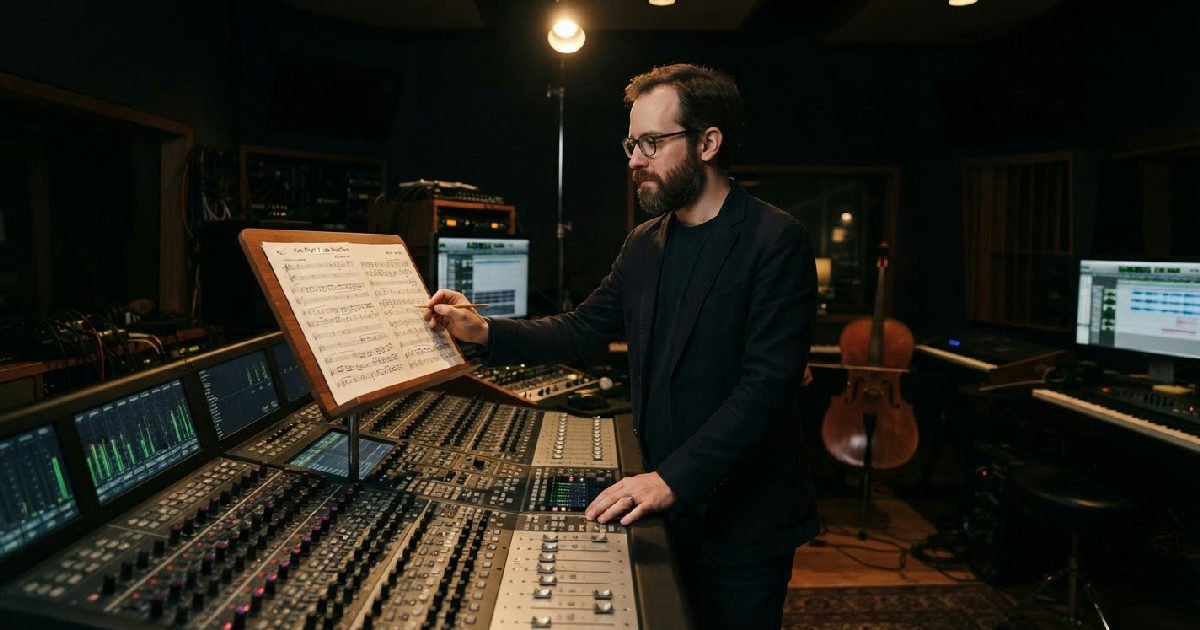
Austin Wintory releases Mass Effect Universe soundtrack
The Mass Effect 5 leak soundtrack features a 20-minute score by Austin Wintory from the canceled Mass Effect: Universe project. This emotional release, coming shortly after BioWare’s closure by publisher Electronic Arts, underscores the abrupt end to the highly anticipated title’s development, including the Mass Effect 5 leak soundtrack.
Wintory’s unexpected share comes barely a week after a mysterious trailer for Mass Effect: Universe also surfaced online, intensifying the collective grief among fans still reeling from BioWare’s shutdown. The composer’s contribution adds a poignant layer to the story of a game that will now never see the light of day.
The Mass Effect 5 Leak Soundtrack Revealed
Known for his evocative work on titles like Journey and Hades II, Wintory had reportedly been in discussions with BioWare and EA for years to score Mass Effect 5. His passion for the series is evident in the unreleased tracks, which he described as his ultimate “white whale” project.
Wintory took to Bluesky to announce his musical revelation, explaining his deep personal connection to the Mass Effect series. “Mass Effect was my ultimate white whale, my all-time dream project,” he wrote, detailing years of discussions with both BioWare and EA about potentially joining the project.
As part of these talks, Wintory proactively composed nearly 20 minutes of exploratory music, hoping to showcase his vision for the franchise’s future sound. This experimental score, featuring seven unique tracks and one remix, is now available for public listening, accompanied by an image bearing the mournful caption, “Mass Effect: Universe, the music that might have been.”
The composer expressed immense gratitude to his contacts at BioWare and EA, remarking that “to even dream in your sandbox was a privilege.” His work paid homage to the original game’s composers, Jack Wall and Sam Hulick, while integrating modern elements like analog synths and complex orchestral arrangements, drawing parallels to the hybrid soundscape of films like The Matrix.
A Score for a Lost Universe
Wintory’s deep-seated admiration for the franchise dates back to his first playthrough of the original Mass Effect in 2007. He instantly recognized its potential to become a lifetime favorite, a sentiment that fueled his ambition to contribute to its legacy. This personal connection underscores the significance of his efforts to craft a score he believed would elevate the series.
Though nothing was ever formally finalized, the enthusiasm from both developer and publisher was reportedly high. Wintory’s proactive “love letter” to the franchise served as an audition, a speculative narrative dive into where the beloved space opera could head next musically. The tracks offer a tantalizing audio narrative of what could have been a defining chapter for the series’ sound design.
BioWare’s Closure and its Impact
The release of Wintory’s music is set against the somber backdrop of BioWare’s official closure on October 21, 2026. Electronic Arts, the studio’s long-time publisher, confirmed the shutdown, bringing an end to over three decades of innovative role-playing game development and simultaneously canceling the next Mass Effect game.
This decision by EA was driven by the commercial and critical underperformance of several recent BioWare titles, including 2019’s Anthem and 2024’s Dragon Age: The Veilguard. The latter reportedly fell short of EA’s sales expectations, attracting only 1.5 million players in its initial three months, half of what was projected.
The closure forms part of a broader restructuring at EA, which involved approximately 400 layoffs across the company. This strategic shift reflects EA’s stated intention to concentrate its investments on fewer, larger-scale projects, primarily focusing on “larger shooters and action-adventure titles.”
The End of an Era for a Famed Studio
BioWare, founded in 1995 by doctors Ray Muzyka, Greg Zeschuk, and Augustine Yip, built a formidable reputation for crafting sprawling narratives, rich character development, and impactful player choices.
Its influence shaped the role-playing game genre with iconic RPG titles such as Star Wars: Knights of the Old Republic, Baldur’s Gate, and Dragon Age. The studio had also continued to iterate on its core offerings, refining gameplay across its various franchises.
EA acquired BioWare in 2007 for around $775 million. The studio’s closure also follows EA’s own acquisition on August 4, 2026, by a consortium including Saudi Arabia’s Public Investment Fund (PIF), Silver Lake, and Affinity Partners, in a deal valued at approximately $55 billion. This acquisition marked the end of EA’s 36-year history as a publicly traded company.
The Legacy of Mass Effect: Universe
Prior to Wintory’s musical offering, a leaked trailer for Mass Effect: Universe, verified by outlets like IGN, had given fans a visual taste of the ill-fated project. This internal leadership trailer, created using “in-engine footage from our small team” and “pre-production assets,” depicted classic Mass Effect elements: alien species, space travel, a galaxy map, and even a nightclub scene.
The game was set to transport players hundreds of years after the events of Mass Effect 3, bringing the narrative back to the Milky Way galaxy following the defeat of the Reapers. Players would have embodied a customizable N7 agent, envisioned as a “John Wick/James Bond-type character” armed with experimental technology implants.
Moreover, the game promised the return of an older Liara T’Soni, a fan-favorite, appearing as a powerful Asari Matriarch. The storyline was framed as a “Galactic Cold War,” a departure from galaxy-ending threats, involving humans, Krogans, and Batarians as key factions, with the Geth emerging as a new superpower.
There were even plans to weave in connections between the Milky Way and Andromeda galaxies, suggesting a grander scope.
Milky Way Return vs. Andromeda’s Shadow
The concept for Mass Effect: Universe explicitly aimed to preserve Commander Shepard’s legacy, regardless of players’ choices in Mass Effect 3. This approach contrasts sharply with previous rumors of a different Mass Effect 5 leak, reportedly titled Mass Effect: Andromeda – The Lost Chapters. That rumored title suggested a direct continuation of the mixed-reception Andromeda storyline, which had left some fans apprehensive.
The now-canceled game also intended to deliver an unprecedented level of player autonomy and choice, according to former BioWare cinematic supervisor Tony de Waal. Gameplay features included “Hitman-style freedom” in mission completion, environmental hacking, and brutal close-range executions.
Squadmate dynamics were expected to be more complex, potentially leading to clashes, while romance options were designed to be less “sanitized,” aiming for a more mature experience often lauded in titles setting a new action RPG gold standard.
Speculation and the Franchise’s Future
The leaks, both the trailer and Wintory’s score, have sparked widespread discussion among the gaming community. Some fans speculate these releases could be a deliberate “Deadpool-style” effort by former developers to generate public outcry and potentially revive the canceled project. This isn’t unprecedented in the industry, where passionate communities can sometimes influence corporate decisions.
Former BioWare cinematic supervisor Tony de Waal, among many who lost their jobs in the shutdown, conveyed the team’s belief that they were “making something special.” He noted that recent successes from studios like Larian with Baldur’s Gate 3 and CD Projekt with Cyberpunk 2077 had inspired BioWare to push the boundaries for the next Mass Effect installment, aiming for a truly groundbreaking experience.
Gaming content creator Dantics, who was part of a “Mass Effect Council” that provided feedback to BioWare, affirmed that the game “looked incredible” and was designed “for us, the fans.” This sentiment highlights the disconnect between the development team’s vision and EA’s ultimate decision to shutter the studio and cancel the project.
Uncertainty for the Mass Effect IP
The future of the entire Mass Effect intellectual property remains shrouded in uncertainty. Electronic Arts has not yet commented on whether it plans to continue the franchise’s development with another studio or if the IP will be shelved indefinitely. This silence leaves fans clinging to the legacy of a series that once defined a genre.
Despite the game’s cancellation and BioWare’s closure, there is still a live-action Mass Effect television series reportedly in development at Prime Video. This project, if it moves forward, could provide a new avenue for the franchise’s rich lore and characters to reach audiences, even if the gaming future is currently bleak.