

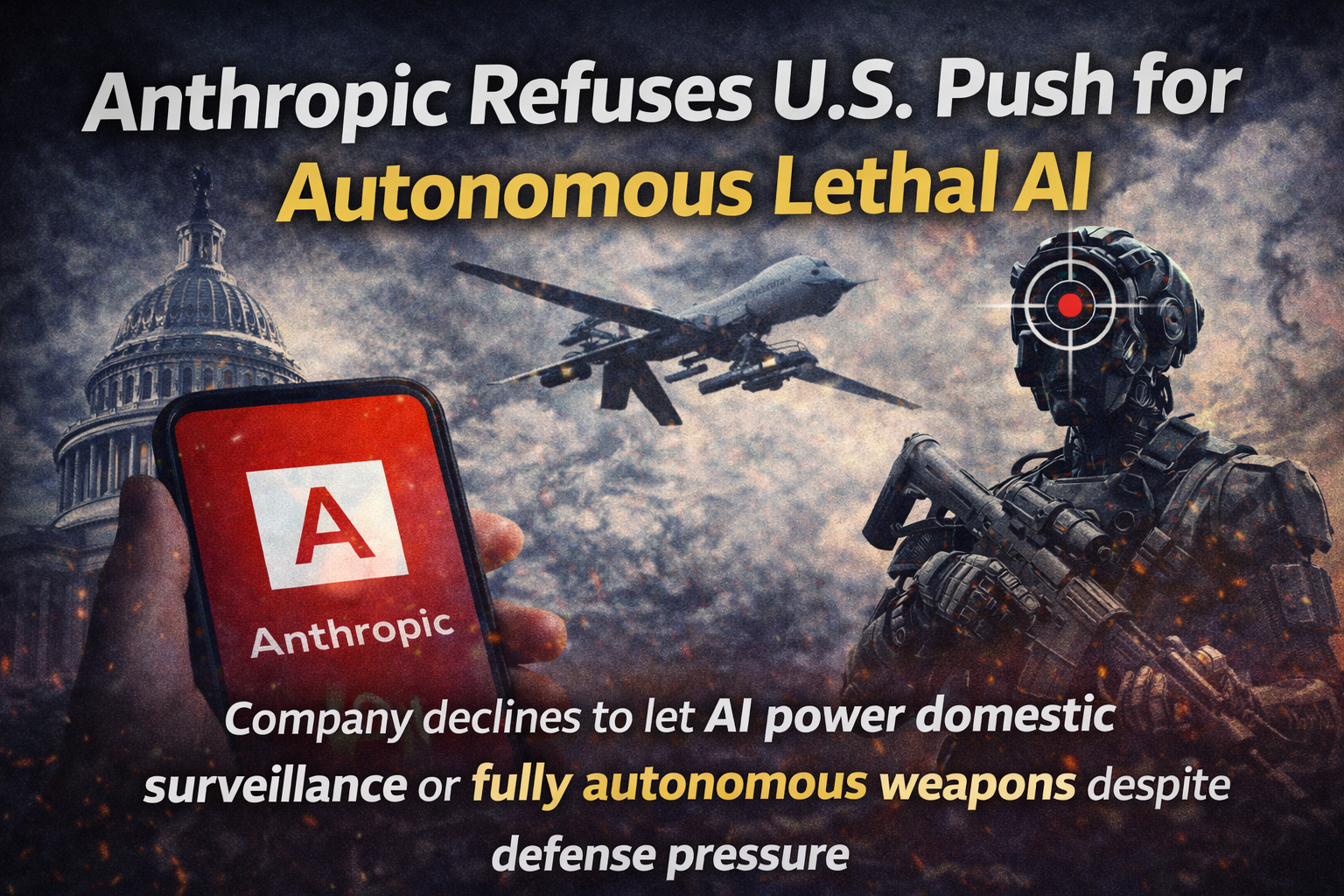
Anthropic Refuses U.S. Push for Autonomous Lethal AI
Anthropic has drawn a rare public line in the rapidly blurring boundary between artificial intelligence and military power. The generative AI firm confirmed it will not permit its Claude model to be used for domestic mass surveillance or fully autonomous lethal weapons, despite reported pressure from U.S. defense authorities.
The decision places the company at the center of an intensifying debate over how far commercial AI providers should integrate with national security systems — and who ultimately defines ethical guardrails in an era of accelerated AI deployment.
Where Anthropic Draws the Boundary
Anthropic CEO Dario Amodei acknowledged that Claude is already widely deployed across U.S. defense and national security agencies. Applications include intelligence analysis, operational modeling, cyber operations, and planning — all areas where large language models are increasingly embedded.
However, Amodei stated the company will not remove safeguards that prevent:
- Domestic mass surveillance of U.S. citizens
- Fully autonomous weapons systems capable of lethal decision-making without human oversight
According to public statements, U.S. authorities have pushed for the removal of these constraints and warned that Anthropic could lose military contracts or be labeled a “supply chain risk” if it refuses.
Anthropic’s position is not anti-military. It is anti-autonomous lethality and domestic surveillance at scale.
The Strategic Stakes for AI Providers
The dispute underscores a larger structural issue in AI governance.
Large language models are becoming foundational infrastructure. Once integrated into intelligence analysis and military planning systems, expanding their operational scope becomes a technical rather than philosophical question.
If one AI provider declines certain use cases, governments can shift to competitors. This dynamic places pressure on companies to either comply or risk marginalization.
Notably, employees from Google and OpenAI — Anthropic’s primary competitors — reportedly signed an open letter supporting Anthropic’s refusal to enable autonomous lethal systems or domestic mass surveillance. That rare cross-company alignment suggests broader internal resistance within the AI industry.
Military Integration Is Already Deep
Claude’s integration into defense workflows is already significant. Intelligence agencies increasingly rely on AI systems to:
- Process vast datasets
- Model operational scenarios
- Conduct cyber risk assessments
- Support strategic planning
The key distinction is not whether AI is used in defense — it already is — but whether it operates independently in lethal decision chains.
Autonomous weapon systems without human oversight remain one of the most contentious ethical issues in AI policy. Critics argue that delegating life-and-death decisions to probabilistic models introduces unacceptable moral and operational risks.
Supporters within defense sectors contend that autonomy can enhance speed, coordination, and battlefield advantage.
Regulatory and Political Implications
The reported threat to invoke the Defense Production Act signals that the federal government views advanced AI systems as strategic infrastructure.
Labeling a domestic AI firm as a “supply chain risk” would be unprecedented, particularly when that firm continues to cooperate in non-lethal defense applications.
This conflict also intersects with broader legislative debates in Washington regarding AI oversight, export controls, and military deployment frameworks.
If Anthropic’s refusal holds, it could set precedent for:
- Formal separation between analytical AI and lethal autonomy
- Codified human-in-the-loop requirements
- Clearer compliance standards for defense contracts
The Broader AI Governance Question
Anthropic’s stance does not eliminate the risk of autonomous weapons; it redistributes it.
If one firm declines, another may accept.
The long-term question is whether guardrails will be set by corporate ethics policies, market competition, or statutory law.
For now, Anthropic has defined its threshold publicly. Whether that line holds under sustained political and contractual pressure remains to be seen.
Source: https://kotaku.com/anthropic-claude-ai-department-of-war-military-murder-2000674386