

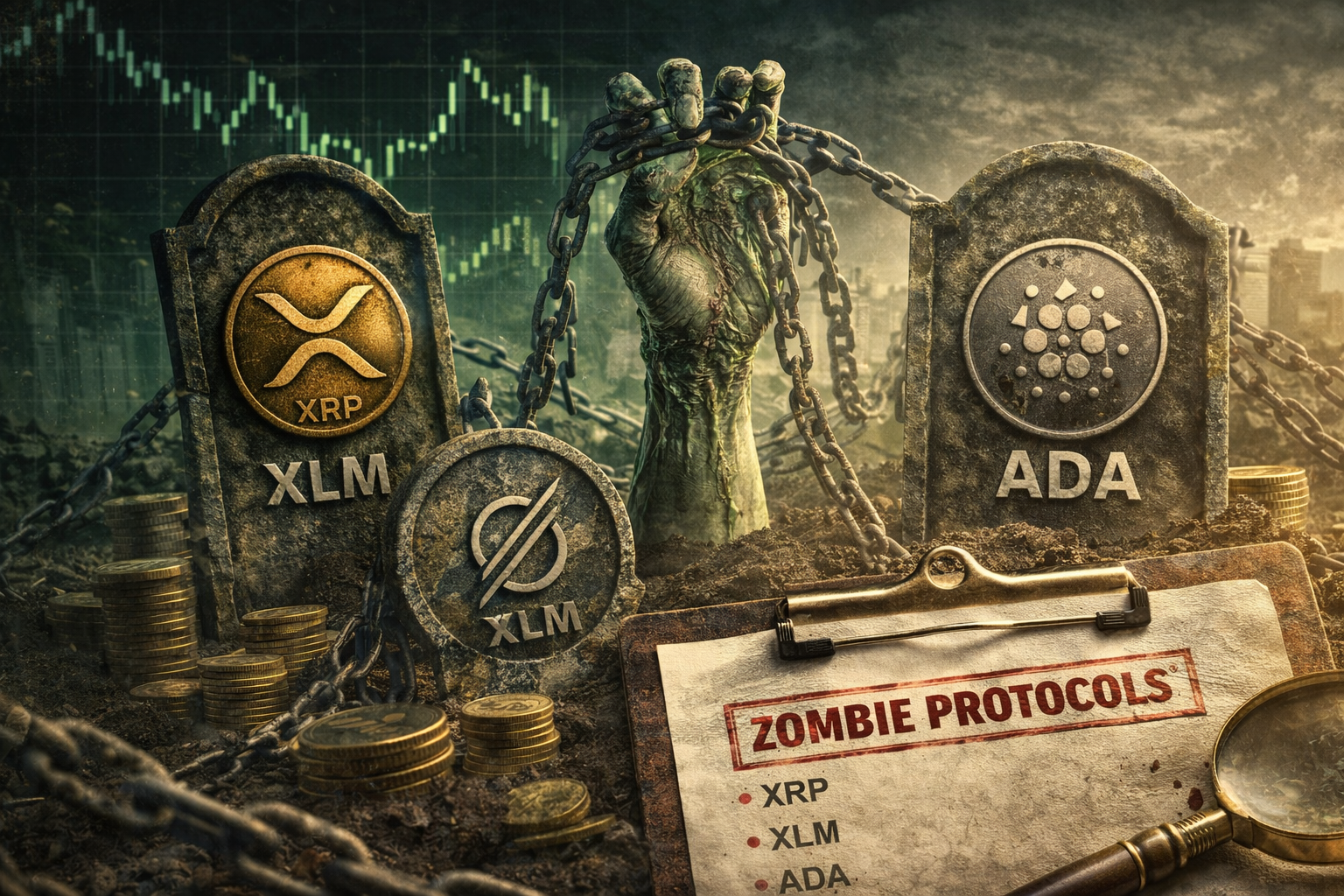
XRP, XLM, ADA Flagged in “Zombie Protocol” Screen
A fresh “zombie protocol” framework is gaining traction in crypto research circles by reframing a familiar bear-market question: which networks are thriving economies, and which are simply well-funded institutions with underused blockspace? An analysis published Tuesday by CryptoNews applied treasury-to-fee and “Total Economic Activity” (TEA) metrics to large-cap tokens, putting XRP, Stellar’s XLM and Cardano’s ADA among a cohort it labels “zombies”—not as dead projects, but as ecosystems where large reserves and locked supply outweigh measurable on-chain utility.
The framing matters because it avoids the usual “price action vs narrative” debate and instead asks what investors are buying per dollar of fully diluted value: a busy network with growing fee capture, or a balance sheet that can outlast competitors even if usage stagnates.
A Bear-Market Label With a Different Meaning
CryptoNews’ piece explicitly warns that “zombie” does not mean a protocol is failing. In its taxonomy, some “zombies” can be “fortresses”—chains or foundations with sizable non-native reserves that can finance development through a long downturn.
That distinction is at the heart of the debate. A capital-rich foundation can keep shipping code, funding grants, and paying validators for years. But from an investor-efficiency perspective, a large treasury with thin fee generation can also resemble idle capital: strong survivability, weak current productivity.
The Screen: Treasury-to-Fees, Then a “TEA” Overlay
The CryptoNews methodology begins with a treasury-to-fee ratio: it estimates a protocol’s liquid treasury value (with an emphasis on non-native assets such as stablecoins, BTC and ETH) and compares it to fees generated by the chain or protocol. A high ratio implies the treasury is effectively subsidizing activity.
It then layers in Total Economic Activity (TEA), which the analysis describes as an annualized aggregation of value moving through the network across settlement volume, application-level fees, and chain fees & MEV. The idea is to measure “real economy” throughput rather than token price momentum.
Finally, it introduces a price-to-fees multiple as a market “revenue multiple,” aiming to identify where valuations appear rich or cheap relative to fee generation.
Why XRP, XLM, and ADA Sit Near the Center of the Argument
The critique leveled at XRP and XLM is not that they fail to move value—both networks are associated with high settlement flows—but that large escrow or foundation-controlled holdings dominate the capital base, depressing efficiency scores when measured against fee capture and “productive” treasury deployment.
For Cardano, the article points to a different tension: a large treasury and committed community alongside comparatively slower DeFi velocity and on-chain growth, producing a weaker capital productivity reading under the model.
This is where the piece implicitly challenges a common investor heuristic. In bull markets, large treasuries are marketed as “runway.” In bear markets, they can be a defensive moat. But when the market rotates back toward cash-flow narratives, large idle reserves can become a drag in relative comparisons—especially against “lean giants” where fee generation is already substantial.
The “Fortress” Counterpoint: Idle Doesn’t Mean Unsafe
CryptoNews argues that some of the same traits that earn a “zombie” label can also indicate resilience. In a severe drawdown, a project with meaningful non-native reserves may be able to maintain developer spending and ecosystem incentives while peers cut back.
That logic increasingly shows up in token screening as investors watch the broader real-world asset (RWA) tokenization sector mature. Data platforms tracking tokenized assets have reported sustained growth in on-chain RWAs, sharpening attention on which ecosystems can convert capital and narratives into repeatable fee streams.
In other words, the “zombie vs fortress” debate is less about whether a chain survives—and more about whether it can translate survivability into a credible path to sustained usage and revenue.
What This Means for Investors and Protocol Strategy
The immediate market implication is not a simple “avoid these tokens” call. The framework is better read as a map of trade-offs:
Capital productivity vs. balance-sheet strength
- Protocols with high efficiency scores can look expensive if the market already priced in growth.
- Protocols with low efficiency scores can look “safe” in runway terms but may struggle to justify valuation without a step-change in usage or fee capture.
The governance and optics problem
Large escrow holdings, foundation-controlled reserves, and long-term R&D treasuries can invite criticism in a fee-driven cycle, even if the protocol is operationally healthy. This can influence sentiment, listings, and institutional appetite—particularly as tokenized securities, RWAs, and regulated on-chain finance draw more scrutiny around transparency and economic design.
The exit ramps from “zombie” status
CryptoNews suggests two broad pathways: increase velocity (more settlement and app activity) or reduce the denominator (burn or otherwise shrink idle reserves).
In practice, that points to concrete strategic levers—stablecoin liquidity, on-chain credit markets, stronger fee capture, and applications that drive repeatable demand rather than one-off spikes.
Source: CryptoNews (Exclusive)