

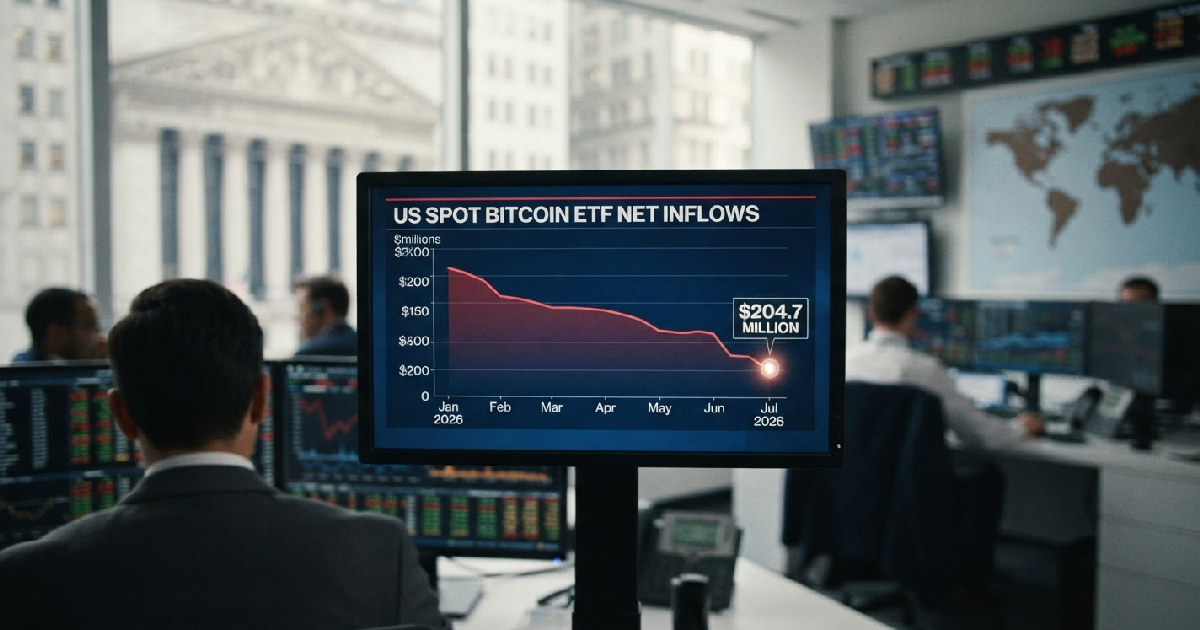
US spot Bitcoin funds record lowest net inflows
US spot Bitcoin Exchange-Traded Funds (ETFs) are on track to record their lowest monthly net inflows ever this July, signaling a significant cooling in institutional demand for the leading cryptocurrency. As of July 30, 2026, these funds have attracted just $204.7 million in net inflows for the month, according to SoSoValue data.
This sluggish performance highlights a challenging period for the digital asset market, following a substantial $4.40 billion exodus in May 2026. While some analysts had noted multi-day inflow streaks, the broader monthly figures indicate a sustained pullback from major investors.
Institutional demand for Bitcoin ETFs wanes
The July 2026 figure of $204.7 million in net inflows for Bitcoin ETFs stands in stark contrast to the initial enthusiasm following their approval. These funds collectively accumulated over $10 billion in assets within their first month of trading in February 2024.
The peak of this excitement came in June 2025, with an impressive $6.18 billion in inflows. However, the market saw its weakest month in May 2026, experiencing a significant $4.40 billion in outflows.
Week of outflows highlights shifting sentiment
Investor sentiment notably shifted in mid-July, with US spot Bitcoin ETFs enduring a four-session outflow streak that saw more than $500 million drain from the funds. Data from Farside Investors indicates approximately $526 million in outflows over four consecutive trading days leading up to July 29.
The heaviest losses during this period occurred on July 23 and July 24, with $225 million and $240 million exiting the market, respectively. BlackRock’s iShares Bitcoin Trust (IBIT), a prominent fund, lost 3,511 BTC (roughly $200.23 million based on Bitcoin’s $63,990 price) in the week ending July 28.
This outflow from IBIT surpassed the entire category’s total net outflow of 3,170 BTC for that week, suggesting concentrated selling pressure. The negative trend reversed briefly on July 29, when Bitcoin ETFs recorded a modest $32.1 million in net inflows, ending the four-day slump.
However, for the full week ending July 30, US spot Bitcoin ETFs still posted net outflows of $29.29 million. Previously, from July 14 to July 22, the funds had seen approximately $999 million in inflows over seven consecutive days.
Ether ETFs attract more capital in July
While Bitcoin ETFs experienced a significant slowdown, US-listed spot Ether ETFs have shown relatively stronger performance. These funds attracted $342.85 million in July, almost matching their April inflows and significantly outperforming Bitcoin ETFs for the month.
This capital influx into Ether products wasn’t isolated. XRP ETFs also recorded their fourth consecutive month of inflows, albeit with a modest $13.61 million. Solana ETFs secured $13.82 million during the same period, further diversifying institutional interest.
The stronger haul for Ether aligns with its recent price performance against Bitcoin. The Binance-listed ether-bitcoin pair has surged by 11% this month, suggesting a tactical rotation among investors. This divergence in capital flows points to varying institutional appetites for different digital assets, moving beyond Bitcoin’s dominance.
Broader market context and subdued Bitcoin price
The cooling interest in Bitcoin ETFs unfolds against mixed signals in the broader financial markets. Bitcoin’s price has shown limited decisive movement recently, trading at $63,990 as of July 30, reflecting a 0.2% decline over 24 hours and a 2.5% drop across the past seven days.
The cryptocurrency briefly fell to around $63,300 during US trading hours, a level analysts at Marex describe as a critical “referee.” Holding above this 200-week moving average suggests underlying strength, they note. But a drop below $62,500 could open the door for bears to target $60,000 liquidations.
This period of price stagnation coincides with a wider slowdown in crypto trading activity. Spot volumes on Binance in July 2026 reached only $35 billion. That’s a dramatic fall from the $246 billion recorded in November 2024, indicating a significant decrease in overall market engagement.
Further market volatility could be on the horizon. The release of key U.S. core PCE inflation and GDP data later today is highly anticipated. These economic indicators often influence Federal Reserve policy and investor risk appetite, impacting critical Bitcoin price levels and broader crypto sentiment.
Stagnant capital inflows raise concerns
Blockchain analytics firm Glassnode noted that broader capital inflows into Bitcoin remain stagnant, with fresh money entering the market close to zero. This observation holds true even as Bitcoin trades near $65,000.
Glassnode highlighted that during the 2023-2025 bull market, monthly inflows often climbed from about $2 billion to more than $10 billion. May’s rebound only reached $2.8 billion before fading, underscoring the current lack of significant new institutional participation.
What’s next for crypto investment?
The total cumulative net inflows across all Bitcoin ETFs stand at $51.36 billion. This impressive long-term figure contrasts with the recent slowdown in monthly additions, which provides a crucial indicator for the future of institutional engagement.
The coming weeks will reveal whether this pause in inflows is temporary or indicates a more sustained shift in investor focus. For now, the institutional story for Bitcoin seems subdued as investors await clearer market direction or new catalysts.
The overall broader crypto market could see increased volatility later today with the release of key US economic data, including core PCE inflation and GDP figures. These reports often influence the Federal Reserve’s future monetary policy decisions, impacting investor appetite for risk assets like cryptocurrencies.