

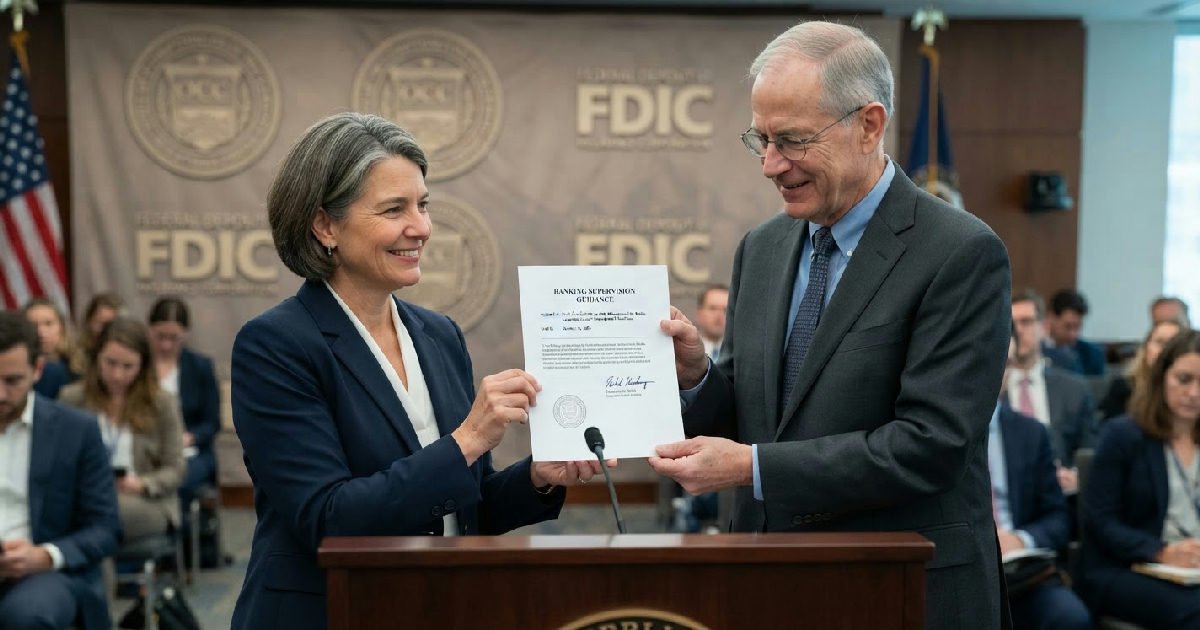
US regulators finalize rule clarifying bank supervision
US banking regulators finalized a rule on August 27, 2026, to redefine “unsafe or unsound practices” in bank supervision, addressing “crypto debanking. C. — US banking regulators have moved to redefine what constitutes “unsafe or unsound practices” in bank supervision, a critical step aimed at curbing what critics call “crypto debanking.”
The Office of the Comptroller of the Currency (OCC) and the Federal Deposit Insurance Corporation (FDIC) jointly finalized the new rule on August 27, 2026.
It’s set to take effect 60 days after its official publication in the Federal Register.
New guidelines as regulators finalize rule for banking supervision
This joint action by the OCC and FDIC seeks to bring clarity to an often-ambiguous regulatory landscape, particularly impacting digital asset firms. Head of the OCC, Jonathan V. Gould, emphasized the rule’s intent to help bank leaders concentrate on “material financial risks” rather than subjective concerns. It’s part of a broader push to solidify a more risk-based approach to bank oversight.
The core of the new regulation is a clear definition of “unsafe or unsound practice,” specifying conduct contrary to prudent operation. Such practices must either cause, or reasonably could cause, material financial harm to an institution or pose a significant risk to the Deposit Insurance Fund. This move directly addresses long-standing concerns about vague interpretations by bank examiners.
Jonathan V. Gould noted that supervision should focus on “substantive violations of law” over issues tied to policies, processes, or documentation alone. He concluded, “Today, the OCC is taking a number of historic steps to codify the agency’s return to risk-based supervision, helping to ensure that its more reasonable, intentional approach to bank supervision endures.”
This shift aims to prevent non-financial factors from leading to enforcement actions.
FDIC Chairman Travis Hill echoed this sentiment, arguing that an “explicit or implicit focus on ‘reputation risk’ untethered from other risk channels” often pressures banks into debanking lawful customers. He believes that while reputation is vital, its supervisory focus should align with traditional risk channels like credit or market risk. This new framework aims to establish clearer boundaries for regulatory intervention.
The rule also standardizes the threshold for issuing Matters Requiring Attention (MRAs). It mandates providing banks with remediation opportunities before taking enforcement action. The intent is to reduce MRAs based solely on procedural shortcomings that don’t create material financial risk.
Unwinding “Operation Choke Point 2.0”
Many observers view this regulatory update as a direct response to “Operation Choke Point 2.0,” a term used by critics to describe previous efforts to limit banking access for certain industries. Former FOX Business reporter and host of Crypto in America, Eleanor Terrett, called the move “pro-crypto.” She sees it as “another significant step toward unwinding ‘Operation Choke Point 2.0’.”
Terrett highlighted that the term “unsafe or unsound practices” had remained largely undefined for years, leaving considerable discretion to individual bank examiners. This ambiguity, particularly during the Biden-era administration, allowed regulators to impose broad restrictions on crypto firms, ultimately leading to debanking. This push for clarity extends to other areas of digital asset regulation, including ongoing efforts to define crypto custody standards.
In 2022, banks reportedly received warnings not to engage with entities involved in crypto assets or stablecoins, leading to widespread debanking across the sector. This impacted crypto firms, related fintechs, founders, and even their clients. The supervisory guidance that enabled such actions was eventually rescinded in early 2025.
The current administration, under President Donald Trump, has actively pushed for a reversal of these restrictions. Regulators have been instructed to remove barriers that prevent crypto and fintech firms from fully participating in the US banking system. This joint OCC-FDIC rule stands as a direct response to that directive.
Contrasting views on regulatory impact
While proponents celebrate the rule as a move towards greater clarity and fairness for the digital asset industry, not everyone agrees. Jeremy Kress, an Associate Professor of Business Law at the University of Michigan Ross, has sharply criticized the new regulations. He labeled it “a terrible rule that exceeds the OCC’s/FDIC’s statutory authority.”
Kress argues that the rule conflicts with established judicial precedent and will ultimately “undermine effective supervision.” He has called for its “expeditious” rescission by the next administration, underscoring the deep divisions within legal and academic circles regarding crypto regulation.
Such strong disagreements highlight the ongoing struggle to balance innovation with financial stability in the digital age. Regulators, including the SEC, have been active in pursuing fraudulent crypto schemes.
Gould, however, firmly pushes back on the idea that reputation risk alone should be a basis for supervision. He stated, “Regulators and banks have too often used it as a pretext for decisions that have nothing to do with safety and soundness, financial risk, or even BSA/AML compliance.” This sentiment suggests a deliberate effort to pivot away from what some see as arbitrary enforcement.
Future of crypto in traditional finance
The regulatory shift reflects a growing acceptance and integration of digital assets into the traditional financial system, at least under the current administration. The number of OCC bank charter approvals, particularly for stablecoin issuers and other crypto firms, has reportedly soared during President Trump’s second term. This indicates a more welcoming environment for legitimate crypto operations.
This increased regulatory clarity could significantly ease the operational challenges faced by crypto firms seeking banking services. Reduced uncertainty surrounding “unsafe or unsound practices” might encourage more traditional banks to engage with digital asset businesses, potentially fostering greater stability and predictability for the sector. Against this backdrop, understanding digital asset market trends remains crucial for participants.
However, the long-term impact remains uncertain. Kress’s call for the rule’s reversal by a future administration highlights the potential for ongoing political shifts to influence crypto policy. The question of whether these changes will endure beyond the current presidential term looms large, creating a degree of forward-looking instability for the sector.
The debate around debanking practices also touches on broader principles of financial inclusion and due process. By clearly defining the parameters for supervisory action, the OCC and FDIC aim to protect lawful businesses from being unfairly denied essential banking services. This protection extends beyond crypto, theoretically benefiting any industry that might face similar arbitrary restrictions.
Historical context of regulatory ambiguity
The ambiguity surrounding “unsafe or unsound practices” wasn’t a new phenomenon, but it became particularly contentious during the Biden-era administration. The lack of a precise definition allowed for broad interpretations, often leading to what was perceived as a targeted crackdown on the nascent crypto industry. This period saw a significant chilling effect on banking relationships for many legitimate digital asset businesses.
The warnings issued to banks in 2022 regarding engagement with crypto and stablecoin firms created a climate of fear and caution. Many financial institutions, wary of regulatory penalties, chose to sever ties with crypto-related clients, regardless of their compliance records. This preemptive debanking choked off access to vital financial services for numerous companies and entrepreneurs in the space.
President Trump’s administration, upon taking office, made it a priority to dismantle these perceived barriers. The rescission of the previous supervisory guidance in early 2025 marked a clear pivot. This latest joint rule from the OCC and FDIC is the most concrete regulatory output of that policy shift, seeking to codify a more permissive stance towards the crypto industry’s integration into mainstream finance.
While the immediate beneficiaries appear to be crypto and fintech firms, the underlying principle of the rule is to ensure fair and consistent application of banking regulations. It’s about ensuring that supervisory actions are grounded in measurable financial risks and legal compliance, rather than subjective interpretations or reputational concerns that can be used as pretexts.