

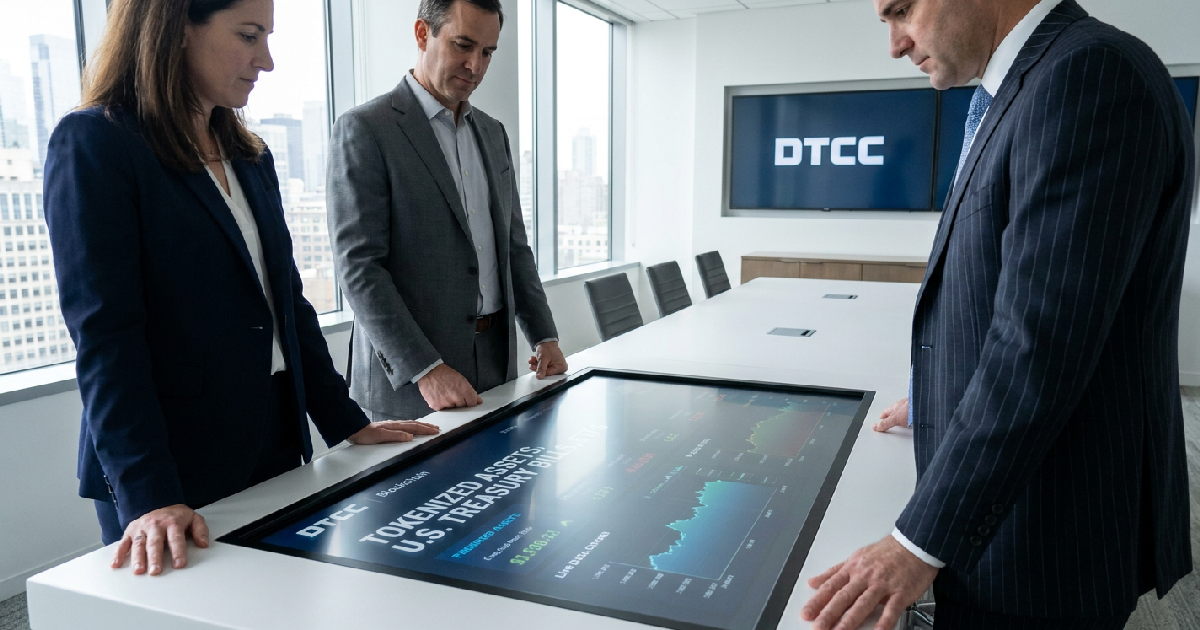
The Depository Trust & Clearing Corporation begins
The Depository Trust & Clearing Corporation (DTCC), the foundational market infrastructure clearing and settling most U.S. securities trades, has initiated limited production trading of tokenized real-world assets. This pivotal move involves financial giants such as JPMorgan, BlackRock, and Goldman Sachs, pushing its long-anticipated blockchain initiative closer to a comprehensive commercial launch in October 2026.
This service allows securities held in custody to be represented as tokens on a blockchain, crucially maintaining the same legal ownership and investor protections as traditional holdings. The DTCC is focusing on highly liquid assets including stocks, Exchange-Traded Funds (ETFs), and U.S. Treasurys in this initial phase.
DTCC transitions from pilot to live production
The DTCC’s digital assets project has progressed from a pilot phase to live production, operating under a crucial no-action letter granted by the U.S. Securities and Exchange Commission (SEC) in December 2025. This letter outlined a clear regulatory pathway for tokenizing eligible securities held within the depository’s framework.
A full commercial launch of the DTCC tokenized assets service is anticipated in October 2026. This phased rollout reflects careful consideration and collaboration between industry stakeholders and regulators.
Regulatory backing and growing participation
The SEC’s no-action letter provided the necessary regulatory clarity, allowing the DTCC to advance its tokenization efforts. This regulatory milestone follows earlier approvals for tokenized equity trading for Nasdaq in March 2026 and for the New York Stock Exchange in April 2026, both operating under the Depository Trust Company’s (DTC) three-year tokenization pathway.
Beyond JPMorgan, BlackRock, and Goldman Sachs, the pilot program has drawn significant interest. Nearly 40 financial firms and technology providers are participating, with some sources indicating the number could be over 50. Key names include Bank of America, Nasdaq, Circle, Robinhood, Kraken, Ondo Finance, Ripple Prime, Vanguard, BNP Paribas, Citi, Morgan Stanley, and State Street.
Nadine Chakar, global head of DTCC Digital Assets, has been instrumental in steering this initiative. The broad participation underscores a collective industry recognition of tokenization’s potential to reshape financial markets.
Bridging traditional finance with blockchain innovation
The DTCC’s tokenization project is designed to seamlessly integrate blockchain technology with existing market infrastructure. It aims to create “digital twins” of traditional securities, ensuring that fundamental legal ownership, dividend rights, and governance remain unchanged.
The system leverages the DTCC’s DTC Tokenization Service on its ComposerX platform. Live trades are currently settling on either HyperLedger Besu, a private blockchain, or the Wall Street-backed Canton network. This hybrid approach reflects the complexities of integrating nascent technology with robust, regulated financial systems.
Specific assets and transaction types
The range of assets undergoing tokenization in this initial phase is diverse and strategically chosen for their liquidity. These include Microsoft shares, Circle shares, the Invesco QQQ Trust ETF, the State Street SPDR S&P 500 ETF, and BlackRock’s iShares 0-3 month Treasury Bond ETF.
These tokenized assets are being used across a variety of crucial financial operations. These include collateral transfers, repo transactions, equity trades, margin movements, and general asset transfers. This breadth of application highlights the versatility and potential impact of the new tokenization framework.
Major players deepen tokenization strategies
The involvement of institutional heavyweights like JPMorgan, BlackRock, and Goldman Sachs isn’t a surprise; these firms have been aggressively exploring blockchain and tokenization for years. Their participation in the DTCC’s initiative signals a critical endorsement of a standardized, regulated approach to digital assets.
JPMorgan, for instance, successfully converted holdings of the Invesco QQQ Trust (QQQ) ETF into tokenized assets during the pilot. This demonstrates their ongoing commitment to leveraging blockchain for improved efficiency in capital markets. The bank has long been active in blockchain initiatives, including testing Quorum, its enterprise blockchain platform.
BlackRock’s bold digital asset vision
BlackRock, the world’s largest asset manager, has vocalized its ambitious goals in the tokenization space. CEO Larry Fink has famously predicted that “every stock and bond would eventually live on a shared digital ledger,” highlighting the company’s long-term vision.
In March 2024, BlackRock launched its inaugural tokenized fund on the Ethereum blockchain, the BlackRock USD Institutional Digital Liquidity Fund (BUIDL). This fund focuses on US Treasury bonds and has already surpassed $2 billion in assets under management. BlackRock is also a key participant in a UK tokenization taskforce, working to boost the economic output potentially by up to $44 billion.
Goldman Sachs embraces digital infrastructure
Goldman Sachs has also been a prominent advocate for tokenization. Mathew McDermott, Global Head of Digital Assets at Goldman Sachs, emphasized tokenization as the “topic du jour” in October 2025. The investment bank has developed its own tokenization platform, GS DAP, which launched in 2022.
Goldman Sachs plans to spin out GS DAP in mid-2026 to scale its adoption, leveraging technology from Digital Asset to create a distributed ecosystem. They’ve also launched a tokenized real estate fund, demonstrating a comprehensive approach to integrating digital assets across various investment categories.
Brian Armstrong, CEO of Coinbase, has warned that traditional finance must move on-chain to avoid obsolescence, a sentiment echoed by these major players.
The promise of enhanced market efficiency
The driving force behind the DTCC’s tokenization initiative is a clear pursuit of improved market efficiency, greater transparency, and enhanced interoperability between traditional and decentralized finance. The goal is to fundamentally transform how securities are settled and managed.
One of the most significant anticipated benefits is near-instant delivery versus payment, which could drastically reduce the traditional T+2 settlement cycle. This acceleration of settlement times carries profound implications for capital utilization, risk management, and overall market liquidity.
Meanwhile, legislative efforts like the Clarity Act are advancing in the Senate, potentially bringing new federal rules for cryptocurrencies like Ethereum and Solana, underscoring the broader regulatory momentum around digital assets.
Reducing settlement times and costs
Shortening the settlement cycle from two days to near real-time can free up billions in capital currently held as collateral. This reduction in trapped capital could significantly boost market velocity and economic activity. It also mitigates counterparty risk by minimizing the time between trade execution and final settlement.
Moreover, the automation inherent in blockchain-based systems promises to reduce operational costs associated with manual processes and reconciliation. Frank La Salla, President and CEO of DTCC, has consistently highlighted these efficiency gains as central to the organization’s vision for digital assets.
Looking ahead: the future of digital securities
The DTCC’s move marks a critical inflection point for the broader financial industry, signaling a decisive shift towards integrating blockchain into mainstream operations. With over $114 trillion in assets under custody, the DTCC’s embrace of tokenized assets lends immense credibility and infrastructure to the burgeoning digital economy.
The full commercial launch in October 2026 will be closely watched by market participants globally. It