

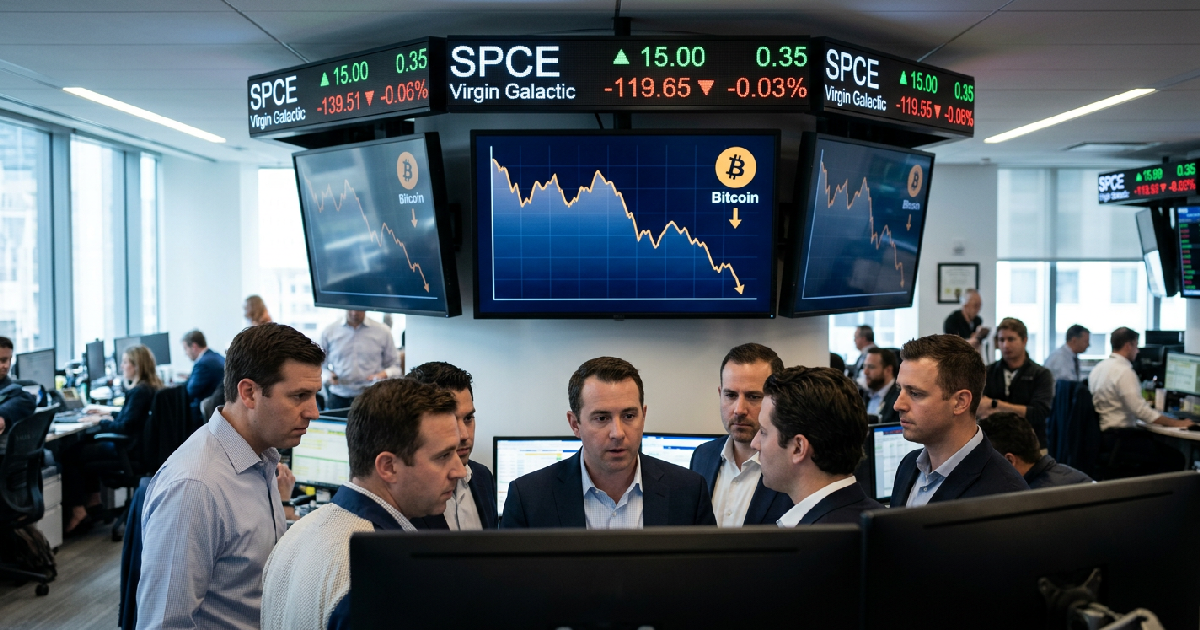
SpaceX public offering speculation reportedly triggers $250 billion crypto decline
Bitcoin fell below $62,000 as the cryptocurrency market suffered a $250 billion decline in early June 2026, leading analysts to debate whether fevered anticipation for a SpaceX initial public offering (IPO) triggered the crash.
The theory suggests that speculative capital is rotating out of digital assets and into a $200 billion pipeline of blockbuster IPOs and AI-driven equity opportunities. This shift in investor preference comes as the aerospace company led by Elon Musk reportedly seeks a valuation as high as $1.
8 trillion, potentially making it one of the largest public offerings in history.
The total value wiped from the crypto sector occurred while United States stock indices traded near record highs, showing no signs of systemic stress. This divergence is the primary evidence for the “capital rotation” theory, which argues that investors are selling crypto to chase asymmetric returns in public and pre-IPO markets.
While Bitcoin has historically held a monopoly on high-upside speculative opportunities, the emergence of massive AI technology stocks has provided a new destination for the limited pool of mobile risk capital.
Analysts suggest the 2026 market environment marks a structural challenge for the industry. A speculative investor asked where to put risk capital today is increasingly choosing semiconductor stocks and the SpaceX IPO over digital currencies.
This transition is not purely conceptual; traders have reportedly been using synthetic derivatives on crypto-native platforms to bet on the IPO wave, effectively using crypto infrastructure to move money into equity-market opportunities.
Capital rotation and the SpaceX IPO fever
The argument for capital rotation rests on the idea that speculative money is finite and follows the most exciting risk-adjusted upside. For years, crypto was the premier destination for investors seeking high growth. However, the current wave of high-profile IPOs, expected to raise more than $200 billion collectively, has created significant competition.
The SpaceX IPO has become a focal point for this shift, representing a generational equity opportunity that rivals the allure of Bitcoin.
This movement of funds helps explain why crypto fell in isolation while the broader equities market remained stable. A general “risk-off” economic event typically hits both asset classes simultaneously. Instead, the June crash saw crypto bleed while technology stocks rallied, supporting the view that money didn’t flee the market but simply changed its target.
Some long-term believers in digital assets now argue that the AI boom is draining the speculative capital that crypto rallies traditionally depend on.
The timing of the crash coincided with a peak in AI enthusiasm and IPO anticipation. As these alternatives became more attractive, Bitcoin was deprived of the marginal speculative inflows required to maintain its price levels.
This relative-attractiveness story suggests that Bitcoin didn’t necessarily get worse as an asset; rather, the competition from the private and public equity sectors simply got more exciting for the global investor class.
Decoupling and the drain of speculative capital
There is concrete evidence that the plumbing of this rotation is already in place. Investors can now speculate on tokenized versions of pre-IPO stocks through crypto-native rails. This means that capital intended for high-risk bets is moving through the same platforms used for crypto, but is being directed toward the SpaceX and AI excitement.
This visibility into how money moves strengthens the case that the “marginal dollar” is being siphoned away from Bitcoin.
Serious researchers have noted that the AI buildout requires an enormous amount of capital. When combined with the massive cash requirements of a $200 billion IPO pipeline, there is simply less liquidity leftover for the crypto market. This shift mirrors other sectors where com/international-news/supply-chain-resiliency-perma-crisis-era-logistics-shift/”>supply chain resiliency increasingly prioritised over simple cost-cutting reflects a broader change in how managers allocate resources in a “perma-crisis” era. For crypto, the crisis is one of attention and liquidity competition.
The argument against the IPO trigger
Despite the appeal of the rotation theory, several factors suggest that SpaceX fever was a contributing factor rather than the direct trigger for the June crash. The SpaceX IPO has been anticipated for months, and a transition to equities is usually a gradual process.
In contrast, the June downturn was a violent 72-hour event characterized by a sharp liquidation cascade. A slow tide of capital rotation rarely produces the kind of abrupt price collapse seen in the crypto market this past week.
The mechanism of the crash—more than $1.7 billion in leveraged positions liquidated within 24 hours—is the signature of a leverage-driven event. While the IPO wave might have weakened the underlying demand, the actual “trigger” was likely a series of acute catalysts that hit the market simultaneously.
These immediate shocks often lead to forced selling that is entirely divorced from long-term investment strategies regarding rocket companies or technology stocks.
Acute catalysts versus long-term rotation
Several dated events provide a more immediate explanation for the market’s sudden volatility. That same week, a strong U.S. jobs report lowered expectations for interest rate cuts, which traditionally hurts high-risk assets like Bitcoin.
Furthermore, Bitcoin ETFs recorded their longest streak of outflows in history, indicating that institutional demand was already exhausted before the price began to slide. These liquidating $445 million in contracts during earlier price swings show how sensitive the market has become to automated selling.
Geopolitical tensions also played a role as fresh U.S.-Iran military strikes shattered a fragile ceasefire. Such events often trigger risk-off sentiment that hits crypto first due to its 24/7 trading availability. At the same time, reports emerged of Strategy selling Bitcoin for the first time in nearly four years, further damaging sentiment.
Each of these factors represents an acute, concrete event capable of sparking a liquidation cascade on its own.
The impact of leveraged liquidations
The rapid drop below $62,000 was primarily driven by forced selling in the derivatives market. When Bitcoin hit key technical levels, it triggered automated sell orders that cascaded through the system. This type of volatility is often seen when institutional outflow creates a vacuum in buy-side liquidity.
While the IPO fever might have thinned out the pool of buyers, the speed of the crash was a product of the market’s internal leverage and technical breaks.
In this context, SpaceX and the broader IPO boom act as a background environment that reduces market resilience. By pulling away the “marginal dollar” that would usually buy the dip, the rotation made the market more vulnerable to the acute shocks that actually pulled the trigger.
The crash was not a choice made by investors to sell Bitcoin for SpaceX shares in a single day, but a leverage-fueled collapse made possible by a lack of fresh liquidity.
Implications for the future of digital assets
The June crash highlights a new phase of competition for Bitcoin. As the “only game in town” for asymmetric returns, it faced little competition for a decade. Now, with the public debut of companies like SpaceX and the ongoing AI revolution, the digital asset sector must prove its value against tangible technology leaders.
The monopoly on speculative interest has been broken, and Bitcoin is now just one option in a growing menu of high-risk opportunities.
The long-term challenge remains the $200 billion IPO pipeline. If capital continues to flow into these public offerings, the crypto market may experience a prolonged period of suppressed liquidity.
However, many analysts believe that once the initial “IPO fever” cools, the absolute scarcity of Bitcoin will again become its primary draw compared to the dilutive nature of stock offerings.
For now, the crypto market is no longer an isolated ecosystem; it is a single player in a wider, more aggressive global competition for risk-on capital.