

Retail Traders Shift From Crypto to Stocks After Bitcoin’s 46% Drop
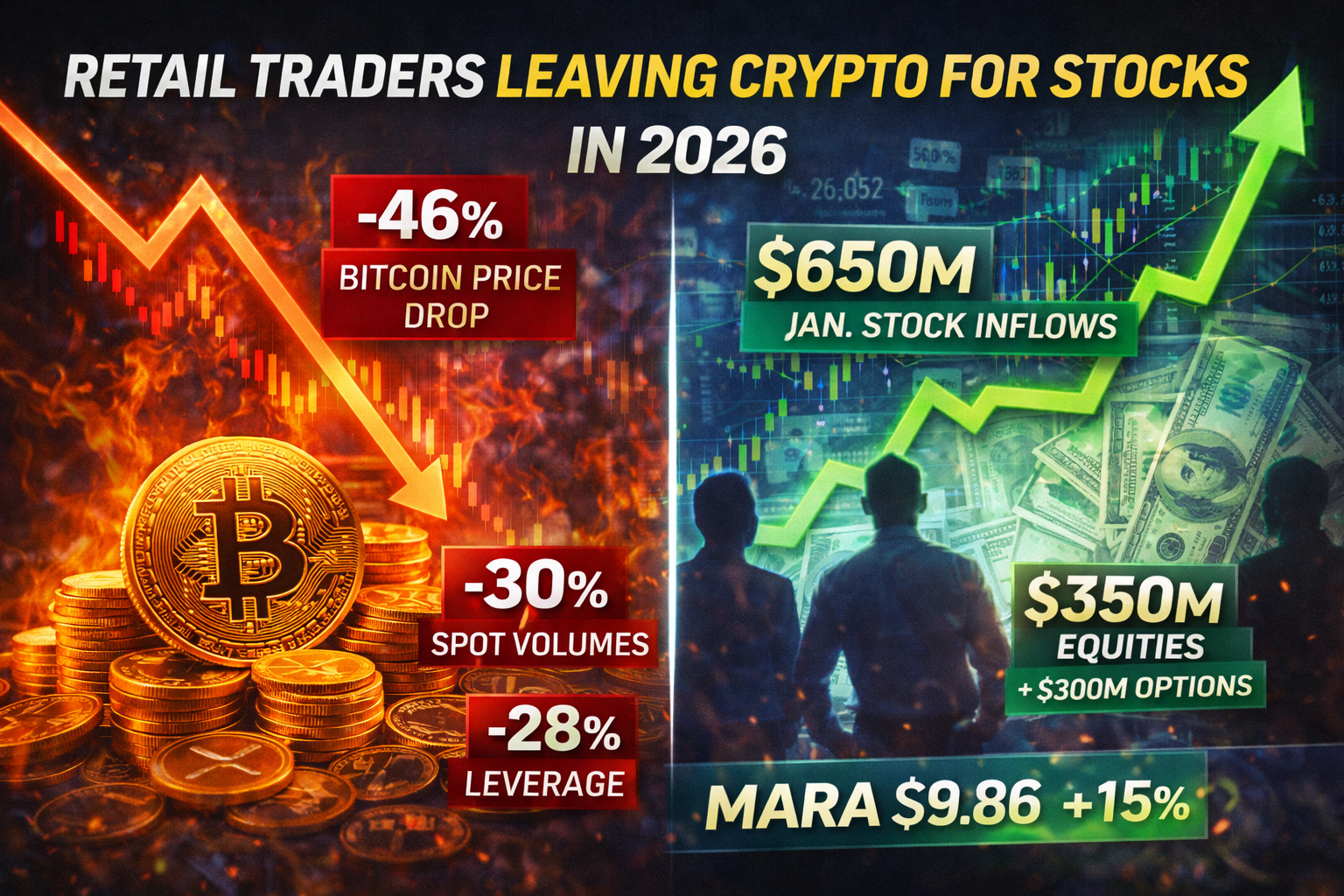
Retail traders are stepping back from crypto markets after Bitcoin’s 46% slide from its $126,000 peak, and the capital is not sitting idle. Instead, it is flowing decisively into equities. Spot trading volumes across major exchanges have fallen 25% to 30%, while speculative leverage has reset sharply — a structural shift that is reshaping market dynamics heading into mid-2026.
The Leverage Reset That Changed the Tone
The clearest signal comes from derivatives markets. Estimated Leverage Ratios dropped 28%, sliding from 0.1980 to 0.1414, according to CryptoQuant data. In practical terms, that means the speculative froth that fueled the 2025 rally has largely been flushed.
Binance’s daily activity declined roughly $4.7 billion, a 16% contraction that leaves volumes hovering near $24 billion. Without heavy retail participation, price rebounds have struggled to sustain momentum. Institutional ETF inflows continue to provide structural demand, but they do not create the high-velocity rallies that retail leverage once produced.
The pattern resembles capitulation rather than rotation within crypto. The dip-buying reflex that defined the 2024–2025 cycle appears diminished, at least temporarily.
Equities Absorb the Risk Appetite
Retail is not retreating to cash. January 2026 saw approximately $350 million in net inflows into cash equities and more than $300 million into options — record levels for retail participation. The shift reflects a recalibration of risk, not a disappearance of it.
The volatility comparison tells the story. The BTC-to-Nasdaq volatility ratio has fallen below 2x, narrowing the perceived risk premium that once justified crypto’s sharper drawdowns. After a nearly 50% retracement, many traders appear to prefer AI-driven equity names that offer high volatility without crypto’s liquidity shocks.
Market makers note that while institutional flows remain active in crypto ETFs, they behave differently from retail. Institutions accumulate methodically; they do not generate the viral momentum spikes that once drove vertical price expansions.
Liquidity Thins as Sentiment Cools
Liquidity depth across major exchanges has contracted alongside retail participation. Order books appear thinner, and short-term rallies have lacked follow-through. Analysts describe the current phase as transitional: institutional accumulation at lower prices, but limited speculative acceleration.
Crypto’s narrative edge has also shifted. In 2024 and 2025, macro liquidity and ETF launches supported sustained enthusiasm. In 2026, retail traders increasingly deploy capital into equities where earnings data, AI themes, and structured research tools offer clearer analytical frameworks.
That does not signal a structural collapse for crypto. It does indicate a change in participation profile.
What Comes Next for Bitcoin and the Broader Market
Some analysts anticipate range-bound price action through mid-2026 if retail risk appetite remains muted. Without aggressive leverage reentering the system, breakouts may require macro catalysts — regulatory clarity, ETF expansion, or renewed monetary easing.
If retail returns, it will likely follow sustained upward momentum rather than attempt to front-run it. Until then, crypto markets appear to be transitioning from speculative euphoria toward consolidation.
The capital has not vanished. It has simply migrated. Whether it migrates back will depend on volatility, opportunity cost, and confidence.
Source: https://cryptonews.com/news/retail-exodus-traders-ditching-crypto-equities-2026/