

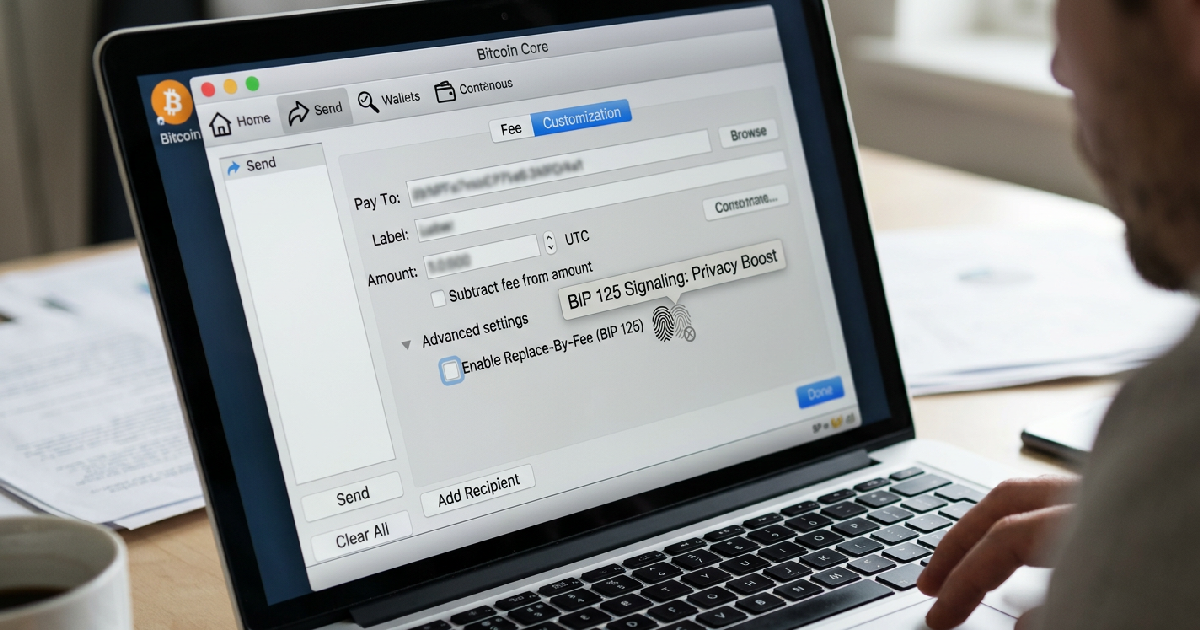
Bitcoin developers remove explicit RBF signaling from wallets to boost privacy
Bitcoin developers are moving to eliminate explicit Replace-by-Fee (RBF) signaling from wallet software to address privacy concerns and technical redundancy. In a post to the developer mailing list, developer rkrux noted the intent to remove BIP 125 signaling from the Bitcoin Core wallet, as the feature’s opt-in mechanism is no longer necessary under current network policies.
The transition is driven by the fact that full-RBF, which allows any unconfirmed transaction to be replaced by a higher-fee version regardless of prior signaling, has become a standard. By removing the specific “fingerprints” left by optional RBF toggles, developers aim to make transactions from different wallets look uniform, preventing chain analysis tools from identifying specific software used by senders.
The evolution of Replace-by-Fee as a core policy
The Replace-by-Fee (RBF) protocol was developed to help transactions confirm faster when network congestion causes lower-fee payments to get stuck in the mempool. It allows a user to “bump” the fee of a pending transaction by sending a replacement that spends at least one of the same inputs.
While transaction replacement existed in Satoshi Nakamoto’s original release, it was disabled in 2010 due to denial-of-service concerns before the current widely-used form, BIP125, arrived in Bitcoin Core 0.12 in early 2016.
The shift toward full-RBF occurred in stages, first becoming a configurable mempool policy in Bitcoin Core v24.0 and later the default policy in v28.0. Because the network now treats all transactions as potentially replaceable by default, the explicit “opt-in” signal in a wallet’s code has become a vestigial data point.
Key details
If different wallets continue to handle this signaling differently, they leave unique digital signatures on-chain that compromise user privacy.
Standardizing this behavior is a priority for maintainers looking to shield user metadata. Community participant Murch noted that every sender must pick a sequence number for every input. If developers can agree on a common default, such as the dominant “MAX-2” sequence, transactions across the ecosystem will become harder to track.
This technical refinement is critical as Bitcoin price levels shift and network efficiency remains a high priority for participants.
Addressing user errors and extremely high transaction fees
The complexity of the RBF framework has historically contributed to significant financial losses through user error and poor interface design. Without clear standardization, users have occasionally mismanaged fee-bumping, leading to exorbitant costs that far exceed the value of the transfer itself.
A notable incident occurred on November 23, 2023, when a Bitcoin user paid a $3.1 million transaction fee to transfer 139.42 BTC—an overpayment of nearly 120,000 times the typical rate. Research suggests this was possibly due to RBF misuse or simple unawareness of the mechanism.
Other errors include crypto firm Paxos paying over $500,000 in fees in September 2023 due to a script bug, and a user paying $60,000 for a small transfer in April 2025.
Key details
Beyond individual errors, fixing RBF logic is vital for the security of Layer-2 protocols like the Lightning Network. These systems are vulnerable to “pinning attacks,” where a malicious party adds many descendant transactions to a pending transfer. This tactic uses existing RBF rules to effectively “pin” a transaction in the mempool, preventing an honest party from confirming a time-sensitive settlement within a critical deadline.
Refining how nodes handle replacements helps mitigate these risks, ensuring that the underlying Bitcoin infrastructure remains a solid foundation for on-chain finance. As industry leaders push for more on-chain asset movement, these technical improvements become essential for institutional stability.
Developers hope that simplifying the code will eventually lead to more intuitive wallet designs that protect both the funds and the privacy of the average user.
What the RBF signaling removal means for merchants
The debate over RBF has always involved a trade-off regarding zero-confirmation (0-conf) transactions. When a transaction signals it can be replaced, it makes immediate, unconfirmed payments riskier for merchants. While contributors like Jonas Schnelli noted as early as 2016 that merchants could simply reject RBF-signaled transactions, the universal adoption of full-RBF makes the risk profile of 0-conf payments consistent across the network.
For the average user, these changes will likely be invisible. If the proposal to remove BIP 125 signaling is integrated into future Bitcoin Core releases, the “opt-in” checkbox may disappear from wallet interfaces, even as the ability to bump fees remains functional.
This shift moves Bitcoin toward an “always-on” privacy model, where the technical metadata of a transaction no longer leaks clues about which wallet software produced it. Professionals in the space continue to advocate for such improvements, similar to how the Clarity Act seeks to define new standards for digital assets across the board.