

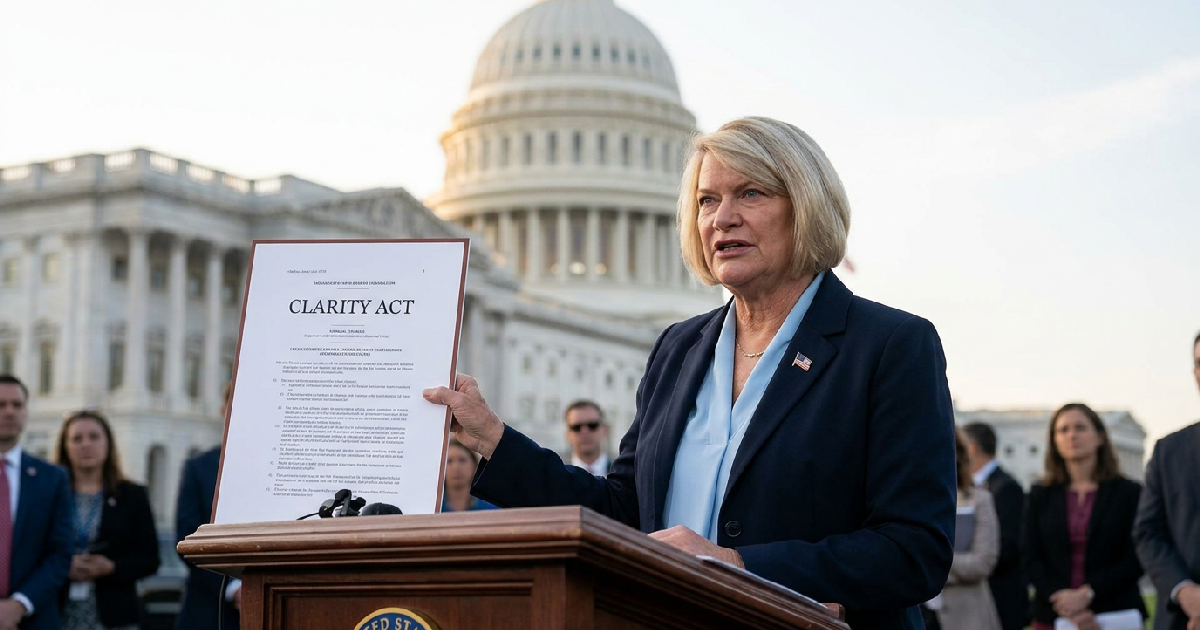
Senator Cynthia Lummis urges CLARITY Act vote before August recess
Senator Cynthia Lummis (R-WY) has intensified her calls for a full Senate floor vote on the Digital Asset Market Clarity Act (H.R. 3633), widely known as the CLARITY Act, before the looming August recess.
This legislative push, coming on July 5, 2026, seeks to establish a comprehensive regulatory framework for digital assets across the United States, an effort Lummis believes is crucial for modernizing the nation’s financial services.
Crucial Senate vote looms for CLARITY Act
The bipartisan bill, initially introduced by Representative French Hill in May 2025, aims to resolve the long-standing jurisdictional disputes between the Securities and Exchange Commission (SEC) and the Commodity Futures Trading Commission (CFTC) over crypto oversight. It also promises to define how digital assets are legally treated under U.S. law, providing much-needed certainty for the burgeoning crypto industry.
The path for the CLARITY Act to become law has seen significant progress, clearing the House of Representatives in July 2025 and subsequently advancing through the Senate Banking Committee in May 2026. However, the clock is ticking for a full Senate vote, with the August recess representing a critical deadline.
If the Senate fails to act before then, the bill’s legislative journey could be stalled until 2027, injecting further uncertainty into the digital asset space. Senator Lummis has been vocal, stating the CLARITY Act is “this generation’s contribution to that legacy” and urging lawmakers to “finish the job.”
Negotiations on the final text of the bill were reportedly wrapping up around July 4, 2026, offering a last window for lawmakers and industry groups to review revisions. This final review is particularly important as the bill navigates debates over complex areas like stablecoin yield products, ethics rules, and the oversight of decentralized finance (DeFi).
These contentious issues highlight the challenge of securing sufficient support within a divided Senate. A crucial aspect of this legislative effort is addressing the existing “spot market gap,” where neither the CFTC nor the SEC currently possess the explicit authority to regulate entities involved in digital commodity spot transactions.
Redefining crypto regulatory jurisdiction
At its core, the CLARITY Act proposes a clear delineation of responsibilities between the two primary financial regulators. It aims to put an end to the regulatory ambiguity that has long plagued the U.S. crypto market.
Under the proposed framework, the SEC would maintain its oversight of investment contract assets, typically associated with initial coin offerings (ICOs) and presales. Meanwhile, the CFTC would be granted a more expansive role, taking exclusive regulatory jurisdiction over digital commodity spot markets, including assets like Bitcoin and Ethereum, and the exchanges where they trade.
The bill categorizes digital assets into three distinct types: digital commodities overseen by the CFTC, investment contract assets under the SEC’s purview, and payment stablecoins, which would fall under the regulation of banking authorities via the GENIUS Act. This structure is designed to provide clear guidance for market participants.
Furthermore, the CLARITY Act establishes specific rules for trading platforms, brokers, and crypto exchanges, mandating the separation of customer assets from company funds. This “Anti-FTX Protection” measure is a direct response to past exchange failures and aims to bolster consumer confidence and asset security.
The advancement of the CLARITY Act, should it pass, will set new federal rules for various crypto entities. In a related development, the CLARITY Act has advanced to the Senate, signaling a shift in the regulatory landscape for platforms dealing with cryptocurrencies like Ethereum and Solana.
Combating fraud with new enforcement tools
Beyond clarifying regulatory roles, the CLARITY Act also includes robust provisions aimed at enhancing fraud prevention and enforcement within the digital asset sector. A significant allocation of $150 million is earmarked specifically for crypto fraud investigations, a move that Senator Lummis believes will empower agencies to “track down scammers and bad actors.”
The bill introduces over 16 safeguards designed to combat illicit finance, mandating compliance with Bank Secrecy Act (BSA) and Anti-Money Laundering (AML) rules for all covered entities. This tightening of reporting standards is expected to increase transparency for platforms handling customer assets and transactions.
Crucially, the legislation includes new sanctions authorities targeting entities linked to illicit activities and empowers exchanges to freeze funds suspected of being connected to such operations. These measures are intended to create a more secure environment for investors and deter fraudulent behavior.
The proactive approach to fraud and illicit finance contrasts with the reactive enforcement-led policies that have often characterized crypto regulation in the past. This shift aims to provide a clear rulebook, rather than relying on legal precedents set after financial misconduct occurs.
Impact on U.S. competitiveness in crypto finance
Proponents of the CLARITY Act argue that its passage is vital for maintaining U.S. leadership in the rapidly evolving global financial landscape. By establishing clear regulatory paths and fostering innovation, the bill seeks to prevent the U.S. from falling behind other jurisdictions, such as the European Union with its Markets in Crypto-Assets (MiCA) framework and Singapore’s comprehensive regulations.
Critics, however, continue to raise concerns about the bill’s effectiveness in providing adequate protection for everyday users and its level of detail concerning decentralized finance. They argue that while clarity is needed, it shouldn’t come at the expense of robust consumer safeguards.
The bill is also designed to create clear registration pathways for U.S. crypto businesses, which could reduce regulatory burdens and encourage more innovation domestically. For banks, the legislation is expected to reduce risks associated with offering custody services for digital assets, potentially paving the way for broader institutional adoption.
As the U.S. navigates this complex regulatory terrain, the outcome of the CLARITY Act could significantly influence capital flows within the crypto market. For instance, recent reports show Bitcoin (BTC) price drops have occurred as capital shifts towards AI and quantum technologies, illustrating the dynamic nature of investment decisions in the absence of clear regulatory frameworks.
Paving the way for digital asset innovation
The CLARITY Act isn’t just about regulation; it’s also designed to be a catalyst for innovation within the digital asset ecosystem. By providing clear rules, it aims to foster an environment where legitimate projects can thrive without the constant threat of regulatory uncertainty.
This includes mandating operational disclosures from digital asset projects, promoting transparency, and incorporating market surveillance strategies to ensure fair and orderly markets. Such measures are essential for building trust and attracting mainstream investment into the crypto space.
The bill also carves out customized capital-raising exemptions of up to $50 million, adjusted for inflation, specifically for smaller projects. This provision is crucial for startups and emerging companies, allowing them to innovate and secure funding without facing the same stringent requirements as larger entities.
Key details
Furthermore, a developer liability provision aims to reduce the need for developers to constantly consult lawyers, streamlining the innovation process. This focus on practical, forward-looking measures underscores the bill’s potential to significantly reshape U.S. crypto finance, making America a more attractive hub for digital asset development.
The proposed legislation represents a concerted effort to move beyond piecemeal enforcement actions and establish a predictable legal environment. Senator Lummis and her allies are betting that this clarity will not only protect consumers but also unleash a new wave of innovation in the crypto sector.
The outcome of the upcoming Senate vote will determine whether this vision for 21st-century financial services becomes a reality this year or if the industry must wait until 2027.