

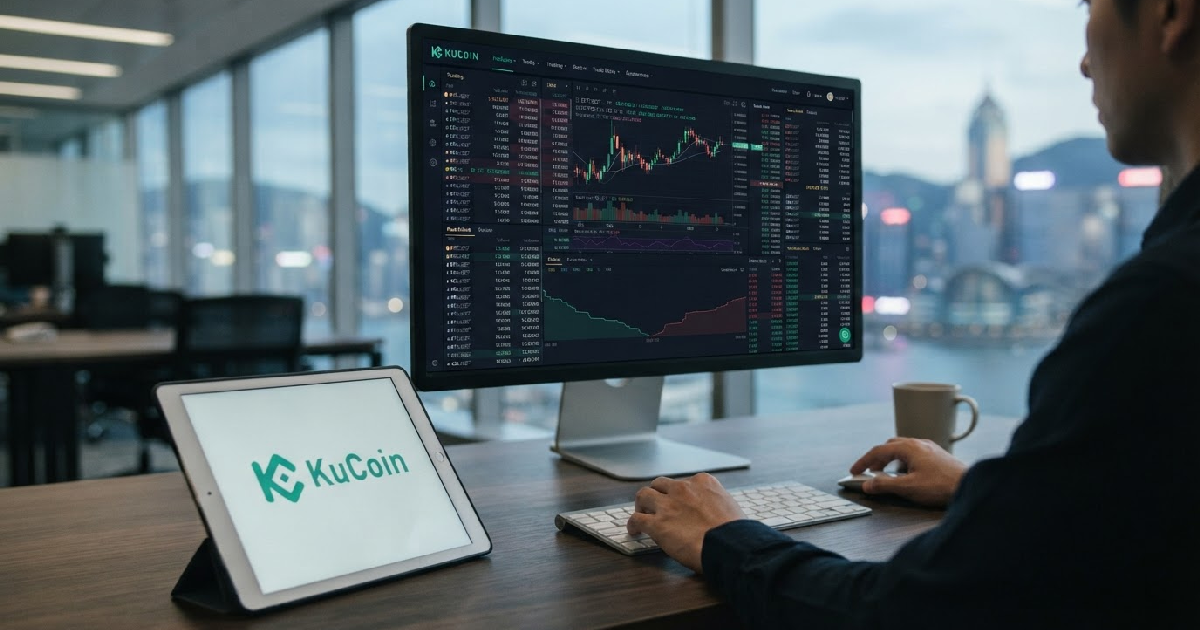
KuCoin exchange cements position as global crypto hub with diverse offerings
KuCoin, the Seychelles-based cryptocurrency exchange founded in 2017 by Chun Gan, Ke Tang, and Johnny Lyu, has firmly established itself as a major player in the digital asset space.
Serving over 45 million users across more than 200 countries and regions, the platform offers a broad spectrum of services for trading, earning, spending, and managing cryptocurrencies. Its initial funding came from a successful initial coin offering (ICO) which raised an estimated $27.5 million, drawing on 5,500 Bitcoin.
KuCoin exchange founding vision and early market entry
This substantial global footprint, combined with an extensive listing of over 1,000 digital assets ranging from established blue-chips to niche micro-cap tokens, positions KuCoin as a comprehensive hub for both novice and experienced crypto participants. The exchange initially branded itself as “The People’s Exchange,” reflecting a commitment to broad accessibility.
But it’s now evolved, aiming to build a trusted infrastructure for the wider digital asset economy, pushing beyond just simple trading.
KuCoin’s journey began in 2017 when its founders, Chun Gan, Ke Tang, and Johnny Lyu, launched the Seychelles-based exchange with an ambitious vision for accessible digital asset trading. The company quickly gained traction, partly thanks to its innovative funding model. They secured approximately $27.5 million through an initial coin offering, exchanging 5,500 Bitcoin to bootstrap their operations.
This early capital injection allowed KuCoin to rapidly develop its platform and expand its reach. From the outset, the exchange focused on providing a wide array of digital assets, a strategy that helped it attract a diverse user base looking for alternatives beyond the mainstream cryptocurrencies. This commitment to variety remains a core part of its appeal today.
Diverse trading instruments for every investor
At its core, KuCoin functions as a centralized cryptocurrency exchange, enabling users to deposit both crypto and fiat currencies for trading. But it’s far from basic. The platform has developed a comprehensive suite of tools that cater to everyone from first-time buyers to sophisticated institutional investors. Users can access these services via desktop or through the KuCoin mobile app, trading more than 1,000 digital assets.
Beyond standard spot trading, where users buy and sell cryptocurrencies at current market prices, KuCoin offers several advanced options. Margin trading is available for selected assets, allowing users to amplify their positions with borrowed funds. While this can increase potential gains, it also significantly elevates liquidation risk, requiring careful collateral management.
Advanced trading options
For seasoned traders, KuCoin Futures provides access to perpetual contracts and other futures products, complete with advanced interfaces, order management, charting, and robust risk management tools. This level of sophistication helps professional traders execute complex strategies. The platform also integrates automated trading tools, known as KuCoin Trading Bots.
These bots allow users to set predefined rules for strategies like Spot Grid, Futures Grid, or Dollar-Cost Averaging, enabling hands-free trading even when the app isn’t active.
Simplified asset conversion
For those seeking a more straightforward approach, KuCoin Convert simplifies asset swaps, bypassing the traditional order book interface. This service is ideal for users who want to exchange cryptocurrencies quickly without delving into intricate market mechanics.
Additionally, the KuCoin P2P marketplace connects buyers and sellers directly, facilitating transactions using local payment methods while ensuring security through an escrow mechanism. This peer-to-peer model adds another layer of flexibility for users, especially in regions with varying regulatory environments for direct fiat-to-crypto on-ramps.
KuCoin’s expansive ecosystem and community engagement
KuCoin’s ambition stretches beyond mere trading, aiming to foster a holistic digital asset ecosystem. The platform offers a variety of services designed for yield generation, payments, and community interaction. These initiatives cater to users looking to do more than just buy and sell tokens.
Earning yield and token discovery
Through KuCoin Earn, eligible users can put their digital assets to work via staking, savings, lending, and structured products. This includes both flexible and fixed-term options, alongside offerings like Smart Earn, Hold to Earn, and KuCoin Wealth, which address different asset management goals.
For those interested in new and emerging digital assets, KuCoin provides several avenues for early access. Spotlight acts as a token launchpad for Initial Coin Offerings (ICOs), while GemPool distributes airdrops in exchange for staked assets. KuCoin Alpha offers an early-stage trading zone, and Pre-Market Trading allows for OTC token allocation before official launches.
Web3 integration and real-world payments
The platform also embraces the evolving Web3 landscape. The KuCoin mobile app includes a built-in Web3 Wallet, offering self-custodial storage and access to decentralized applications across multiple blockchains. This gives users greater control over their assets and participation in decentralized finance (DeFi).
For real-world utility, KuCoin Pay allows consumers and merchants to make or accept payments using supported cryptocurrencies, integrating with local payment infrastructures via QR codes or direct transfers. Expanding on this, the KuCard allows eligible users to spend crypto in daily transactions, converting selected digital assets into fiat currency at the point of sale.
Regional availability and specific card features, including Apple Pay support, depend on the specific KuCard product.
Commitment to security and transparency
KuCoin has made significant strides in solidifying its security framework and enhancing transparency, particularly highlighted by its 2025 “Trust Project.” This $2 billion multi-year initiative focuses on bolstering security infrastructure, risk management, compliance, custody, and user protection. The effort culminated in KuCoin becoming the first major global crypto exchange to simultaneously hold four leading security and privacy certifications.
These certifications include SOC 2 Type II, ISO/IEC 27001:2022, ISO/IEC 27701, and the Cryptocurrency Security Standard Certification (CCSS). Beyond these benchmarks, the Trust Project has also seen the company expand its management system certifications into areas like business continuity and artificial intelligence governance.
Operationally, KuCoin employs stringent security measures, from account authentication tools and risk controls to sophisticated wallet management systems and continuous transaction monitoring. Users are also encouraged to activate personal protections such as two-factor authentication.
Furthermore, KuCoin regularly publishes Proof of Reserves information, providing verifiable evidence that the platform maintains assets corresponding to user balances. This allows eligible users to verify their account assets were included in the relevant reserve snapshot, adding a layer of trust and accountability that many in the crypto space now demand.
These efforts underscore a proactive approach to security in a sector often targeted by malicious actors.
The strategic value of KuCoin Token (KCS)
At the heart of the KuCoin ecosystem lies the KuCoin Token (KCS), its native cryptocurrency. Launched in 2017 as an ERC-20 token on the Ethereum blockchain, KCS was later integrated with the KuCoin Community Chain, expanding its utility. It functions as both a utility and a governance token, designed to align user interests with the platform’s growth trajectory.
KCS incorporates a deflationary mechanism through regular buybacks and burns, funded by a portion of the exchange’s profits, reducing its circulating supply over time. As of mid-2026, the token had a circulating supply of around 137 million, with a maximum supply capped at 200 million.
Users can acquire KCS through direct market purchases, various platform activities, airdrops, trading competitions, or by converting small account balances. Holding and staking KCS unlocks substantial benefits.
These advantages include up to 20% discounts on trading fees when KCS is used for payment, daily bonuses derived from a share of KuCoin’s trading fee revenue, and governance rights for voting on platform updates and decisions.
KCS holders also gain enhanced rewards in Earn, Launchpool, and GemPool products, early participation in token sales via Spotlight, and cashback opportunities through the KuCard. Its utility extends further, enabling payments in travel, gaming, retail, and other services, making it a central component of the KuCoin user experience.
Navigating global regulations and market access
While KuCoin serves over 45 million users across more than 200 countries, its operational availability and the specific services offered are intricately tied to local regulatory landscapes. The exchange holds key licenses and registrations in its primary operational regions, demonstrating an effort to comply with diverse legal frameworks.
For instance, it has a digital currency exchange registration with AUSTRAC in Australia and adheres to MiCA regulations for its European entity.
However, despite its wide global reach, KuCoin is notably not available to residents of the United States. This highlights the complex and often fragmented nature of cryptocurrency regulation worldwide, where a platform might thrive in one region but face restrictions in another. Users looking to access KuCoin’s services must complete Identity Verification (KYC) to create an account, with some advanced features requiring additional suitability assessments.
The variability in regional product availability means that not every service is accessible in every market. Users are always advised to consult KuCoin’s specific terms and conditions for their jurisdiction.
This intricate regulatory dance underscores the challenges faced by global crypto exchanges as they try to expand while maintaining compliance, often leading to a tailored service offering that differs significantly from country to country. It’s a dynamic environment where adaptation is key.