

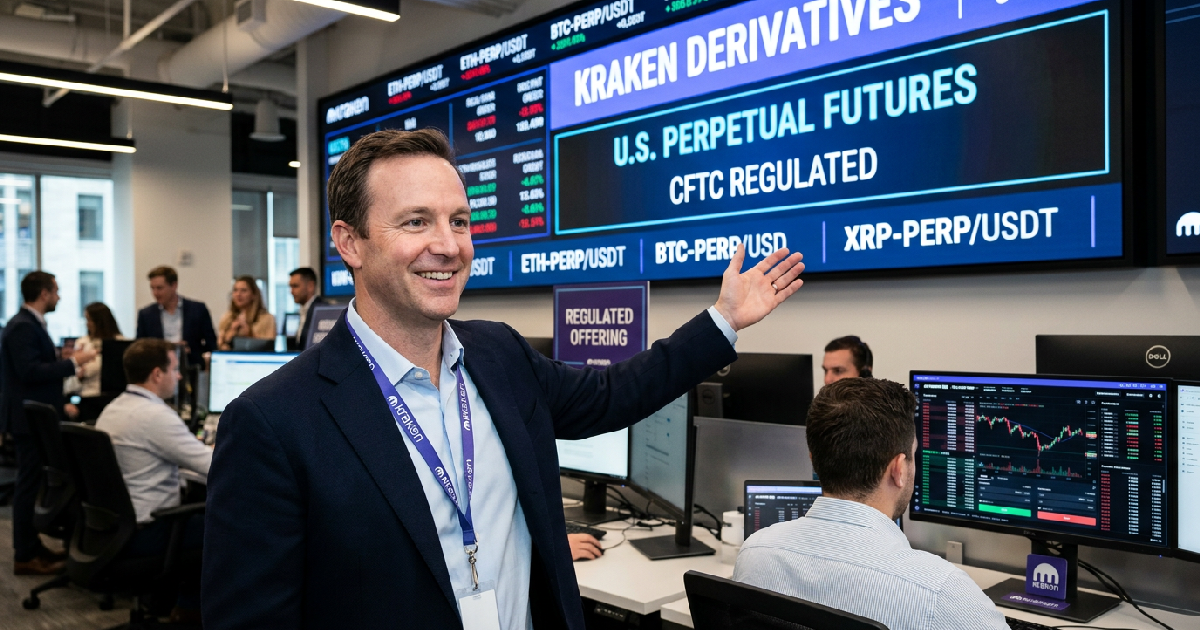
Kraken launches CFTC-regulated U.S. perpetual futures on June 15, 2026
Kraken officially launched Commodity Futures Trading Commission (CFTC) regulated U.S. perpetual futures on Monday, June 15, 2026. This release allows eligible U.S. clients to trade the dominant crypto derivatives product through the Kraken Pro platform. The service operates via Bitnomial Exchange, LLC and NinjaTrader Clearing, LLC, which is doing business as Kraken Derivatives US.
The move follows years of American capital flowing to offshore exchanges to access these high-volume instruments. By bringing the product onshore, Kraken aims to provide domestic traders with the same flexibility available in global markets. John Palmer, Global Head of Derivatives at Kraken, noted that “US traders have been waiting for a regulated, domestic way to trade” these products.
Perpetual futures allow traders to maintain market exposure without an expiration date. Unlike traditional contracts, they do not require users to “roll” positions to avoid settlement. This instrument has become central to the digital asset economy, with global annual volume for perpetuals surpassing $60 trillion in 2025. This launch allows U.S. users to manage these positions alongside their existing spot and margin holdings.
Regulatory framework and the acquisition of Bitnomial
The launch was made possible through Payward, Kraken’s parent company, and its strategic acquisition of Bitnomial. That deal, announced in April, carried a price of up to $550 million. Bitnomial brings essential CFTC-regulated licenses as an exchange, clearinghouse, and brokerage to the partnership. These licenses ensure that the futures are listed on a platform specifically authorized for such activity in the United States.
Additionally, the products are offered through NinjaTrader Clearing, LLC dba Kraken Derivatives US. Because this entity is a CFTC-registered Futures Commission Merchant, it provides a layer of federal oversight long absent from the perpetuals market. This structured approach follows bitcoin price drops that frequently test the liquidation mechanisms of unregulated offshore platforms.
Darius Tabatabai, Head of Kraken Pro, confirmed that the platform targets sophisticated participants as first movers. These individuals or firms are often already connected to exchanges and trade in a proprietary manner. By integrating these tools, Kraken is attempting to capture volume that previously bypassed the domestic economy due to regulatory limitations.
Integrated trading features on Kraken Pro
Eligible traders can access the new derivatives through the standard Kraken Pro interface. This dashboard now hosts spot trading, margin trading, and CME-listed crypto futures in one location. This consolidation is meant to help professional traders build and manage positions with greater operational efficiency.
It mirrors a broader trend toward professionalizing the sector, as seen with firms like the Bitcoin Standard Treasury Company aiming for major Nasdaq listings.
At launch, Kraken supports a range of cryptocurrencies for perpetual trading. These include Bitcoin (BTC), Ether (ETH), Solana (SOL), and XRP. The initial list also features several mid-cap assets:
- Cardano (ADA)
- Chainlink (LINK)
- Dogecoin (DOGE)
- Litecoin (LTC)
- Avalanche (AVAX)
Traders can leverage their positions up to 50x, though the exact limit depends on the specific asset and the user’s jurisdiction. To mitigate risk, the platform sets a default stop loss at -8% of the entry price. Clients have the option to customize this setting to align with their specific risk tolerance and strategy.
Mechanics of funding rates and market alignment
Since perpetual contracts lack an expiration date, they require a specific mechanism to keep prices aligned with the underlying spot market. This is achieved through funding rates. These are periodic payments exchanged between long and short position holders. The direction of the payment depends on whether the contract is trading above or below the spot price.
On the Kraken Pro platform, these funding payments occur three times per day. The specific exchange times are set for 7:00 p.m., 3:00 a.m., and 11:00 a.m. Central Time (CT). This system creates a constant incentive for the derivative price to converge with the actual market value of the digital asset, preventing long-term divergence.
The timing of this launch is critical as the domestic market matures. While ethereum whales accumulate larger portions of the supply, the demand for regulated hedging tools has increased. Bringing these products onshore allows American institutions to engage with digital assets without navigating the legal complexities and risks associated with foreign jurisdictions.
Expanding the US crypto derivatives landscape
The debut of U.S. perpetual futures follows a series of product releases from Kraken over the last year. In July 2025, the exchange launched support for CME-listed crypto futures. Earlier in June 2026, it introduced CFTC-regulated spot margin trading. The addition of perpetuals marks the culmination of an effort to offer a full suite of regulated derivatives.
This expansion comes amid a wider shift at the CFTC to position the United States as a larger regulated hub for crypto trading. By utilizing domestic clearinghouses and brokerages, the industry is moving away from the “gray market” era of derivatives. For Kraken, this integration is about changing how U.S. clients build their crypto portfolios.
Future growth will likely depend on how quickly retail and institutional participants migrate from offshore alternatives. While professional traders are the primary focus today, the presence of a regulated domestic option fundamentally changes the competitive landscape. Kraken’s integration of these tools into a single interface suggests the exchange expects derivatives to become a core component of the average professional’s crypto strategy.